
Can You Eat a Protein Bar Before Bed? (Not a Caffeinated One)
STAT Bar TeamLast reviewed
Yes, for most people. A protein bar before bed is fine if it's caffeine-free, snack-sized and eaten about 30 minutes or more before you lie down. Studies giving up to 40 g of milk protein 30 minutes before sleep found no harm to sleep. Skip caffeinated bars at bedtime; they belong hours earlier.
| What the research found | Number | Source |
|---|---|---|
| 40 g of casein protein taken 30 minutes before sleep after evening exercise | Digested and absorbed overnight; whole-body protein synthesis about 26% higher than placebo | Res et al., Med Sci Sports Exerc, 2012 |
| 27.5 g of protein every night before sleep during 12 weeks of strength training | Strength gains of 164 kg vs 130 kg with a non-caloric placebo | Snijders et al., J Nutr, 2015 |
| 40 g of casein, another milk protein or carbohydrate about 30 minutes before bed, in 21 college athletes | No difference in sleep or recovery vs placebo | Paterson et al., J Int Soc Sports Nutr, October 2026 |
| 100 mg of caffeine taken 4 or more hours before bed | No significant change in sleep vs placebo; 400 mg disrupted sleep even 12 hours out | Gardiner et al., Sleep, 2025 |
Is a protein bar before bed good or bad?
Neither, on its own. Whether a protein bar before bed works for you comes down to four things, and the first one matters most:
- What's in it. A bar with caffeine (from coffee, coffee extract, coffee fruit extract, guarana, tea or added caffeine) is a different food at 10pm than a bar without it.
- How big it is. A snack-sized bar is a small evening snack. Two bars, or a bar on top of a late dinner, is a meal.
- How your stomach handles it. If a bar sits heavy at lunch, it won't sit better lying down.
- What you want from it. Stopping hunger from waking you up, getting in more protein for the day, or recovering from an evening workout are all reasonable reasons. "Better sleep" is not something a protein bar is proven to give you.
If you pass on caffeine and keep it small, a protein bar before bed is a perfectly ordinary evening snack. Here's what the research behind that actually says.
What the research on protein before sleep shows
Most of what we know about eating protein before bed comes from a group of studies from the past 15 years, many from the same lab in the Netherlands. They used protein drinks, not bars, and mostly studied young men who lift weights, so read them with that in mind.
Your body does digest protein while you sleep. In a 2012 study, 16 healthy young men did a strength workout in the evening, ate a normal recovery meal, then drank 40 g of casein (the main protein in milk) 30 minutes before sleep. The protein was digested and absorbed through the night, and amino acids stayed elevated until morning. Whole-body protein synthesis over 7.5 hours was higher than with a placebo (311 vs 246 μmol/kg), and muscle protein synthesis was about 22% higher, a result right at the edge of statistical significance.
Over 12 weeks, it added up for people who were training. In a 2015 trial, 44 young men followed a 12-week strength program. Half had a 27.5 g protein drink every night before sleep; half had a drink with no calories. The protein group gained more strength (164 kg vs 130 kg in total one-rep-max gains) and more thigh muscle size.
Dose seems to matter. A review by the same research group notes that in older adults, 40 g of casein before sleep raised overnight muscle protein synthesis while 20 g did not. The International Society of Sports Nutrition's position stand on nutrient timing puts the useful amount at about 30 to 40 g of casein, taken roughly 30 minutes before sleep and about 2 hours after dinner.
The big caveat: total protein. A 2021 systematic review of nine studies agreed that 20 to 40 g of casein about 30 minutes before sleep boosts overnight protein synthesis in healthy young men, but warned that in many of the long-term trials, the protein group simply ate more protein overall than the placebo group. That makes it hard to say whether bedtime was special or whether more total protein did the work.
What that means for a protein bar before bed:
| What the studies used | What a typical protein bar has | What to take from it |
|---|---|---|
| 27.5 to 40 g of protein | Usually around 10 to 20 g | A bar adds to your day's protein; it isn't the 40 g dose from the studies. |
| Mostly casein, a slow-digesting milk protein | Often whey, milk protein, soy or a blend | Milk proteins were the ones tested. Check the label for what your bar uses. |
| A protein drink with little else | Protein plus carbs, fat and fiber | A bar is a small snack with calories, so count it toward your day like any food. |
| Young, active adults, often after evening training | Anyone | If you didn't train, the main benefit is filling a protein or hunger gap, not muscle gain. |
If you're trying to understand what protein can and can't do for you during the day, our guide on does protein give you energy covers that side.
Will eating a protein bar before bed keep you awake?
The protein won't, as far as the research shows. The caffeine might.
Protein before bed hasn't hurt sleep in trials. A 2019 review from that Dutch research group reports that pre-sleep protein had no effect on how long it took people to fall asleep, sleep quality or next-morning appetite in either young or older adults. Two newer trials point the same way:
- October 2026: In a randomized, double-blind crossover trial published in the Journal of the International Society of Sports Nutrition, 21 NCAA Division I women athletes had 40 g of casein, 40 g of alpha-lactalbumin (another milk protein), 40 g of carbohydrate or a near-zero-calorie placebo about 30 minutes before bed, three nights each. Wearable-measured sleep time, time to fall asleep, sleep efficiency, resting heart rate and heart rate variability did not differ between any of them, and neither did how rested they said they felt.
- 2026: In a small crossover trial of 9 trained adults, 40 g of whey 30 minutes before bed after a workout led to falling asleep faster (about 9 vs 19 minutes) and better sleep efficiency than an equal-calorie carbohydrate drink. Whey was not better than casein, and with 9 people, read this as interesting, not settled.
Caffeine is the real bedtime problem. Caffeine's half-life is about 5 to 6 hours, and NIOSH notes it is "much longer in some people." Dose and timing both count:
- In a 2013 study, 400 mg of caffeine taken at bedtime, 3 hours before bed or 6 hours before bed all disrupted sleep. Even at 6 hours, it cut total sleep by more than an hour.
- In a 2025 randomized trial of 23 healthy young men, 100 mg taken 4, 8 or 12 hours before bed did not significantly change sleep compared with placebo, while 400 mg did, and 400 mg delayed falling asleep even when taken 12 hours before bed.
Notice what neither study tested: caffeine right before bed at a smaller dose. There's no good evidence that a caffeinated bar at 10pm is fine for a 10:30pm bedtime, so don't make it your bedtime snack. For the full timing picture, see how long does caffeine last.
How to spot caffeine in a protein bar
Most protein bars have none, but it's easy to miss when one does. Check the label for these:
| On the label | What it means at bedtime |
|---|---|
| "Caffeine" with a mg amount on the front or panel | A caffeinated bar. Save it for earlier in the day. |
| Coffee, instant coffee or coffee extract in the ingredients | Real coffee, so real caffeine, even if no amount is listed. |
| Coffee fruit extract | Made from the coffee cherry; it contains caffeine. |
| Guarana, yerba mate or tea extract | Plant sources of caffeine. |
| Cocoa or chocolate | Small amounts of caffeine, much less than coffee. See does chocolate have caffeine. |
Want the numbers by bar type? Our guide to how much caffeine is in a protein bar lays them out.
How long before bed should you eat a protein bar?
The studies above gave protein about 30 minutes before sleep, typically about 2 hours after dinner. That's a reasonable default for a snack-sized bar.
A bigger meal is different. NIOSH's sleep guidance for shift workers advises against heavy, spicy meals in the 2 to 3 hours before bed, and also says that if you're likely to wake up hungry, a small snack before bedtime makes sense. A protein bar sits on the "small snack" side of that line.
| Your situation | Timing that tends to work |
|---|---|
| Normal dinner, a bit hungry later | A caffeine-free bar about 30 to 60 minutes before bed. |
| Evening workout, then bed | Recovery meal or snack after training; a protein snack about 30 minutes before sleep if you want one. |
| Late, heavy dinner | Skip the bar. You likely don't need it, and big meals close to bed are the ones to avoid. |
| Caffeinated bar | Think of it like a cup of coffee: hours before bed, not at bedtime. |
| Sensitive stomach | Eat a little earlier; half a bar may sit better than a whole one. |
What to look for in a bedtime protein bar
You don't need a special "sleep" bar. A good bedtime protein bar is just a normal protein bar that clears a few checks:
- No caffeine. Run the label check above. "Coffee," "mocha" or "energy" in the name are cues to look closer.
- Enough protein to be worth it. Around 15 to 20 g makes it a real protein snack. If you're after the 30 to 40 g used in the studies, a bar plus a glass of milk or a cup of Greek yogurt gets you closer.
- A size that fits your day. A bar adds calories like any food. If you eat one at night, count it, rather than adding it on top of everything else.
- Ingredients your stomach likes. If a bar's fiber or sweeteners bother you during the day, they won't be gentler at night.
- Milk protein if you want to match the research. Casein and other milk proteins are what most pre-sleep trials tested. Labels may list milk protein isolate, milk protein concentrate, micellar casein or whey.
Not a bar person at night? Greek yogurt, cottage cheese or a glass of milk are milk-protein foods that fit the same idea. And if you're weighing powder against bars in general, see protein powders vs protein bars.
The night-shift version: when bedtime is 8am
Everything above assumes you sleep at night. If you work nights, "before bed" means the end of your shift, and the same rules apply on a flipped clock.
- Caffeine goes early in the shift. NIOSH's guidance for night-shift nurses says workers who rely on caffeine "could consume it at the beginning of the shift but should stop several hours before the shift ends."
- Protein can go late. A caffeine-free protein snack in the last hour of the shift or once you're home can keep hunger from waking you mid-sleep, the same reason NIOSH suggests a small snack before bed.
- Work backward from sleep, not clock-out. If you clock out at 7am and expect to be asleep by 8am, a 100 mg caffeinated bar by about 4am stays outside the 4-hour window from the 2025 trial. If you're sensitive to caffeine, go earlier.
| Shift | Planned sleep | Caffeinated bar by about | Caffeine-free protein snack |
|---|---|---|---|
| 7pm to 7am | 8am | 4am at the latest; earlier is easier | Last hour of the shift or at home |
| 11pm to 7am | 8am | 4am at the latest; earlier is easier | Last hour of the shift or at home |
| 3pm to 11:30pm | 12:30am | 8:30pm at the latest | After you get home |
For the rest of the morning routine, from the drive home to blackout shades, read how to sleep after night shift. For what to eat across the whole night, see our night shift eating schedule and our picks for protein bars for night shift.
Our recommendation: STAT Energy Bar
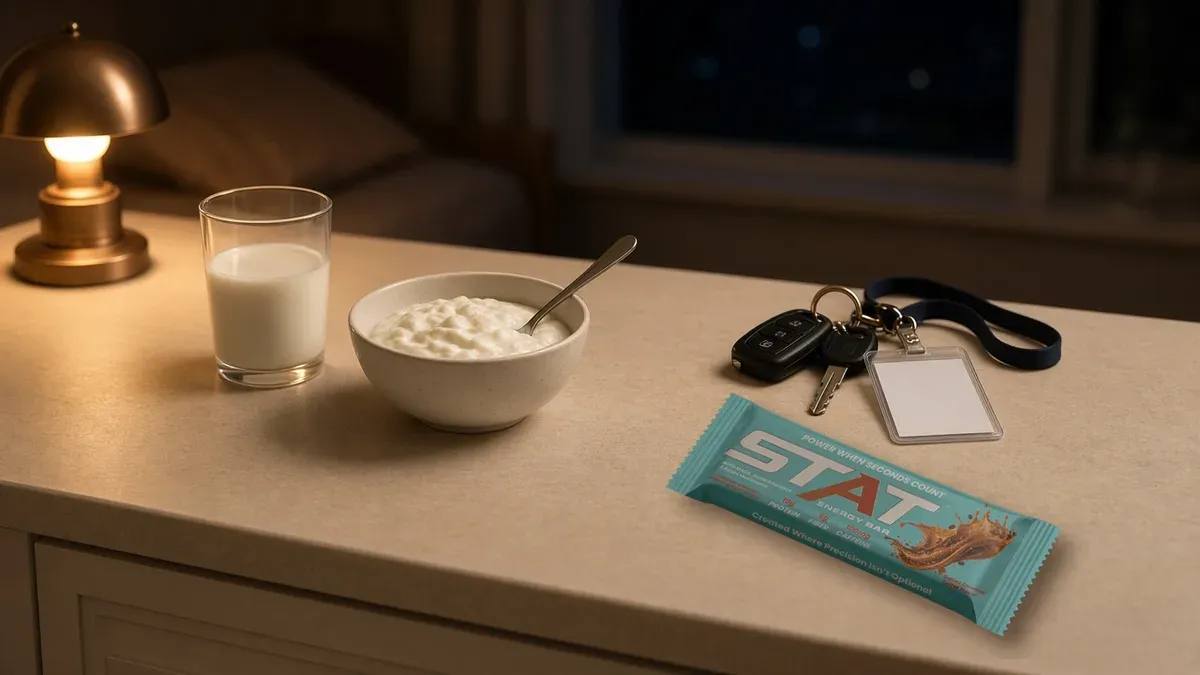
STAT Energy Bar: 100 mg caffeine, 16-19 g protein, 0 g added sugar.
Let's be straight: STAT is a caffeinated bar, so it is not a bedtime protein bar, and we'd rather you know that before you buy it. Every STAT flavor has caffeine, including Chocolate. Where STAT fits is the start or middle of a long day or night, when you need protein and alertness at the same time. On a 7pm to 7am shift, that's your first or second break, not the last hour. On a day shift, it's the mid-morning or early afternoon slump, well before dinner. In a 2025 trial, 100 mg taken 4 or more hours before bed didn't significantly change sleep in healthy young men, so keep at least that buffer, and more if caffeine hits you hard. Each bar is individually wrapped and shelf-stable, with no refrigeration needed, so it can live in your bag or locker.
We've all been there: it's 3am, there are four hours left on your shift, dinner was a long time ago and the next break could get pulled any minute. Nurse, firefighter, dispatcher, warehouse lead, anyone on a long shift: that's the moment STAT Energy Bar was made for, when seconds count. Each bar has 100mg of caffeine for energy and alertness, about what's in a strong cup of coffee, plus 16 to 19g of protein and 0g added sugar, and you can eat it in two minutes and get right back to work. Most protein bars have no caffeine at all. STAT has 100mg, along with maca, ashwagandha, cordyceps and reishi. If you like chocolate, the Chocolate bar (16g protein) gets its caffeine from coffee fruit extract. If you're a coffee person, Peanut Butter Espresso (17g) and Salted Caramel Coffee (19g) use real coffee plus coffee fruit extract. Each bar's protein comes from a blend of whey and milk proteins. All three contain milk and soy; Chocolate and Salted Caramel Coffee contain almonds, and Peanut Butter Espresso contains peanuts. See what's inside every STAT bar or read more about our caffeine protein bar.
Not sure which flavor fits? Variety, 3 Boxes has one 12-count box of each, or you can shop all three flavors. Subscribe and save 10%, and orders over $50 ship free. Curious how STAT compares with other caffeine bars? Start with what's in each one, then pick the timing that fits your shift. For a bedtime snack, reach for something caffeine-free instead.
Protein bar before bed: FAQ
Is it OK to eat a protein bar before bed?
For most people, yes. A snack-sized, caffeine-free protein bar about 30 minutes or more before bed is an ordinary evening snack. Trials giving up to 40 g of milk protein shortly before sleep found no harm to sleep. Skip it if it's caffeinated, if you just ate a big dinner, or if it upsets your stomach.
Will eating a protein bar before bed keep you awake?
The protein shouldn't. Studies of protein before sleep found no effect on how fast people fell asleep or how well they slept, including an October 2026 trial in college athletes. Caffeine is what can keep you up, so check the label for caffeine, coffee, coffee fruit extract, guarana or tea extract before eating a bar at night.
How long before bed should I eat a protein bar?
Most pre-sleep protein studies gave protein about 30 minutes before sleep and about 2 hours after dinner. For a small bar, 30 to 60 minutes before bed is a good default. Save heavy meals for 2 to 3 hours before bed or earlier, and have caffeinated bars hours before bedtime.
Does protein before bed help build muscle?
It can help if you're strength training. In a 12-week trial, young men who had 27.5 g of protein each night before sleep gained more strength and muscle size than a placebo group. A 2021 review noted the protein groups often ate more protein overall, so total daily protein likely matters as much as timing.
What happens if you eat a protein bar before bed?
Your body digests and absorbs the protein overnight, and amino acids stay raised into the morning, according to studies using milk protein drinks. Research has not found an effect on sleep quality or next-morning appetite. The bar's calories count toward your day like any other snack.
Is casein or whey better before bed?
Most studies used casein, a slowly digested milk protein, at 30 to 40 g. A small 2026 trial found whey helped people fall asleep faster than a carbohydrate drink but was not better than casein, and an October 2026 trial found casein didn't change sleep at all. Either milk protein is a reasonable choice.
Do coffee or chocolate protein bars have caffeine?
Some do. Coffee-flavored bars that list coffee, coffee extract or coffee fruit extract contain caffeine. Chocolate and cocoa have small amounts naturally, much less than coffee, and some chocolate bars add caffeine on purpose. Read the ingredients and look for a caffeine amount before eating one near bedtime.
Should I eat a protein bar after a night shift before sleeping?
If you're hungry, a small caffeine-free protein snack in the last hour of the shift or once you're home can keep hunger from waking you. Keep any caffeinated bar early in the shift, at least 4 hours before you plan to sleep and earlier if you're sensitive to caffeine.
Protein before bed is fine. Caffeine before bed isn't. Keep each where it works, and save your caffeinated bar for the shift. Shop STAT Energy Bars.
References
- Res PT, et al. Protein ingestion before sleep improves postexercise overnight recovery. Med Sci Sports Exerc. 2012;44(8):1560-1569. PMID 22330017. https://pubmed.ncbi.nlm.nih.gov/22330017/
- Snijders T, et al. Protein ingestion before sleep increases muscle mass and strength gains during prolonged resistance-type exercise training in healthy young men. J Nutr. 2015;145(6):1178-1184. PMID 25926415. https://pubmed.ncbi.nlm.nih.gov/25926415/
- Snijders T, Trommelen J, Kouw IWK, et al. The impact of pre-sleep protein ingestion on the skeletal muscle adaptive response to exercise in humans: an update. Front Nutr. 2019;6:17. PMID 30895177. https://pmc.ncbi.nlm.nih.gov/articles/PMC6415027/
- Kerksick CM, et al. International Society of Sports Nutrition position stand: nutrient timing. J Int Soc Sports Nutr. 2017;14:33. https://pmc.ncbi.nlm.nih.gov/articles/PMC5596471/
- Reis CEG, et al. Effects of pre-sleep protein consumption on muscle-related outcomes: a systematic review. J Sci Med Sport. 2021;24(2):177-182. PMID 32811763. https://pubmed.ncbi.nlm.nih.gov/32811763/
- Paterson KGP, et al. Pre-sleep milk-derived proteins do not impair sleep or recovery in elite female athletes. J Int Soc Sports Nutr. 2026;23(1):2746899. Published online Oct 20, 2026. PMID 42897977. doi:10.1080/15502783.2026.2746899. https://pubmed.ncbi.nlm.nih.gov/42897977/
- Aussieker T, et al. Presleep whey but not casein protein ingestion improves sleep quality after resistance exercise when compared with an isocaloric control in resistance trained individuals. Int J Sport Nutr Exerc Metab. 2026;36(5):481-490. PMID 42413910. doi:10.1123/ijsnem.2025-0205. https://pubmed.ncbi.nlm.nih.gov/42413910/
- Drake C, et al. Caffeine effects on sleep taken 0, 3, or 6 hours before going to bed. J Clin Sleep Med. 2013;9(11):1195-1200. PMID 24235903. https://pmc.ncbi.nlm.nih.gov/articles/PMC3805807/
- Gardiner CL, et al. Dose and timing effects of caffeine on subsequent sleep: a randomized clinical crossover trial. Sleep. 2025;48(4):zsae230. PMID 39377163. https://pmc.ncbi.nlm.nih.gov/articles/PMC11985402/
- NIOSH. Training for Nurses on Shift Work and Long Work Hours, Module 6 (prepare for sleep). https://www.cdc.gov/niosh/work-hour-training-for-nurses/longhours/mod6/04.html
- STAT Nutrition Facts panels and ingredient lists. /stat-by-the-numbers
Related reading
- Snacks for Night Shift Workers: What to Pack Before the Shift
Everything worth eating is closed at 3am. A practical guide to packing night-shift snacks that don't depend on a vending machine.
- Adaptogenic Protein Bar: What Maca, Ashwagandha, Cordyceps and Reishi Are on a Label
The phrase is a search, not a food category. Maca, ashwagandha, cordyceps, and reishi are adaptogens. Listing them is not a health claim, and it is not a milligram dose.
- Adaptogens in food: what the label means (and what it doesn’t)
"Adaptogens in food" is not an FDA food category. Here is the historical meaning of the term, how botanicals show up on packaged-food labels, and what a plant name does (and does not) claim.
Ready to Fuel Up?
Try STAT Bar: the energy bar built for those who can't afford to slow down.
Get shift snack tips in your inbox
Join the STAT Bar newsletter for new flavor drops, subscriber-only deals, and practical shift guides, plus $5 off your first box.
By signing up you agree to receive marketing emails from On Call Foods LLC. You can unsubscribe at any time. See our Privacy Policy and Terms.