
Night shift eating schedule: what the newest research says about when to eat
STAT Bar TeamLast reviewed
A night shift eating schedule is not just about what goes in the lunch bag. It is about when the food lands relative to your body clock, your sleep, and your caffeine. Three studies published between mid September and early October 2026 looked at exactly that in real shift workers, and their answers line up well enough to build a practical schedule. This guide walks through what each study found, where it falls short, and what it means for your next run of nights.
If you are new to nights, start with what a NOC shift is and how to stay awake on night shift. This post is about timing. For the food itself, see snacks for night shift workers.
Study 1: moving food earlier on night shifts (October 8, 2026)
A team from Erasmus University Medical Center and TNO in the Netherlands published a three-month trial in Frontiers in Nutrition on October 8. The participants were healthy male port workers in Rotterdam on 12-hour rotating shifts (6 a.m. to 6 p.m. and 6 p.m. to 6 a.m.). Twenty-two of them followed personalized advice on night shift days that split their food into four eating occasions: dinner between 6 and 8 p.m. (about 40% of the day's calories), a light meal between midnight and 2 a.m. (about 20%), a breakfast after the shift between 6 and 8 a.m. (about 25%), and an afternoon snack after waking (about 15%).
What happened: the point by which half of their night shift calories had been eaten moved from about 10:20 p.m. to 7:50 p.m. at the start, and was still 88 minutes earlier than baseline at the end of three months. Total calories and overall diet quality did not change. After a standardized test meal, their total, LDL, and HDL cholesterol responses were lower than at baseline, and so were several inflammation markers. Glucose and insulin responses to the test meal did not change, and some glucose monitor readings during daily life actually moved in an unfavorable direction while time in range rose slightly.
The limits matter. Workers chose their own group instead of being randomized, all were men, food intake was self-reported, and the test meal was only given to the nutrition group, so the authors say the changes cannot be firmly credited to the advice. What it does show is that rearranging the same food around a night shift was doable in a real, physically demanding workplace, with high reported adherence.
Study 2: what a new review says about meals and sleep (September 18, 2026)
A systematic review in Sleep and Biological Rhythms, published September 18 by nursing researchers in Korea, pulled together 14 studies on meal patterns and sleep in shift workers and in lab simulations of night shifts. Four findings stand out. In simulated night shifts, large meals increased subjective sleepiness compared with snacking. In real-world groups, keeping regular meal times across work days and days off, and keeping night shift meal times close to rest day meal times, was associated with lower risk of insomnia and shift work sleep disorder. A shorter gap between the meal after a night shift and falling asleep during the day was linked with longer and better rated sleep. And shortening the daily eating window showed limited benefit.
The review is careful about its own weight. The evidence was mixed, no meta-analysis was possible, and the authors call for real-world trials before firm guidance. Treat it as a direction, not a rulebook.
Study 3: night work and the body clock (September 24, 2026)
The third study did not test meals at all, but it explains why timing keeps coming up. Published in Frontiers in Endocrinology on September 24, it compared 46 female healthcare workers on night schedules with 47 day workers in Italy. Night workers had lower expression of several clock genes in their blood cells, including CLOCK, TEF, and PER1. For TEF and CLOCK, the gap was larger in women with more years and more total night shifts worked. It is a cross-sectional snapshot of 93 people, samples were taken at the same clock time rather than the same body clock time, and the authors say it cannot show cause or whether the changes reverse. It is a reminder that nights are a body clock problem, not only a sleep problem.
What earlier trials in nurses add
A 2024 randomized crossover trial in The Journal of Nutrition gave 51 female hospital night workers in the Netherlands either no meal, one small yogurt meal, or three small yogurt meals overnight, with either low or high glycemic index carbohydrate. Small low glycemic index meals led to fewer attention lapses on a reaction time test than three small high glycemic index meals, and any meal reduced hunger compared with none. The three small low glycemic index meals also produced more mild gut complaints such as rumbling and bloating. The authors suggest no more than three small low glycemic index meals overnight, and checking your own tolerance.
A large European survey published in Nutrition Journal in April 2026 shows how most people actually eat on nights. Of 3,784 current night workers, 13% reported eating nothing on a night shift, most ate one or two times, and the most common time was the middle of the shift. Compared with day workers, current night workers reported eating faster and drinking sugar-sweetened and caffeinated beverages more often. Appetite, available time, and available food drove most choices.
A sample night shift eating schedule
Put together, the research points to a simple shape: put the biggest share of the day's food at or just before the start of the shift, keep one light meal overnight, eat a small breakfast before daytime sleep, and keep the pattern regular. Here is how that looks for a 7 p.m. to 7 a.m. shift, adapted from the four-meal pattern used in the Rotterdam trial. Shift it to match your hours.
- About 2 to 3 p.m., after waking: a modest snack. Protein plus something with fat holds better than a sweet pastry.
- About 5 to 8 p.m., just before or early in the shift: your main meal of the day. In the Rotterdam trial, with a 6 p.m. start, this meal (about 40% of the day's calories) came in the first two hours of the shift.
- About midnight to 2 a.m.: one light, planned meal. Small, not a full dinner. Lower glycemic index carbohydrate fits the nurse trial findings; adding some protein is a practical choice, not something that trial tested.
- About 3 to 6 a.m.: water, and only a small snack if hunger is getting in the way of work. In lab simulations, large overnight meals raised sleepiness more than snacks did, so keep this stretch light.
- About 7 to 8 a.m., after the shift: a small breakfast close to when you plan to sleep, so hunger does not wake you.
On days off, try to keep meal times closer to this rhythm than to a completely different schedule. The review linked big swings between work day and rest day meal times with worse sleep outcomes.
Where caffeine fits in the schedule
The SHIFT2HEALTH survey found night workers reach for caffeinated drinks more often than day workers, which makes the timing question practical. A 2023 systematic review and meta-analysis of 24 studies in Sleep Medicine Reviews found caffeine cut total sleep time by about 45 minutes on average. Its model put the cutoff for a cup of coffee (107 mg) at least 8.8 hours before bedtime. Those studies measured night-time sleep, so the number is a rough guide for daytime sleep, not a precise rule. Still, the math is sobering: for a planned 8 a.m. bedtime, 8.8 hours earlier is about 11 p.m. Our guide to staying awake on night shift uses a six-hour minimum, based on a 2013 lab study of a 400 mg dose. This newer analysis suggests even a single cup may need more room than that, so treat six hours as the floor, not the target.
In practice, that argues for putting caffeine early in the shift rather than at 4 a.m., and counting milligrams instead of cups. FDA cites 400 milligrams a day as an amount not generally associated with negative effects for most adults, with wide variation in sensitivity. The same label math applies whether the caffeine comes from coffee, a soda, or a caffeine protein bar.
What this research does not tell you
- None of these studies proves that a schedule prevents disease. The Rotterdam trial measured short-term responses to a test meal, and the clock gene study was a one-time snapshot.
- Most of the newest data come from Europe and from narrow groups (men at a port, women in hospitals), so your results may differ.
- Rotating schedules, 24-hour call, and quick turnarounds were not tested directly. Adapt the shape, not the exact clock times.
- If you have diabetes or another medical condition that affects meal timing, work out a schedule with your clinician.
Night shift eating schedule checklist
- Is my biggest meal eaten before or early in the shift, not after midnight?
- Do I have one light meal planned for around midnight to 2 a.m., not a full dinner?
- Is the overnight meal lower glycemic index carbohydrate plus protein?
- Do I have a small breakfast planned close to my daytime sleep?
- Is my last caffeine early enough for the sleep I am planning?
- Am I keeping meal times on days off reasonably close to my night shift rhythm?
For more on what to pack for each of those slots, see protein bars for night shift, portable protein snacks, and snacks for nurses on a 12-hour shift.
A light option for the midnight slot
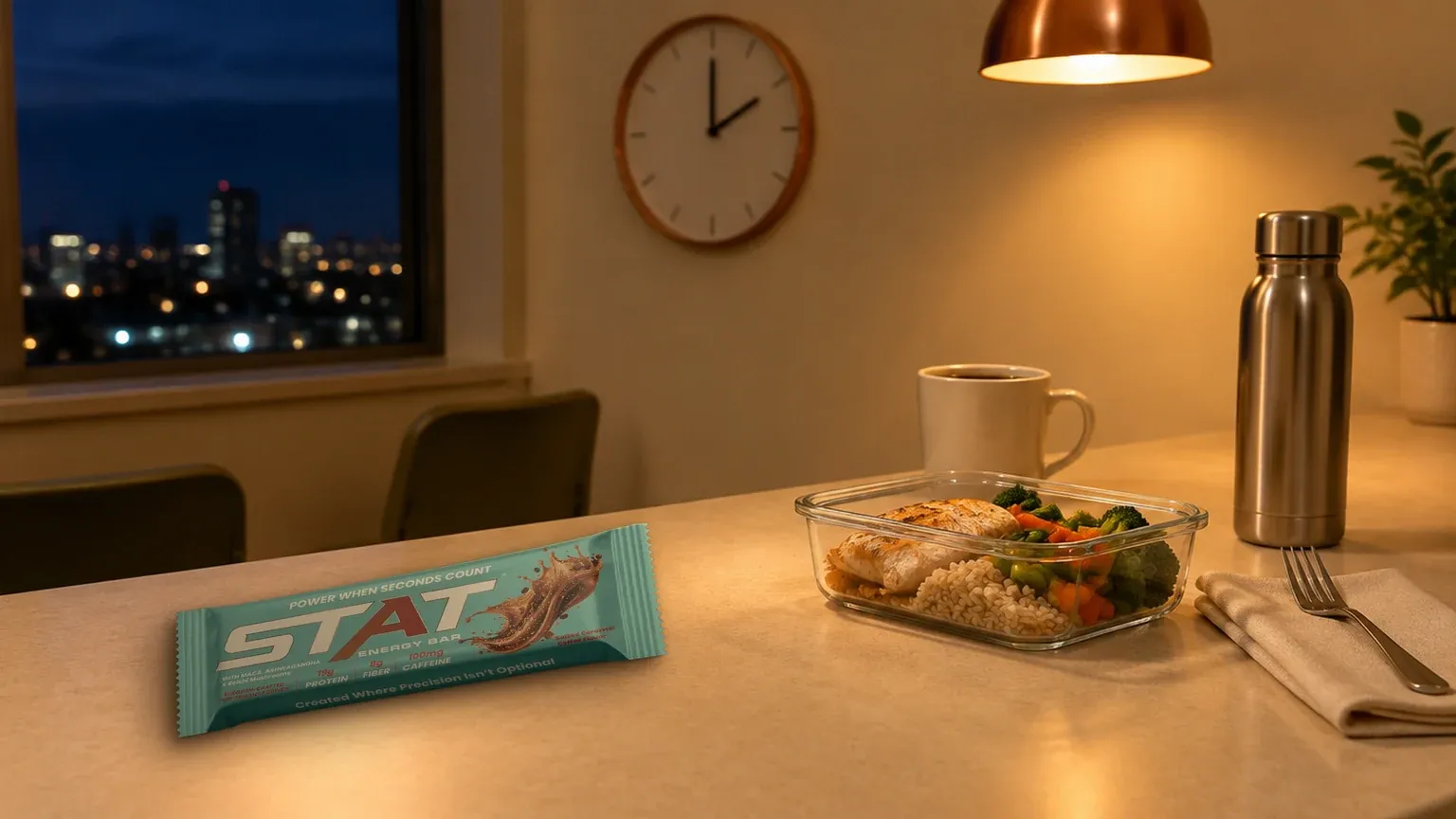
If your plan calls for something small around midnight, STAT Energy Bars are one sealed option that needs no fridge or microwave. Each bar prints 16-19g of protein, 100mg caffeine, and 0g added sugars on the Nutrition Facts panel. Calories sit in the 200-210 range by flavor. Not a low calorie food. Botanicals are flavor only, and this is a food product, not a dietary supplement. Because each bar carries caffeine, eat it early in the shift and count it toward your daily milligrams. Flavors such as Salted Caramel Coffee are one way to fold the caffeine you already planned into that first half of the night.
References
- van der Rhee M, et al. A personalized nutrition intervention advances meal timing and is associated with reduced postprandial lipid and inflammatory responses in night shift workers. Frontiers in Nutrition, October 8, 2026. DOI: 10.3389/fnut.2026.1912094. ClinicalTrials.gov NCT06147089. frontiersin.org
- Jeon B, Baek J, Lee Y. Chrono-nutrition and sleep health in shift workers: a systematic review. Sleep and Biological Rhythms, September 18, 2026. DOI: 10.1007/s41105-026-00685-1. link.springer.com
- Vivarelli S, et al. Night-shift work is associated with peripheral clock gene dysregulation and circadian transcriptional network remodeling in female healthcare workers. Frontiers in Endocrinology, September 24, 2026. DOI: 10.3389/fendo.2026.1934310. frontiersin.org
- de Rijk MG, et al. The effect of meal frequency and glycemic index during the night shift on alertness, hunger, and gastrointestinal complaints in female health care workers: a two-armed randomized crossover trial. The Journal of Nutrition, 2024. DOI: 10.1016/j.tjnut.2024.09.027. jn.nutrition.org
- Klink U, et al. Night shift work and dietary behaviors: a comparative analysis of European night shift and day workers from the SHIFT2HEALTH online survey. Nutrition Journal, April 7, 2026. DOI: 10.1186/s12937-026-01320-y. link.springer.com
- Gardiner C, et al. The effect of caffeine on subsequent sleep: a systematic review and meta-analysis. Sleep Medicine Reviews, 2023. DOI: 10.1016/j.smrv.2023.101764. doi.org
- U.S. FDA. Spilling the Beans: How Much Caffeine is Too Much? fda.gov
Related reading
- Snacks for allied health workers: therapists, techs, pharmacists and more
Allied health jobs share one schedule problem: a list or board that rarely protects a meal, and no food in clinical areas. Shared rules first, then a section for each role.
- Protein bars on a night shift: what the label has to do
A night shift does not change how to read a Nutrition Facts panel. It does make printed milligrams and protein grams the difference between a counted snack and a guess next to break-room coffee.
- What first responder snacks actually need
A first responder snack has to survive a hot vehicle, open in seconds and print its caffeine in milligrams. Shared rules first, then a section for each role.
Ready to Fuel Up?
Try STAT Bar — the energy bar built for those who can't afford to slow down.
Get shift snack tips in your inbox
Join the STAT Bar newsletter for new flavor drops, subscriber-only deals, and practical shift guides — plus $5 off your first box.
By signing up you agree to receive marketing emails from On Call Foods LLC. You can unsubscribe at any time. See our Privacy Policy and Terms.