
How to Sleep After Night Shift: From Clock-Out to Lights Out
STAT Bar TeamLast reviewed
To sleep after a night shift, stop caffeine several hours before the shift ends, cut bright light on the way home, and get into bed soon after you walk in. Sleep in a dark, cool, quiet room with your phone silenced, and keep a similar sleep window across work days.
| What the research found | Number | Source |
|---|---|---|
| Night workers' daytime sleep in a two-week diary study | Averaged 337 minutes (about 5.6 hours), below the 7 to 9 hours recommended | Lammers-van der Holst et al., Sleep Health, 2024 |
| Drives home after a night shift on a closed test track | Near-crashes in 6 of 16 drives, versus 0 of 16 after a night of sleep | Lee et al., PNAS, 2016 |
| A large dose of caffeine (400 mg) taken 6 hours before bed | Still disrupted sleep compared with placebo | Drake et al., J Clin Sleep Med, 2013 |
| Adult shift workers with shift work disorder | About 27% | American Academy of Sleep Medicine guideline, 2026 |
How to sleep after night shift: the morning, step by step
Most sleep advice starts at the bedroom door. For night workers, the work starts earlier. The choices you make in the last third of the shift, on the drive and in the first half hour home decide how fast you fall asleep and how long you stay down. Here's the whole sequence in one place.
| When | What to do | Why |
|---|---|---|
| Last 4 to 6 hours of the shift | No more large doses of caffeine. Keep it to the first part of the shift. | Caffeine's half-life is about 5 to 6 hours, and NIOSH advises stopping "several hours before the shift ends." |
| Last hour of the shift | Eat something small if you're hungry; skip a heavy meal. | Going to bed hungry can wake you, but heavy, spicy meals 2 to 3 hours before bed can do the same. |
| Clock-out | If you're drowsy, don't drive. Get a ride, nap first, or use transit. | Post-night-shift drives had far more near-crashes in a test-track study. |
| The commute | Dark sunglasses if it's light out, as long as you can still see the road clearly. | Morning light tells your body clock it's daytime. |
| First 30 minutes home | One short check-in or small ritual, low lights, phone on do not disturb, then bed. | A short, repeatable routine helps the switch from work to sleep. |
| Sleep | Dark, cool, quiet room. Aim for 7 to 9 hours of sleep across 24 hours, in one block or a main sleep plus a nap. | Night workers tend to come up short on sleep, so protect the time. |
The rest of this guide goes through each step with the evidence behind it. If you want the bigger picture on shift life, from staying alert at 4am to meal timing, see our guide on how to survive night shift.
When to stop caffeine before sleeping after a night shift
Caffeine is the most common reason night workers lie awake after a long shift, and the fix is mostly about timing, not quitting.
- NIOSH's guidance for night-shift nurses says the half-life of caffeine is 5 to 6 hours "but is much longer in some people," and that night workers who rely on it "could consume it at the beginning of the shift but should stop several hours before the shift ends."
- Dose matters. In a 2013 home sleep study, 400 mg of caffeine taken at bedtime, 3 hours before bed, or 6 hours before bed all disrupted sleep compared with placebo. The authors concluded it supports avoiding substantial caffeine for at least 6 hours before bedtime.
- Smaller doses are less of a problem. In a 2025 randomized trial of 23 healthy young men, 100 mg taken 4, 8 or 12 hours before bed did not significantly change sleep compared with placebo, while 400 mg did. That was a small, specific group, so use it as a guide, not a guarantee.
Here's how a 6-hour buffer for larger amounts works out on common night schedules. Work backward from when you actually plan to fall asleep, not from when you clock out.
| Shift | Planned bedtime | Last big caffeine dose by about |
|---|---|---|
| 7pm to 7am | 8am | 2am |
| 11pm to 7am | 8am | 2am |
| 10pm to 6am | 7am | 1am |
| 7pm to 7:30am, with a 45-minute commute | 9am | 3am |
If you're sensitive to caffeine, push the cutoff earlier. If you need something late in the shift, a smaller amount is less likely to cost you sleep than a large one. For the full timing math, read how long does caffeine last, and for a planned nap on break, our coffee nap guide explains how to time it.
The drive home is part of your sleep plan
You can't sleep well if you don't get home. In a 2016 study at a closed driving track, 16 night-shift workers drove for two hours twice: once after a normal night of sleep and once after a night shift. After the night shift, there were 11 near-crashes in 6 of the 16 drives, and 7 of the 16 drives were stopped early for safety. After sleep, there were none.
What helps, from NIOSH's guidance for night nurses:
- If you're very sleepy, don't drive. Ask a family member, friend or coworker to drive you, take a taxi or public transit, or set up a car pool.
- Nap before you leave. NIOSH also lists taking caffeine and then immediately taking a short nap before the drive, and finding a room to sleep in close to work.
Light on the way home matters too. NIOSH suggests blue-light-blocking or very dark wraparound sunglasses from the time you leave work until you're in your dark bedroom. The 2026 American Academy of Sleep Medicine (AASM) guideline lists reduced light-transmittance glasses in the morning as part of a combined approach, and adds a clear note: "Attention to driving safety is important when wearing reduced-light transmittance glasses." If tinted lenses make the road harder to see, put them on when you park, not before.
The first 30 minutes home after a night shift
This is the part most sleep guides skip, and it's where a lot of night workers lose an hour. You walk in wired, the house is waking up, someone wants to talk about the day ahead, and before you know it it's 10am.
Night workers commonly say two things help most: agreeing on the plan with the people at home before the shift starts, and keeping the gap between the front door and bed short and predictable. That lines up with what sleep researchers recommend. A 2023 expert consensus on sleep for shift workers says to make sleep a priority by "informing friends, family, and neighbors of your sleep schedule," and NIOSH tells night workers to "educate and insist that your family and friends not disturb you when you are sleeping."
Before the shift: set the plan. A two-line text or a quick conversation is enough. When you'll be home, how much time you have, and when you're going down. For example: "Home around 7:45. I've got 15 minutes, then I'm asleep until 2." If you have a partner, decide together what the short check-in looks like, so nobody feels shut out when the bedroom door closes.
At home: keep it short and repeatable. One small ritual, then bed. Here's a sample:
| Minutes after you walk in | What it looks like |
|---|---|
| 0 to 5 | Shoes off, keys and bag in the same spot, lights kept low. |
| 5 to 15 | A short check-in with your partner or family, or walk the dog. Keep it to one thing. |
| 15 to 25 | Shower or wash your face, brush your teeth, change for bed. A small snack if you're hungry. |
| 25 to 30 | Phone on do not disturb, blackout shades down, lights out. |
If that snack is a bar, here's how to pick a protein bar before bed that won't keep you up.
A few rules make this work:
- Skip chores and errands. NIOSH says plainly: "Do not use your early morning time to do chores or errands, because this is prime sleep time for night shift nurses." The same goes for any night worker.
- Keep lights low. NIOSH suggests keeping light levels low for 1 to 2 hours before bed, which for night workers means the commute and the time at home.
- Set your phone, don't just silence it. NIOSH suggests customizing do not disturb so selected contacts can still reach you in an emergency, and turning off social and other non-essential alerts.
- Don't make it a nightcap. Alcohol can help you fall asleep, but NIOSH notes it "causes early awakening and sleep disturbances," and the shift worker consensus says to avoid it as part of a bedtime routine.
The goal isn't a perfect routine. It's a short one you can repeat even after a bad night, so your body learns that this sequence ends in sleep.
Morning sleep, delayed sleep or split sleep: which works for you?
There's no single right pattern. A 2024 study followed 33 US night workers, more than half of them in healthcare, with two weeks of sleep diaries, and found four common patterns:
| Pattern | Typical sleep timing | Average total sleep | Feeling refreshed (1 to 7 scale) |
|---|---|---|---|
| Morning sleepers | About 8am to 2pm | 353 minutes | 2.9 |
| Delayed sleepers | Afternoon, about 2:20pm to 6:30pm | 233 minutes | 4.1 |
| Split sleepers | About 9:40am to 1pm, then 5:15pm to 8:25pm | 363 minutes | 2.3 |
| Mixed sleepers | Varied from day to day | 387 minutes | 3.4 |
Total sleep time did not differ significantly between the groups, and across everyone it averaged 337 minutes, short of the recommended 7 to 9 hours whatever the pattern. Feeling refreshed did differ: delayed and mixed sleepers felt more refreshed than split sleepers, and delayed sleepers more than morning sleepers. It's a small observational study, so it can't tell you which pattern causes better sleep.
NIOSH's advice leans toward sleeping as soon as you get home: if your body clock hasn't adjusted to day sleep, you have "a small window of time before your natural circadian alerting mechanism will kick in," and "the more sleep you get before 2 p.m., the better rested you will be."
A practical way to choose: start with going to bed soon after you get home for one block of shifts, then try a different pattern for the next block. Track how long you actually slept and how you felt at the start of the next shift. Keep what works.
How long should you sleep after a night shift?
Aim for 7 to 9 hours of actual sleep in each 24-hour period. The shift worker consensus guidelines say this "may be achieved as one single sleep period, or as a main sleep supplemented by a shorter sleep(s)."
- Count sleep, not time in bed. If you're in bed 8am to 2pm but awake for an hour of it, that's five hours.
- Top up with a nap. The same guidelines say 15 to 20 minute naps can boost alertness, while 90-minute naps can reduce sleep debt. Avoid longer naps in the 4 to 6 hours before your main sleep.
- Plan for grogginess. Sleep inertia usually lasts 15 to 30 minutes after waking but can last up to 2 hours, so avoid driving right after you wake up if you can.
- Protect a core window. NIOSH describes a compromise schedule where some hours, such as 8am to noon, stay sleep time on both work days and days off. Our night shift survival guide walks through how to set that up.
Coming off a block of nights? The consensus guidelines suggest one option: a short sleep in the morning, then going to bed earlier than usual that night, with some sunlight after waking the next morning to help your body clock realign. NIOSH warns against staying up all day after your last night shift, because you'll be awake too many hours in a row.
Can't sleep after night shift? What to try, and when to get help
Some mornings you'll be exhausted and still wide awake. A few steps from the shift worker consensus guidelines and NIOSH:
- Don't lie there fighting it. If you can't sleep, get out of bed and do something quiet in dim light, limit screens and clock-watching, and go back when you feel sleepy.
- Make the room darker than you think you need. NIOSH's standard is "so dark you cannot see your hand in front of your eyes," or an eye mask. Block light around doors and the path to the bathroom, and use a dim red nightlight if you need to get up.
- Keep it cool and quiet. The consensus guidelines suggest about 60 to 68ºF. Earplugs or a fan or white noise machine can cover daytime noise.
- Turn the clock away so you're not checking the time.
If sleep problems happen more than 3 times a week for several weeks in a row, the consensus guidelines say to seek advice from a healthcare professional. The AASM's 2026 guideline estimates shift work disorder affects about 27% of adult shift workers, and suggests cognitive behavioral therapy for insomnia for people who have trouble falling or staying asleep around their work schedule. Melatonin and other sleep medicines are something to discuss with your own provider before trying, since timing matters for shift workers.
Our recommendation: STAT Energy Bar
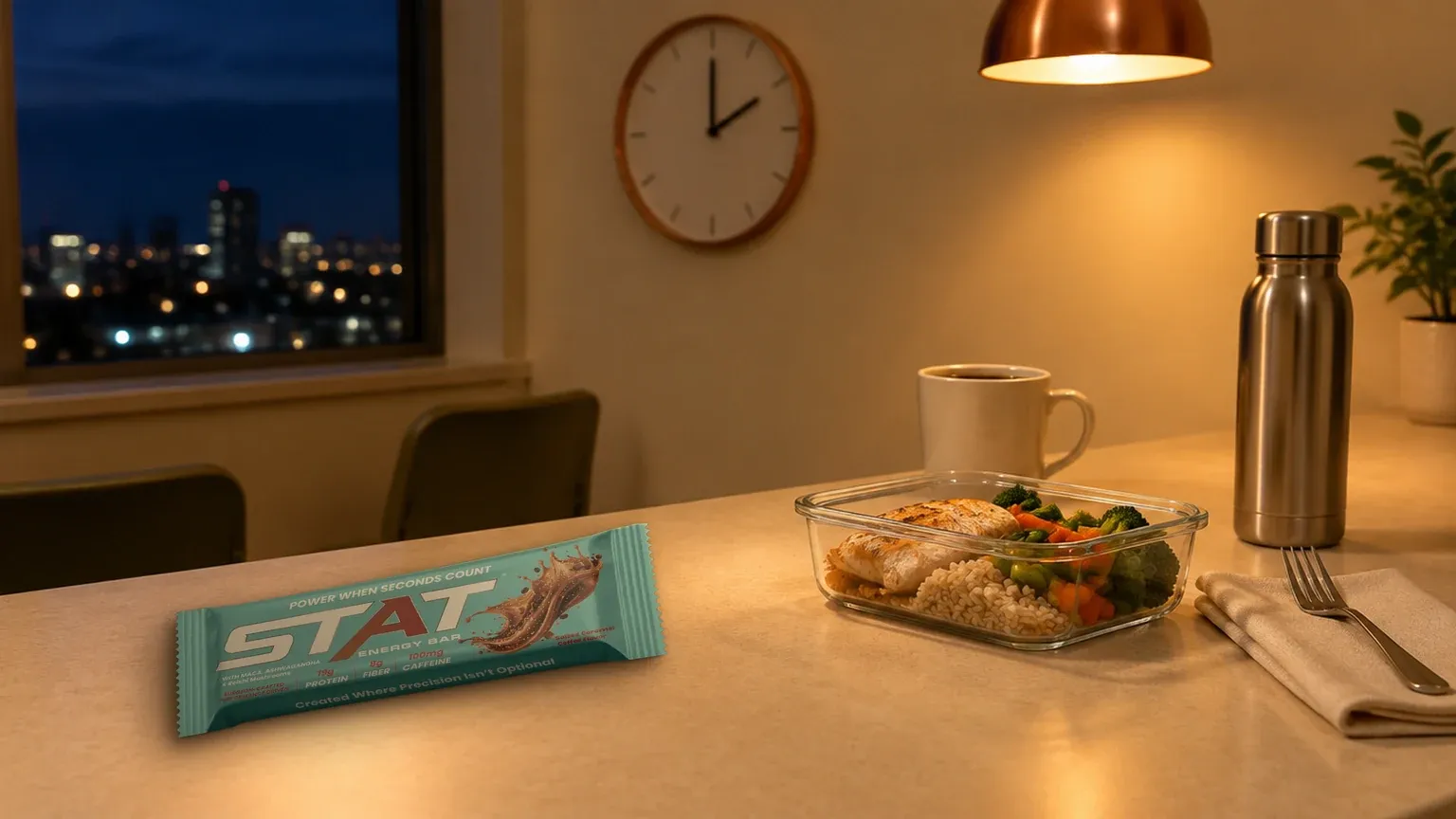
STAT Energy Bar: 100 mg caffeine, 16-19 g protein, 0 g added sugar.
Let's be straight: STAT is a caffeinated bar, so it isn't a bedtime snack and it doesn't belong on the drive home. It belongs early in the shift. NIOSH's guidance is to use caffeine at the beginning of a night shift and stop several hours before it ends, and in a 2025 trial, 100 mg taken 4 or more hours before bed didn't significantly change sleep in healthy young men. So if your shift runs 7pm to 7am, a STAT bar at your first break, around 11pm to midnight, leaves about eight hours before an 8am bedtime. When you need real food in two minutes during the busy first half of the night, that's where our pick is STAT Energy Bar. Each bar is individually wrapped and shelf-stable, with no refrigeration needed, so it can live in your bag or locker.
We've all been there: it's 11:30pm, you've been moving since you clocked in, dinner is a memory, and there are still seven hours to go. Nurse, firefighter, dispatcher, warehouse lead, anyone on a long night: that's the moment STAT Energy Bar was made for, when seconds count. Each bar has 100mg of caffeine for energy and alertness, about what's in a strong cup of coffee, plus 16 to 19g of protein and 0g added sugar, and you can eat it in two minutes and get right back to work. Most protein bars have no caffeine at all. STAT has 100mg, along with maca, ashwagandha, cordyceps and reishi. If you like chocolate, the Chocolate bar (16g protein) gets its caffeine from coffee fruit extract. If you're a coffee person, Peanut Butter Espresso (17g) and Salted Caramel Coffee (19g) use real coffee plus coffee fruit extract. All three contain milk and soy; Chocolate and Salted Caramel Coffee contain almonds, and Peanut Butter Espresso contains peanuts. See what's inside every STAT bar or read more about our caffeine protein bar.
Not sure which flavor fits? Variety, 3 Boxes has one 12-count box of each, or you can shop all three flavors. Subscribe and save 10%, and orders over $50 ship free. For what else to pack, see our list of night shift snacks, and for the hours before your cutoff, our guide on how to stay awake on night shift.
How to sleep after night shift: FAQ
How do you sleep after a night shift?
Stop caffeine several hours before the shift ends, cut bright light on the way home with dark sunglasses if it's safe to drive in them, and go to bed soon after you get in. Keep the first 30 minutes home short, sleep in a dark, cool, quiet room, and silence your phone except for emergency contacts.
How long should you sleep after a night shift?
Aim for 7 to 9 hours of actual sleep in each 24 hours. Shift worker sleep guidelines say that can be one block or a main sleep plus a shorter nap. In a 2024 diary study, night workers averaged about 5.6 hours of daytime sleep, so most people need to protect more time than they think.
Should I sleep right after a night shift or stay up?
Either can work. NIOSH advises going to bed as soon as you get home, because your body clock starts pushing you awake later in the day. A 2024 study found people who slept later in the afternoon felt more refreshed, though total sleep was similar. Try one pattern per block of shifts and keep what works.
When should I stop caffeine before sleeping after a night shift?
NIOSH says to use caffeine early in the shift and stop several hours before it ends. A study of 400 mg found it still disrupted sleep when taken 6 hours before bed, while a 2025 trial found 100 mg taken 4 or more hours before bed did not significantly change sleep. Bigger doses need a bigger buffer.
Why can't I sleep after a night shift?
Your body clock treats morning as time to be awake, so after a night shift there's a limited window before it starts pushing you toward alertness. Morning light, caffeine late in the shift, noise and a long gap before bed all make it harder. If it happens more than 3 times a week for several weeks, talk to a healthcare professional.
Is it safe to drive home after a night shift?
It can be riskier than people expect. In a 2016 test-track study, drives after a night shift had near-crashes in 6 of 16 drives, compared with none after a normal night of sleep. If you're very sleepy, get a ride, use transit, or take a short nap before you leave.
Should I eat before bed after a night shift?
If you're hungry, have something small. NIOSH suggests a small meal with protein and a carbohydrate, like cereal and milk, so hunger doesn't wake you, and advises against heavy, spicy meals 2 to 3 hours before bed. Skip anything with caffeine at this point, including caffeinated bars.
How do I switch back to days after night shift?
One option from shift worker sleep guidelines is a short sleep the morning after your last night, then an earlier bedtime than usual that night, with some sunlight after waking the next day. Avoid staying awake all day after your last shift, which NIOSH says leaves you awake too many hours in a row.
Sleep is the part of the shift nobody sees. Plan it like the rest, and keep your caffeine where it helps: early in the night. Shop STAT Energy Bars.
References
- Lammers-van der Holst HM, et al. Evaluation of sleep strategies between night shifts in actual shift workers. Sleep Health. 2024;10(1S):S108-S111. PMID 37940478. https://pmc.ncbi.nlm.nih.gov/articles/PMC11031311/
- Lee ML, et al. High risk of near-crash driving events following night-shift work. Proc Natl Acad Sci U S A. 2016;113(1):176-181. PMID 26699470. https://pmc.ncbi.nlm.nih.gov/articles/PMC4711869/
- Drake C, et al. Caffeine effects on sleep taken 0, 3, or 6 hours before going to bed. J Clin Sleep Med. 2013;9(11):1195-1200. PMID 24235903. https://pmc.ncbi.nlm.nih.gov/articles/PMC3805807/
- Gardiner CL, et al. Dose and timing effects of caffeine on subsequent sleep: a randomized clinical crossover trial. Sleep. 2025;48(4):zsae230. PMID 39377163. https://pmc.ncbi.nlm.nih.gov/articles/PMC11985402/
- Shriane AE, et al. Healthy sleep practices for shift workers: consensus sleep hygiene guidelines using a Delphi methodology. Sleep. 2023;46(12):zsad182. PMID 37429599. https://pmc.ncbi.nlm.nih.gov/articles/PMC10710992/
- American Academy of Sleep Medicine. Management of shift work disorder: an AASM clinical practice guideline. J Clin Sleep Med. Published Oct 24, 2026. https://aasm.org/new-guideline-provides-recommendations-on-managing-shift-work-disorder/
- NIOSH. Training for Nurses on Shift Work and Long Work Hours, Module 9 (light and the drive home; sleep; sleep schedules). https://www.cdc.gov/niosh/work-hour-training-for-nurses/longhours/mod9/04.html, https://www.cdc.gov/niosh/work-hour-training-for-nurses/longhours/mod9/05.html, https://www.cdc.gov/niosh/work-hour-training-for-nurses/longhours/mod9/06.html
- NIOSH. Training for Nurses on Shift Work and Long Work Hours, Module 6 (sleep environment; prepare for sleep). https://www.cdc.gov/niosh/work-hour-training-for-nurses/longhours/mod6/03.html, https://www.cdc.gov/niosh/work-hour-training-for-nurses/longhours/mod6/04.html
- STAT Nutrition Facts panels and ingredient lists. /stat-by-the-numbers
Related reading
- Snacks for allied health workers: therapists, techs, pharmacists and more
Allied health jobs share one schedule problem: a list or board that rarely protects a meal, and no food in clinical areas. Shared rules first, then a section for each role.
- Best protein bars for night shift and 12-hour shifts: nurses, residents, EMS and more
A shift-worker guide to protein bars for nurses, residents, EMS crews and anyone on nights or 12-hour shifts: what the label must print, how to pack when breaks get interrupted, and our pick.
- Can a Protein Bar Replace a Meal? A Shift Worker's Value Guide
A protein bar can get you through a missed break, but by the yardsticks in US and EU food rules it is not a meal. Here is what a meal actually needs, what "meal replacement" really means on a label, and how to judge value when protein prices keep climbing.
Ready to Fuel Up?
Try STAT Bar: the energy bar built for those who can't afford to slow down.
Get shift snack tips in your inbox
Join the STAT Bar newsletter for new flavor drops, subscriber-only deals, and practical shift guides, plus $5 off your first box.
By signing up you agree to receive marketing emails from On Call Foods LLC. You can unsubscribe at any time. See our Privacy Policy and Terms.