High-Protein Energy Bars: What Energy and High Protein Mean on the Label
STAT Bar TeamLast reviewed by Mikael Petrosyan, MD, founder
The short answer: On a Nutrition Facts label, energy means calories from carbohydrate, fat, protein, and alcohol. High protein is judged against a 50g Daily Value, where 20% DV (10g per serving) counts as high. Under-$2 protein bars exist at grocery and warehouse prices. STAT Energy Bars are not under $2; bulk pricing starts at $2.81 per bar on the 4-pack.
| Fact | Number | Source |
|---|---|---|
| Calories on the label | Total energy from carbohydrate, fat, protein, and alcohol in a serving | FDA, Calories on the Nutrition Facts Label |
| Calories from protein | 4 calories per gram of protein | FDA Interactive Nutrition Facts Label, Protein |
| Protein Daily Value / "high" | 50g DV; 20% DV or more per serving is high (10g protein) | FDA Daily Value table; FDA %DV highs and lows |
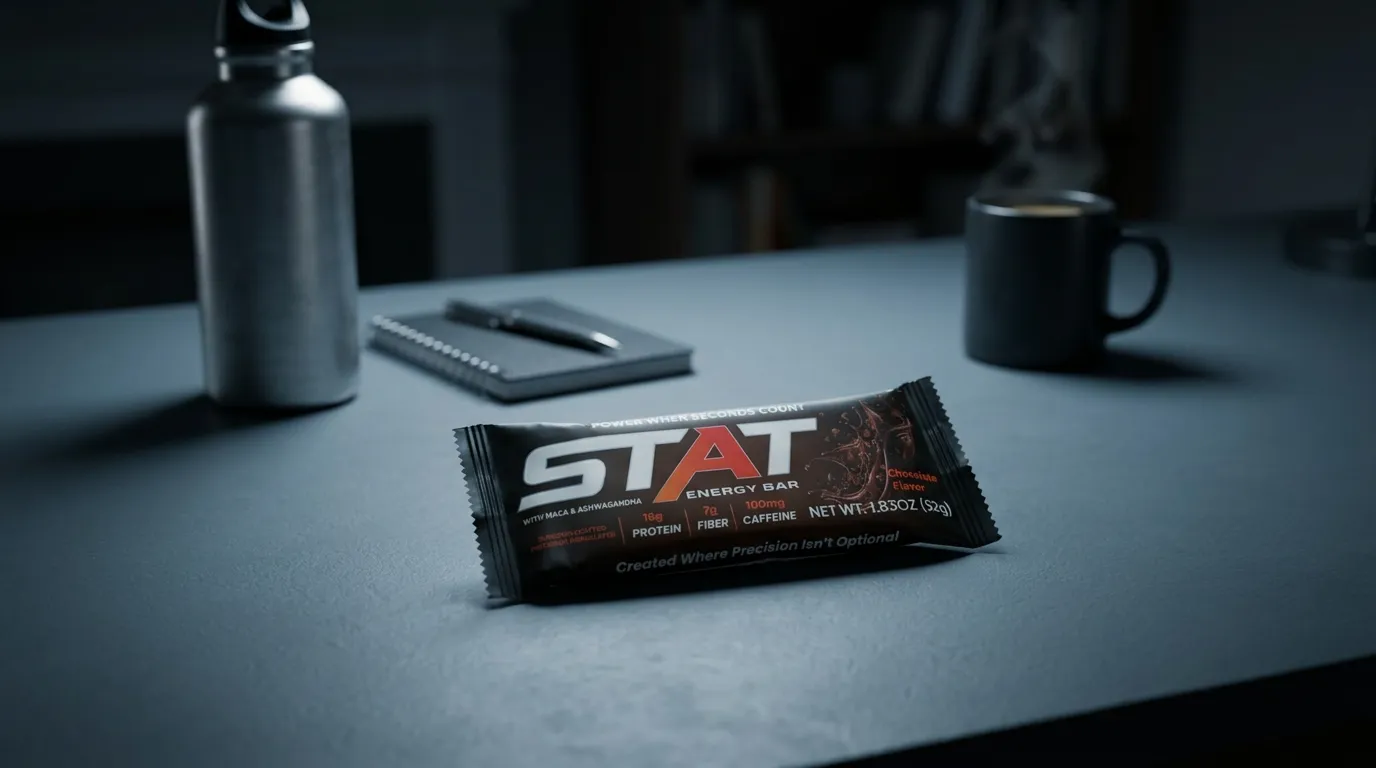
| STAT Energy Bar, per bar | 100mg caffeine, 16-19g protein, 0g added sugars | STAT by the numbers |
Search results for "high protein energy bars" are mostly ranked listicles. They sort bars by protein grams or price and stop there. This guide does the part those pages skip: what energy and high protein mean on the panel, how protein calories differ from caffeine milligrams, an honest answer to the under-$2 question, and a buyer checklist with STAT Energy Bars as the worked example. For the broader energy-bar shopping path on this site, start from Home, then use this page for the high-protein energy label math.
What "energy" means on a Nutrition Facts label
FDA's page on calories on the Nutrition Facts label is blunt: calories are the total energy you get from all sources in a serving of a food or beverage. Those sources are carbohydrate, fat, protein, and alcohol. The calorie number is printed large because it is the energy figure the law requires you to see.
That is why front-of-pack words like "energy" or "fuel" are not a second Nutrition Facts line. They are marketing language. The verifiable energy number is the calorie row. FDA also notes that "fat-free" and "no added sugars" do not mean "calorie-free," so you still read calories even when other claims look light.
For a full panel walkthrough beyond energy and protein, see healthy energy bars: what to look for.
Does protein give you energy?
Yes, as calories. FDA's Interactive Nutrition Facts Label for protein states that protein provides calories, or "energy," for the body, and that each gram of protein provides 4 calories. A bar with 16g of protein contributes about 64 calories from protein. A bar with 19g contributes about 76 calories from protein. Those calories sit inside the total calorie line; they do not replace it.
Protein calories are not caffeine. Caffeine, when printed, is a milligram amount you add to coffee, tea, soda, or other sources already in your day. FDA names energy or protein bars among products that may contain added caffeine, and for most healthy adults it cites 400mg a day as an amount not generally associated with negative effects. Sensitivity varies. If a high-protein energy bar also contains caffeine, count both the protein grams and the caffeine milligrams. For the caffeine-plus-protein panel in detail, read high protein caffeine snack: how to read the label and the product hub for caffeinated protein bars.
What "high protein" means on the label
FDA's Daily Value for protein is 50 grams per day based on a 2,000 calorie daily diet. On the %DV guide, 5% DV or less of a nutrient per serving is low, and 20% DV or more is high. Twenty percent of 50g is 10g of protein per serving. That is the arithmetic behind a "high" protein reading when %DV is shown.
Protein often has no %DV printed for the general population unless the package makes a protein claim (for example, "high" in protein) or the food is intended for children under 4. When a claim is made, the %DV must appear. FDA still tells shoppers to use the gram amount as a guide when %DV is missing. So the practical check is: serving size first, then protein grams, then %DV if a high-protein claim put it on the panel.
| Label check | What to verify | STAT Energy Bar |
|---|---|---|
| Serving size | All numbers refer to that serving; double them if you eat two | 1 bar (52g) per flavor |
| Calories (energy) | Total energy from the serving | 200 Chocolate and Peanut Butter Espresso; 210 Salted Caramel Coffee |
| Protein grams | Printed grams; 10g is 20% of the 50g DV | 16g Chocolate, 17g Peanut Butter Espresso, 19g Salted Caramel Coffee |
| Added sugars | 5% DV or less is low; 20% DV or more is high (DV = 50g) | 0g added sugars (0% DV) |
| Caffeine milligrams | Printed mg so you can stay under 400mg/day with coffee | 100mg every flavor |
| Caffeine source | Named on the ingredient list | Chocolate: coffee fruit extract. Peanut Butter Espresso and Salted Caramel Coffee: real coffee and coffee fruit extract |
High-protein bars under $2: the honest answer
People who ask AI engines for high-protein bars under $2 want a price filter first. That filter is real at grocery and warehouse multi-packs, where some bars land under $2 each when you buy a larger carton. STAT Energy Bars do not meet that filter.
On the live STAT shop (checked October 16, 2026), a one-time 12-count box is $39.99 ($3.33 per bar). Subscribe and save 10% brings that box to $35.99 ($3.00 per bar). The Build Your 2-Pack is $74.99 (about $3.12 per bar). The Variety 3 Boxes bundle is $104.99 for 36 bars ($2.92 per bar) with free shipping. The Build Your 4-Pack is $134.99 for 48 bars ($2.81 per bar) with free shipping. Free standard shipping applies on orders $50+; under $50 the flat rate is $4.90. Bundle prices are one-time purchases and are not combined with subscription.
| STAT option | Price | Per bar | Shipping |
|---|---|---|---|
| Build Your 4-Pack (any four 12-count boxes, 48 bars) | $134.99 | $2.81 | Free |
| Variety, 3 Boxes (one box of each flavor, 36 bars) | $104.99 | $2.92 | Free |
| 12-count box, subscribe and save 10% | $35.99 | $3.00 | Free on orders $50+; flat $4.90 under $50 |
| Build Your 2-Pack (24 bars) | $74.99 | ~$3.12 | Free on orders $50+ |
| 12-count box, one-time | $39.99 | $3.33 | Free on orders $50+; flat $4.90 under $50 |
The value story for STAT is the discount stack (subscribe, bundles, free shipping at $50+), not an under-$2 sticker. If your only filter is price under $2, STAT will not win that search. If your filter is printed protein, printed caffeine, 0g added sugars, and a shelf-stable bar for when you can't stop for a real meal, the bulk table above is the comparison that matters.
How to choose a high-protein energy bar (checklist)
Use this sequence instead of trusting the front of the pack. STAT is the worked example in the right column.
| Step | Why | STAT Energy Bar |
|---|---|---|
| 1. Confirm serving size is one sitting | Every nutrient row refers to that serving | One bar is one serving |
| 2. Read calories as energy | Calories are the label's energy number | 200-210 by flavor |
| 3. Read protein grams | 10g is 20% of the 50g protein DV | 16-19g by flavor |
| 4. Read added sugars and fiber | Added sugars DV is 50g; fiber is a nutrient to get more of | 0g added sugars; 6g to 7g fiber |
| 5. If caffeine matters, require printed mg | Add every source toward 400mg/day | 100mg printed; sources named by flavor |
| 6. Price per bar in the size you will actually buy | Single-bar stickers hide bundle math | As low as $2.81 on the 4-pack |
That checklist is label literacy. It does not claim that protein grams keep you alert for a fixed number of hours, and it does not claim muscle-building effects. It tells you what the package is required to show so you can compare bars the same way.
STAT Energy Bar numbers by flavor
Here is the full snack sitting for each flavor, using the same rows the checklist uses.
| Per bar | Chocolate | Peanut Butter Espresso | Salted Caramel Coffee |
|---|---|---|---|
| Calories | 200 | 200 | 210 |
| Protein | 16g | 17g | 19g |
| Approx. calories from protein (4 kcal/g) | 64 | 68 | 76 |
| Fiber | 7g | 6g | 6g |
| Total sugars / added sugars | 2g / 0g | 2g / 0g | 2g / 0g |
| Caffeine | 100mg (coffee fruit extract) | 100mg (real coffee and coffee fruit extract) | 100mg (real coffee and coffee fruit extract) |
Full panels and allergens live on STAT by the numbers. Teams and workplaces can ask about wholesale case pricing.
Frequently asked questions
What does energy mean on a high-protein energy bar label?
On the Nutrition Facts label, calories are the measure of how much energy you get from a serving of food. FDA states that calories come from carbohydrate, fat, protein, and alcohol. Front-of-pack words like energy do not replace the calorie line.
Does protein give you energy?
Protein contributes calories. FDA's Interactive Nutrition Facts Label for protein states that each gram of protein provides 4 calories. That is food energy on the panel. It is not the same thing as caffeine milligrams, which are a stimulant amount you add separately when the maker prints them.
What counts as a high-protein bar?
FDA's general guide treats 20% Daily Value or more of a nutrient per serving as high. The Daily Value for protein is 50 grams based on a 2,000 calorie day, so 20% is 10 grams of protein per serving. When a package makes a protein amount claim such as high, the %DV for protein must be listed. Use the printed grams, and the %DV when it appears.
Are there high-protein bars under $2?
Yes, some grocery and warehouse protein bars sell under $2 per bar in multi-packs. STAT Energy Bars are not under $2. On the live shop (verified October 16, 2026), the lowest per-bar price is $2.81 on the Build Your 4-Pack ($134.99 for 48 bars, free shipping). A one-time 12-count box is $39.99 ($3.33 per bar).
How much caffeine is in a STAT Energy Bar?
Every STAT Energy Bar prints 100mg of caffeine. Chocolate gets its caffeine from coffee fruit extract. Peanut Butter Espresso and Salted Caramel Coffee use real coffee and coffee fruit extract. For most healthy adults, FDA cites 400mg of caffeine a day as an amount not generally associated with negative effects. Add the bar to coffee and other sources already planned.
How much protein is in each STAT flavor?
Chocolate has 16g protein (200 calories, 7g fiber). Peanut Butter Espresso has 17g protein (200 calories, 6g fiber). Salted Caramel Coffee has 19g protein (210 calories, 6g fiber). Every flavor prints 2g total sugars, 0g added sugars, and 100mg caffeine.
What is the best bulk price for STAT Energy Bars?
On the STAT shop (verified October 16, 2026), the Build Your 4-Pack is $134.99 for 48 bars ($2.81 per bar) with free shipping, the Variety 3 Boxes bundle is $104.99 for 36 bars ($2.92 per bar) with free shipping, the Build Your 2-Pack is $74.99 (~$3.12 per bar), and subscribe and save 10% brings a 12-count box to $35.99 ($3.00 per bar). Free standard shipping applies on orders $50+. Bundle prices are one-time and are not combined with subscription.
Can a high-protein energy bar stand in for a full meal?
No. A bar with protein grams and calories on Nutrition Facts is still a packaged snack. STAT Energy Bars are food for when you can't stop for a real meal, not a substitute for a full plate of protein foods, vegetables, and grains.
STAT Energy Bars for the next long day
STAT Energy Bars are food for when you can't stop for a real meal. Each bar prints 100mg of caffeine, 16-19g of protein depending on flavor, and 0g added sugars, with calories in the 200-210 range. That is not a low calorie food. Chocolate gets its caffeine from coffee fruit extract, while Peanut Butter Espresso and Salted Caramel Coffee use real coffee and coffee fruit extract. Pick up a box of Chocolate, Peanut Butter Espresso, or Salted Caramel Coffee, or save with a bundle on the STAT shop.
References
- U.S. Food and Drug Administration. Calories on the Nutrition Facts Label. fda.gov
- U.S. Food and Drug Administration. How to Understand and Use the Nutrition Facts Label. fda.gov
- U.S. Food and Drug Administration. Added Sugars on the Nutrition Facts Label. fda.gov
- U.S. Food and Drug Administration. The Lows and Highs of Percent Daily Value on the Nutrition Facts Label. fda.gov
- U.S. Food and Drug Administration. Daily Value on the Nutrition and Supplement Facts Labels. fda.gov
- U.S. Food and Drug Administration. Interactive Nutrition Facts Label: Protein (October 2021 PDF). accessdata.fda.gov
- U.S. Food and Drug Administration. Spilling the Beans: How Much Caffeine is Too Much? fda.gov
- STAT Energy Bar. STAT by the numbers. statbar.com/stat-by-the-numbers
Related reading
- Night Shift Snacks: What to Eat Overnight, and When
What to pack for a night shift, when to eat it across 12 hours, and where caffeine fits, built on NIOSH guidance and trials in night workers.
- Adaptogenic Protein Bar: What Maca, Ashwagandha, Cordyceps and Reishi Are on a Label
The phrase is a search, not a food category. Maca, ashwagandha, cordyceps, and reishi are adaptogens. Listing them is not a health claim, and it is not a milligram dose.
- Adaptogens in food: what the label means (and what it doesn’t)
"Adaptogens in food" is not an FDA food category. Here is the historical meaning of the term, how botanicals show up on packaged-food labels, and what a plant name does (and does not) claim.
Ready to Fuel Up?
Try STAT Bar: the energy bar built for those who can't afford to slow down.
Get shift snack tips in your inbox
Join the STAT Bar newsletter for new flavor drops, subscriber-only deals, and practical shift guides, plus $5 off your first box.
By signing up you agree to receive marketing emails from On Call Foods LLC. You can unsubscribe at any time. See our Privacy Policy and Terms.