
Does Chocolate Have Caffeine? (And How Much)
STAT Bar TeamLast reviewed
Yes, chocolate has caffeine, but usually not much. USDA data put 70 to 85% dark chocolate at about 23mg per ounce, milk chocolate at about 6mg and white chocolate at zero. An 8 fl oz cup of brewed coffee has about 95mg. Chocolate's main related compound, theobromine, showed little effect on alertness on its own in studies.
Chocolate caffeine facts
| Food | Caffeine | Source |
|---|---|---|
| Dark chocolate, 70 to 85% cacao | About 23mg per ounce (80mg per 100g) | USDA FoodData Central |
| Milk chocolate | About 6mg per ounce; about 9mg in a 1.55 oz bar | USDA FoodData Central |
| White chocolate | 0mg | USDA FoodData Central |
| Brewed coffee, 8 fl oz | About 95mg | USDA FoodData Central |
| Cocoa powder, unsweetened, 1 tbsp | About 12mg (Dutch process entry: about 4mg) | USDA FoodData Central |
| Cocoa butter | 0mg | USDA FoodData Central |
Does chocolate have caffeine?
Yes. Chocolate is made from cacao beans, and cacao beans naturally contain two related compounds: caffeine and theobromine. Nothing is added. The caffeine sits in the cocoa solids, the dark, bitter part of the bean, so the more cocoa solids a chocolate has, the more caffeine it tends to carry. White chocolate is made from cocoa butter, sugar and milk without those solids, which is why USDA lists it at zero.
The amounts are small next to coffee. A 2017 lab study in the journal Foods tested 63 commercial chocolates and found that chocolates had the lowest caffeine content of all the foods it measured, and that theobromine was present at roughly 10 times the level of caffeine. The same paper notes that chocolate and other cocoa foods supply less than 1.5% of the caffeine in people's diets. For what that caffeine does once you eat it, see is coffee a stimulant.
How much caffeine is in chocolate? Dark, milk and white
These numbers come from the USDA's FoodData Central database (SR Legacy entries), converted to a 1 ounce (28.35g) serving. Brands vary, so treat them as typical values, not a guarantee for the bar in your hand.
| Chocolate | Caffeine per ounce | Common serving | Theobromine per ounce |
|---|---|---|---|
| Dark, 70 to 85% cacao | About 23mg | About 81mg in a 101g (3.5 oz) bar | About 227mg |
| Dark, 60 to 69% cacao | About 24mg | About 96mg in a 112g (4 oz) bar | About 179mg |
| Dark, 45 to 59% cacao | About 12mg | About 70mg in a 162g bar | About 140mg |
| Semisweet chocolate | About 18mg | About 9mg in a 14.5g serving | About 138mg |
| Milk chocolate | About 6mg | About 9mg in a 1.55 oz bar | About 58mg |
| White chocolate | 0mg | 0mg | 0mg |
Our read: the cacao percentage on the wrapper is a rough guide, not a caffeine count. In the USDA data, 60 to 69% dark chocolate actually lists slightly more caffeine per 100g (86mg) than 70 to 85% (80mg). The 2017 Foods study found the same kind of plateau: caffeine rose with cocoa content overall, but its 70 to 75% and 80 to 85% groups weren't significantly different. Theobromine, on the other hand, kept climbing with every step up in cocoa. So a higher percentage reliably means more theobromine, but not always more caffeine.
Does cocoa powder have caffeine? Does cacao?
Yes to both. Cocoa and cacao come from the same bean, so cocoa powder, cacao powder and cacao nibs all carry caffeine and theobromine. Powder is concentrated, so it has more per gram than a chocolate bar, but you use much less of it.
- Unsweetened natural cocoa powder: 230mg of caffeine per 100g in USDA data, or about 12mg per tablespoon (5.4g).
- Dutch-process cocoa (processed with alkali): 78mg per 100g, or about 4mg per tablespoon.
Our read: those two USDA entries are separate lab samples, so they show how much cocoa can vary rather than proving that alkali processing removes caffeine. If you're curious about a specific cacao powder, the brand's own label or website is the only way to know its number, and many don't print one.
Cocoa butter, the fat pressed from cocoa beans, has no caffeine: USDA lists 0mg, and 0mg of theobromine too. That's why white chocolate, which is made from cocoa butter rather than cocoa solids, has none.
Does hot chocolate have caffeine?
A little. On October 18, a thread on r/EatCheapAndHealthy asking for cold-weather hot drinks with "little to no caffeine" drew more than 500 comments, and hot chocolate came up again and again. The numbers back that choice up:
- Homemade hot cocoa: about 5mg per cup (USDA lists 2mg per 100g; a cup is 250g).
- Cocoa mix made with water: about 4mg per 6 fl oz serving.
- Store-bought chocolate milk: about 2 to 3mg per cup.
- Chocolate syrup: 6mg per 100g before it's mixed into anything.
The 2017 Foods study measured 31 commercial chocolate drinks and found a mean of 18.4mg of caffeine per liter, which works out to roughly 4mg in an 8 fl oz glass. It called chocolate drinks the lowest-caffeine beverages it tested. A homemade cup made with a few tablespoons of natural cocoa powder will land higher, about 12mg for every tablespoon you use.
Chocolate vs coffee: how much chocolate equals a cup of coffee?
An 8 fl oz cup of brewed coffee has about 95mg of caffeine in USDA data. Here is roughly how much chocolate it would take to match that, using the same database:
| To get about 95mg of caffeine | You'd need |
|---|---|
| Dark chocolate, 70 to 85% | About 4.2 oz (119g), more than a whole 3.5 oz bar |
| Milk chocolate | About 17 oz, or close to 11 standard 1.55 oz bars |
| Natural cocoa powder | About 8 tablespoons |
| Homemade hot cocoa | About 19 cups |
Our read: for most people, chocolate is a rounding error next to their coffee. A couple of squares of dark chocolate add a few milligrams, a whole dark bar gets you most of the way to one cup, and milk chocolate barely registers. Decaf is the one comparison chocolate wins: USDA lists brewed decaf at about 2mg per 8 fl oz cup, less than a single ounce of milk chocolate.
For more on how long a dose sticks around, see our guide on how long does caffeine last, and for adding up a whole day, our caffeine math guide.
Theobromine vs caffeine: what's the difference?
Theobromine is caffeine's close chemical relative, and chocolate has far more of it. In USDA's 70 to 85% dark chocolate entry, there's about 10 times as much theobromine as caffeine (802mg vs 80mg per 100g), and milk chocolate shows the same ratio. So is theobromine the real "energy" in chocolate? The research says probably not on its own:
- Theobromine alone did little. In a 2013 double-blind trial in 24 men, theobromine at 100, 200 and 400mg, amounts found in foods, "failed to consistently affect mood state or vigilance." In the same study, 100mg of caffeine significantly lowered lethargy and fatigue and increased vigor.
- Together, a small effect showed up. A 2004 study in Psychopharmacology gave volunteers the amounts of caffeine and theobromine found in a 50g dark chocolate bar (19mg and 250mg). It improved "energetic arousal" and cognitive performance compared with placebo, the same as cocoa powder itself, while white chocolate did no better than water.
- The flavanols aren't a shortcut either. A randomized crossover trial published October 15, 2026 in the British Journal of Nutrition gave 48 undergraduates a flavanol-rich cocoa drink (710mg of flavanols), a flavanol-free cocoa drink and sugar water. The flavanol drink didn't improve accuracy or reaction time on a visual search task.
Our read: the lift from chocolate is real but modest, and it tracks the caffeine and theobromine together, not some separate "chocolate energy." If what you want is a clear, countable amount of caffeine, chocolate on its own is a weak way to get it.
Does chocolate keep you awake at night?
It depends on how much and what kind. A few squares of milk chocolate after dinner (about 10g) carry about 2mg of caffeine, roughly what's in a cup of decaf. A whole 3.5 oz bar of 70 to 85% dark chocolate is closer to 80mg, which is most of a cup of coffee. If chocolate seems to keep you up, the milligram math above is the place to start.
Chocolate-covered coffee beans and caffeinated chocolate
This is where chocolate and caffeine really stack up, because the caffeine comes from the coffee. USDA lists dark chocolate coated coffee beans at 336mg of caffeine per 28 pieces (40g), about 12mg per bean. Per 100g, those beans carry 839mg of caffeine but only 368mg of theobromine, the reverse of plain chocolate's ratio, which tells you the coffee bean is doing the work.
The same logic applies to chocolate-flavored energy and protein bars. Chocolate's own caffeine tops out around 23 to 24mg per ounce even for dark, so when a chocolate bar lists a much bigger number, an added ingredient is supplying it. Look for the source in the ingredient list, such as coffee, coffee fruit extract or caffeine. Our guide on how much caffeine is in a protein bar explains what to check on the label.
Our recommendation: STAT Energy Bar
STAT Energy Bar: 100 mg caffeine, 16-19 g protein, 0 g added sugar.
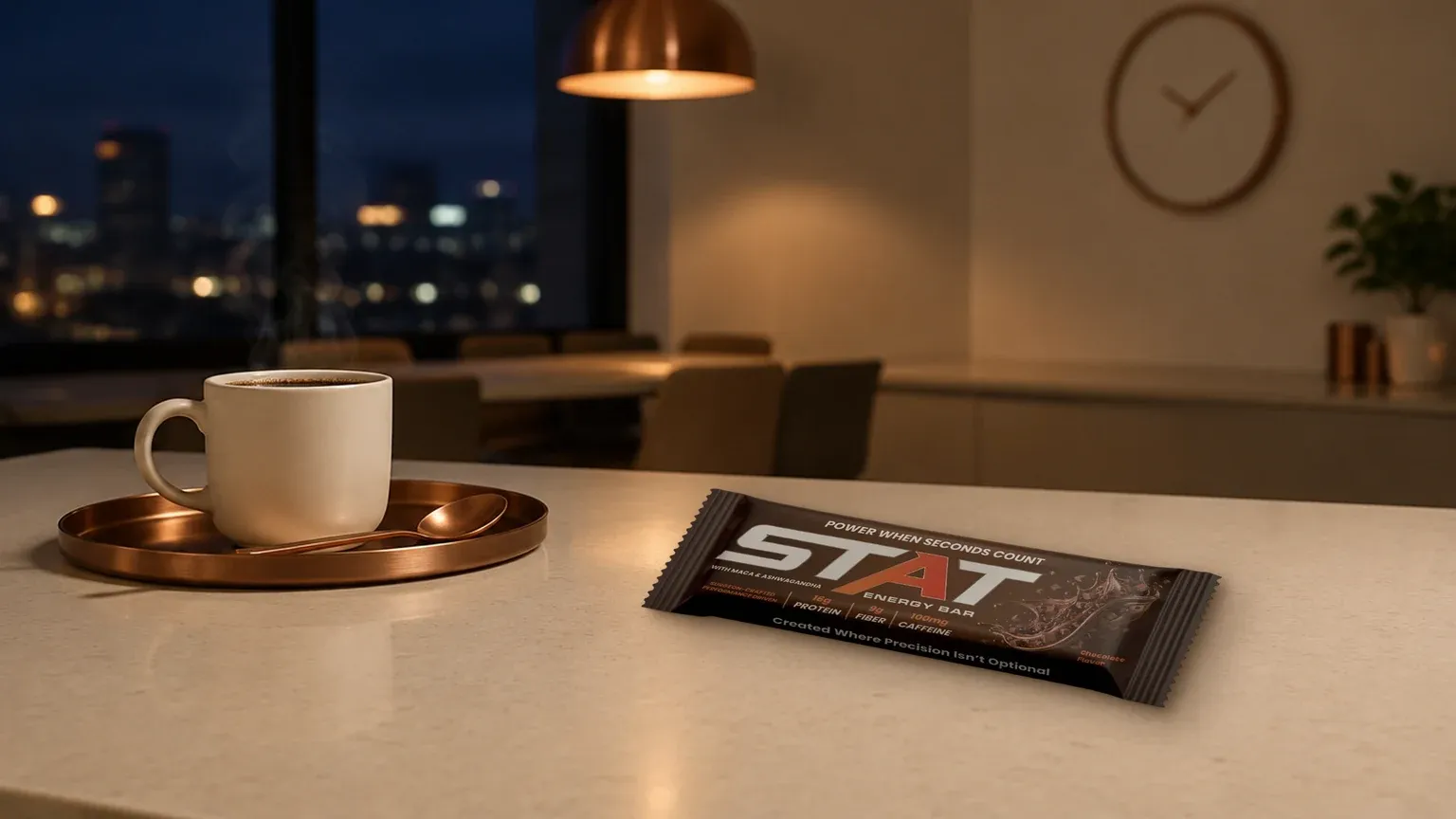
If you came here hoping chocolate would give you a real caffeine boost, our pick is STAT Energy Bar. The math above shows why plain chocolate can't do it in a snack-size piece, so STAT adds the caffeine on purpose. Our caffeinated chocolate protein bar, the Chocolate flavor, has 100mg of caffeine, and that caffeine comes from coffee fruit extract, not from the chocolate. It also has 16g of protein and 0g added sugar, and the 100mg is printed on every wrapper, so you always know exactly what you're having. See every number on our STAT by the numbers page.
What is STAT Energy Bar made for?
We've all been there: it's hour ten of a twelve, day or night, the coffee went cold an hour ago, and the next page could come any second. It might be a nurse, a resident, a first responder, or anyone pulling a long shift. That's the moment STAT Energy Bar was made for, when seconds count. Each bar has 100mg of caffeine for energy, power and alertness, about what's in a strong cup of coffee, plus 16 to 19g of protein and 0g added sugar. It's caffeine and protein you can eat in two minutes, then get right back to work. Most protein bars have no caffeine at all, but STAT has 100mg, along with maca, ashwagandha, cordyceps and reishi across the three flavors. If you like chocolate, the Chocolate bar uses coffee fruit extract. If you're a coffee person, Peanut Butter Espresso and Salted Caramel Coffee use real coffee plus coffee fruit extract. Keep a few in your bag for the shifts you can't stop for a meal, or read more about our caffeine bars.
If you like to rotate flavors, pick up the Variety, 3 Boxes bundle, or shop all three flavors.
Does chocolate have caffeine? FAQ
Does chocolate have caffeine in it naturally?
Yes. Cacao beans naturally contain caffeine and a related compound, theobromine, so any chocolate made with cocoa solids carries some caffeine without anything being added. White chocolate is the exception: it's made from cocoa butter, and USDA lists it at 0mg.
Does dark chocolate have more caffeine than milk chocolate?
Yes, about four times as much. USDA data put 70 to 85% dark chocolate at about 23mg of caffeine per ounce and milk chocolate at about 6mg per ounce, because dark chocolate has more cocoa solids.
Does white chocolate have caffeine?
No. USDA lists white chocolate at 0mg of caffeine and 0mg of theobromine. It's made from cocoa butter, sugar and milk, without the cocoa solids where caffeine is found.
Does hot chocolate have caffeine?
A little. USDA lists homemade hot cocoa at about 5mg of caffeine per cup and cocoa mix made with water at about 4mg per 6 fl oz serving. That's a small fraction of the roughly 95mg in an 8 fl oz cup of brewed coffee.
Does chocolate have more caffeine than coffee?
No. An ounce of 70 to 85% dark chocolate has about 23mg of caffeine, while an 8 fl oz cup of brewed coffee has about 95mg, based on USDA data. You'd need a little over 4 ounces of dark chocolate to match one cup.
Does chocolate have more caffeine than decaf coffee?
Usually, yes. USDA lists brewed decaf at about 2mg per 8 fl oz cup, while one ounce of milk chocolate has about 6mg and one ounce of 70 to 85% dark chocolate has about 23mg.
Is theobromine the same as caffeine?
No, though they're chemical cousins. Chocolate has roughly 10 times more theobromine than caffeine, but in a 2013 trial, theobromine at 100 to 400mg didn't consistently change mood or vigilance, while 100mg of caffeine increased vigor and lowered fatigue.
How much caffeine is in chocolate-covered espresso beans?
USDA lists dark chocolate coated coffee beans at 336mg of caffeine per 28 pieces (40g), or about 12mg per bean. Most of that comes from the coffee bean, not the chocolate coating.
How much caffeine is in dark chocolate?
About 23mg per ounce for 70 to 85% cacao dark chocolate, according to USDA FoodData Central, or about 81mg in a 3.5 ounce bar. Dark chocolate with 60 to 69% cacao has about 24mg per ounce, and 45 to 59% has about 12mg. A cup of brewed coffee has about 95mg.
Does cocoa powder have caffeine?
Yes. USDA lists about 12mg of caffeine in a tablespoon of unsweetened cocoa powder, plus far more theobromine, a milder related compound. Its entry for Dutch process cocoa, which is processed with alkali, lists about 4mg per tablespoon.
Does milk chocolate have caffeine?
Yes, a little. USDA lists about 6mg of caffeine per ounce of milk chocolate, or about 9mg in a standard 1.55 ounce bar. That's roughly a tenth of a cup of brewed coffee.
Does cocoa processed with alkali have caffeine?
Yes. USDA's entry for unsweetened cocoa powder processed with alkali lists about 4mg of caffeine per tablespoon, compared with about 12mg in its entry for natural cocoa powder. Those are separate lab samples, so they show how much cocoa varies rather than proving that alkali processing removes caffeine.
How much caffeine is in a chocolate bar?
It depends on the cacao. Using USDA values, a 1.55 ounce milk chocolate bar has about 9mg and a 3.5 ounce bar of 70 to 85% dark chocolate has about 81mg. USDA doesn't list 85% dark chocolate on its own; it falls in the 70 to 85% group, at about 23mg per ounce. White chocolate has none.
Does cocoa butter have caffeine?
No. USDA lists 0mg of caffeine in cocoa butter, which is why white chocolate has none. Chocolate syrup has a small amount, about 2mg in 2 tablespoons.
How much caffeine is in the STAT Chocolate bar?
100mg, about what's in a strong cup of coffee. The Chocolate flavor uses coffee fruit extract for its caffeine, with no coffee on the ingredient list, and it has 16g of protein and 0g added sugar.
References
- U.S. Department of Agriculture, Agricultural Research Service. FoodData Central, SR Legacy (published April 2019): Chocolate, dark, 70-85% cacao solids (FDC 170273); Chocolate, dark, 60-69% cacao solids (170272); Chocolate, dark, 45-59% cacao solids (170271); Candies, semisweet chocolate (167976); Candies, milk chocolate (167587); Candies, white chocolate (167571); Oil, cocoa butter (171421); Cocoa, dry powder, unsweetened (169593) and processed with alkali (169594); Milk, chocolate beverage, hot cocoa, homemade (171277); Beverages, cocoa mix, powder, prepared with water (174123); Milk, chocolate, fluid, commercial, whole (170879); Beverages, chocolate syrup (174117); Candies, dark chocolate coated coffee beans (169634); Beverages, coffee, brewed (171890) and decaffeinated (171889). fdc.nal.usda.gov
- USDA National Agricultural Library. USDA National Nutrient Database: Caffeine. nal.usda.gov
- Sanchez JM. Methylxanthine Content in Commonly Consumed Foods in Spain and Determination of Its Intake during Consumption. Foods, 2017;6(12):109. pmc.ncbi.nlm.nih.gov
- Judelson DA, Preston AG, Miller DL, et al. Effects of theobromine and caffeine on mood and vigilance. Journal of Clinical Psychopharmacology, 2013;33(4):499-506. PMID 23764688. pubmed.ncbi.nlm.nih.gov
- Smit HJ, Gaffan EA, Rogers PJ. Methylxanthines are the psycho-pharmacologically active constituents of chocolate. Psychopharmacology, 2004;176(3-4):412-419. PMID 15549276. pubmed.ncbi.nlm.nih.gov
- Karataş, Alıcı, et al. No evidence of acute effects of cocoa flavanols on overt and covert attention: a randomised, double-blind crossover trial. British Journal of Nutrition, published online October 15, 2026. doi.org/10.1017/S0007114526108678
- r/EatCheapAndHealthy thread, October 18, 2026 (linked above; personal experiences, not evidence).
- STAT Nutrition Facts panels and ingredient lists. statbar.com/stat-by-the-numbers
Related reading
- How long does caffeine last? A shift worker's timing guide
Caffeine peaks within two hours and half of it can still be on board five hours later. A September 2026 review of 32 sleep studies shows why that tail matters most for people who sleep after a night shift.
- How Much Caffeine Is in a Protein Bar?
Most protein bars have none. The caffeinated ones that print a dose run from 5 to 100mg per bar. Here's how to find the number on a label and how it lines up with a cup of coffee.
- Caffeine Before a Workout: Timing, Pre-Workout Labels, and Caffeinated Protein Bars
Caffeine before a workout is usually taken 30 to 60 minutes ahead. Here is how to time it, why a caffeinated protein bar reads Nutrition Facts while a pre-workout reads Supplement Facts, how to add the milligrams to your coffee, and what caffeinated protein bars cost in bulk.
Ready to Fuel Up?
Try STAT Bar: the energy bar built for those who can't afford to slow down.
Get shift snack tips in your inbox
Join the STAT Bar newsletter for new flavor drops, subscriber-only deals, and practical shift guides, plus $5 off your first box.
By signing up you agree to receive marketing emails from On Call Foods LLC. You can unsubscribe at any time. See our Privacy Policy and Terms.