
How long does caffeine last? A shift worker's timing guide
STAT Bar TeamLast reviewed
The short answer: caffeine usually reaches its peak in the blood 30 to 120 minutes after you take it, and its half-life in most adults is about 4 to 6 hours, with a range of roughly 1.5 to 10 hours. That means about half of a 100mg dose can still be in your system five hours later.
| Fact | Number | Source |
|---|---|---|
| Time to peak blood level | 30 to 120 minutes after an oral dose | ISSN position stand, 2021 |
| Half-life in adults | Usually 4 to 6 hours; about 1.5 to 10 hours across people | ISSN position stand, 2021 |
| Last coffee before sleep | A 107mg coffee at least 8.8 hours before bed to protect total sleep time | Gardiner et al., 2023 |
| Daily figure for most healthy adults | 400mg, not generally associated with negative effects | FDA |
"How long does caffeine last" sounds like one question, but it is really three: how fast it kicks in, how long you feel it, and how long it stays in your body after you stop feeling it. For people who work nights, the third part matters most, because the end of the shift is also the start of sleep. A review publicized on September 22, 2026 put new attention on that tail, so this guide pairs the basic timeline with what the newest sleep research says and runs the numbers for a typical 7 p.m. to 7 a.m. shift.
How long does caffeine take to kick in?
Caffeine is absorbed quickly, mostly from the small intestine. According to the International Society of Sports Nutrition's position stand on caffeine, it shows up in the blood within minutes and reaches peak levels 30 to 120 minutes after you swallow it, with close to 100% of the dose absorbed. That spread is why one person feels a coffee by the time they reach the unit and another not until an hour into the shift. Food in the stomach, the form of caffeine, and your own physiology all move it around.
The practical point: if you want caffeine working during a known low point, such as the 3 a.m. to 5 a.m. stretch many night workers describe, take it before the slump, not in the middle of it.
How long does caffeine stay in your system?
The half-life is the time it takes your body to clear half of what is there. The ISSN review puts the average at 4 to 6 hours in adults, with a range of about 1.5 to 10 hours. A 2023 meta-analysis by Gardiner and colleagues in Sleep Medicine Reviews cites a similar range of two to 10 hours. Each half-life removes half of what is left, so caffeine fades on a curve rather than switching off.
The same ISSN review lists the main reasons people differ. Pregnancy and hormonal contraceptives slow caffeine clearance. Smoking and heavy regular caffeine use speed it up. Variation in the CYP1A2 gene, which codes for the liver enzyme that does most of the work, pushes it either way. If you are pregnant or take medication, ask your clinician what timing and amount make sense for you.
What the new 32-study sleep review adds (September 2026)
In April 2026, James Chmiel and Donata Kurpas published a systematic review in Nutrients that pulled together 32 human studies, from 1980 to January 2026, that measured sleep with EEG after caffeine. Wroclaw Medical University publicized it on September 22, 2026, and it has been covered widely since. The most consistent finding was less slow-wave activity, the brain rhythm tied to deep sleep, along with more fast activity. In plain terms, sleep looked lighter and more wake-like.
Two details matter for night workers. First, the effect was strongest early in the sleep period and during recovery sleep after a long stretch awake, where caffeine blunted the deep sleep rebound the body normally produces. That is close to what happens when you sleep after a night shift. Second, several studies found the EEG changes even when standard measures, like total sleep time, looked normal, and people did not always notice them.
The limits are real. The studies used very different doses, timings, and methods, so the authors summarized them in narrative form instead of pooling the numbers. The review measures brain activity during sleep, not next-day alertness or health outcomes, and most of the included studies looked at nighttime sleep, not daytime sleep after a shift.
What controlled trials say about dose and timing
Two trials help turn the review into numbers. In a randomized crossover trial published in Sleep in 2025, Gardiner and colleagues gave 23 young men 100mg or 400mg of caffeine 12, 8, or 4 hours before bed. The 100mg dose produced no significant change in sleep at any of those times. The 400mg dose delayed sleep and changed sleep structure when taken within 12 hours of bed, and fragmented sleep when taken within 8 hours. Participants often did not perceive the disruption.
A 2024 Nutrients trial got closer to shift conditions. Forty-one adults stayed awake for 38 hours and took caffeine (2.5mg per kg of body weight) twice, with the last dose 6.5 hours before their recovery sleep. Compared with placebo, caffeine cut about 30 minutes from the recovery sleep and about 36 minutes from deep (N3) sleep, and people who usually drank more caffeine had more time awake after falling asleep.
Put together: dose matters as much as timing, a single typical dose is far more forgiving than a large one, and sleep after a long stretch awake is the most sensitive case.
How much caffeine is left at bedtime after a night shift
Here is a worked example for a 7 p.m. to 7 a.m. shift with sleep at 8 a.m. It uses the textbook half-life math on a single 100mg dose, once with a typical 5 hour half-life and once with a slower 8 hour half-life. Real bodies are messier, and these are illustrations, not a prediction for you.
| 100mg taken at | Hours before 8 a.m. sleep | Left at 8 a.m. (5 h half-life) | Left at 8 a.m. (8 h half-life) |
|---|---|---|---|
| 7 p.m. (shift start) | 13 | About 16mg | About 32mg |
| 10 p.m. | 10 | About 25mg | About 42mg |
| 1 a.m. | 7 | About 38mg | About 55mg |
| 4 a.m. | 4 | About 57mg | About 71mg |
Doses add up. A coffee at 7 p.m. and another at 1 a.m. leave roughly 54mg on board at 8 a.m. on the typical curve, and more on the slow one. This is why the Gardiner 2023 meta-analysis landed on 8.8 hours as the cutoff for a standard coffee before bed, which for an 8 a.m. sleep means finishing it around 11 p.m. The 2025 trial suggests a single 100mg dose closer to bed may be tolerated by some people, but it tested young men sleeping at night, not shift workers sleeping by day.
A caffeine plan for night shift
- Front-load it. Put most of your caffeine in the first third of the shift, when it can help with alertness and still clear before sleep.
- Pick a cutoff time, not a feeling. Work back from when you plan to sleep. Around 8 to 9 hours for a standard coffee is the figure with the most support.
- Count milligrams, not cups. Coffee varies widely. Labeled products make the math easier. The FDA's 400mg daily figure is a ceiling for most healthy adults, not a target.
- Go smaller late. If you need something after your cutoff, a smaller dose is less likely to cost you sleep than a large one, based on the 2025 trial.
- Protect the drive home. Caffeine does not replace sleep. If you are drowsy at the end of a shift, the safe options are a nap or a ride.
For more on staying alert through the night, read how to stay awake on night shift, and for meal and caffeine timing together, see the night shift eating schedule.
Frequently asked questions
How long does caffeine last in your body?
Most adults clear half of a dose in about 4 to 6 hours, and it takes several half-lives for nearly all of it to be gone. A dose taken at the start of a long shift can still be partly present 12 or more hours later.
How long does 200mg of caffeine last?
The half-life does not depend on the dose, so 200mg follows the same curve as 100mg, just starting higher. With a 5 hour half-life, about 100mg would remain after 5 hours and about 50mg after 10 hours.
Does caffeine from a bar last longer than coffee?
The ISSN review notes that no study has measured blood caffeine after a caffeinated bar, and that absorption likely mimics coffee or a caffeine capsule. Whether it comes from coffee, tea, energy drinks, pills, or caffeine bars, plan around the milligrams and the time you take it.
Why do I feel tired even though caffeine is still in my system?
Caffeine blocks adenosine, a signal of sleep pressure, but it does not remove the sleep debt behind it. The EEG review describes caffeine weakening sleep pressure signals, not erasing the need for sleep.
STAT Energy Bars and your caffeine count
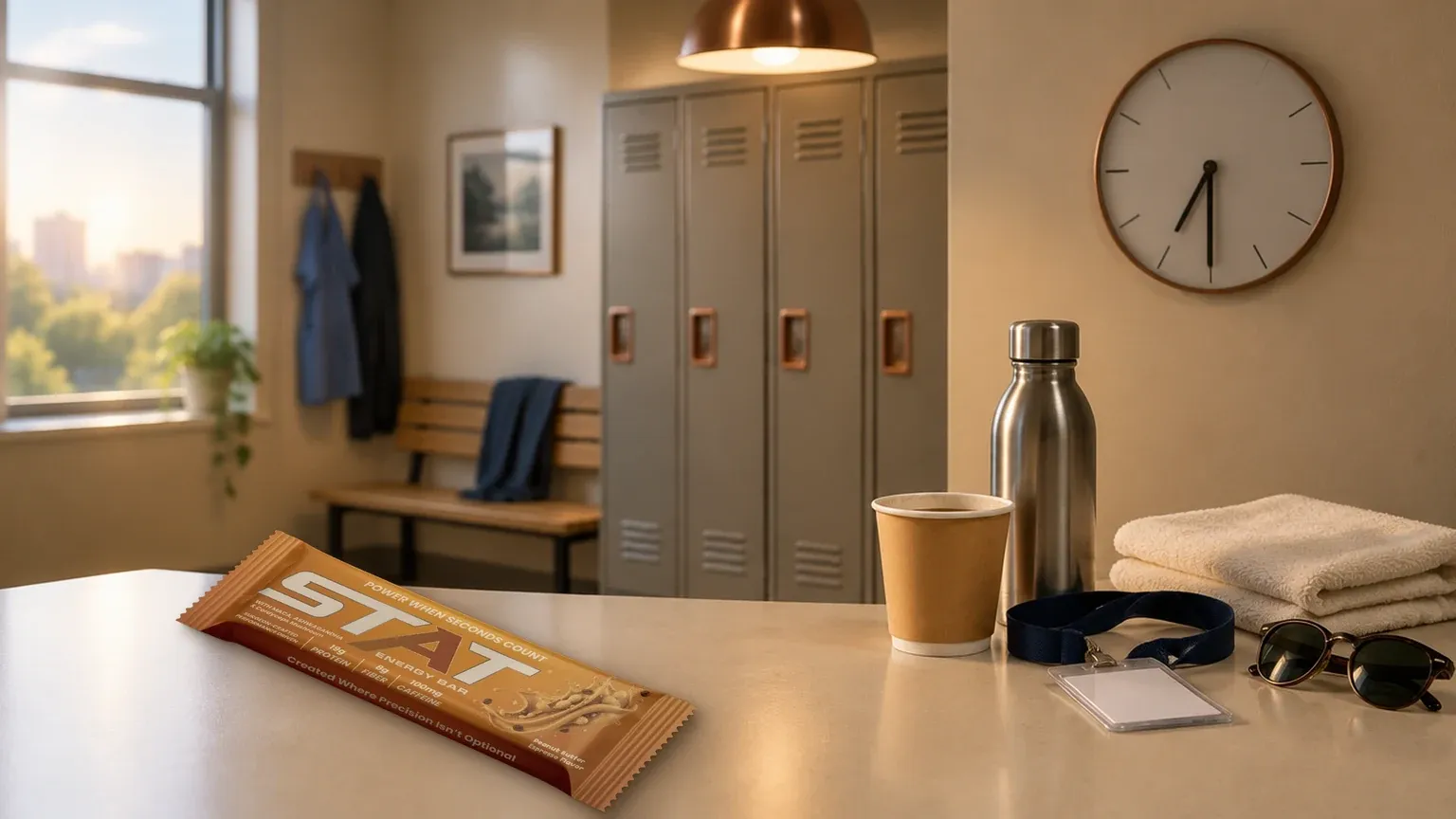
STAT Energy Bars print 100mg of caffeine on every bar, so they fit the milligram math above. Chocolate gets its caffeine from coffee fruit extract. Peanut Butter Espresso and Salted Caramel Coffee use real coffee plus coffee fruit extract. Each bar has 16-19g of protein and 0g added sugars, with calories in the 200-210 range by flavor. Not a low calorie food. Botanicals are flavor only, and this is a food product, not a dietary supplement. If you eat one on a night shift, treat it like a cup of coffee: early in the shift, before your cutoff, and counted toward your daily total.
References
- Chmiel J, Kurpas D. The Caffeinated Brain Part 2: The Effect of Caffeine on Sleep-Related Electroencephalography (EEG). A Systematic and Mechanistic Review. Nutrients. 2026;18(8):1220. doi.org/10.3390/nu18081220
- ScienceDaily (Wroclaw Medical University). Coffee doesn't have to keep you awake to disrupt your sleep. September 22, 2026. sciencedaily.com
- Guest NS, VanDusseldorp TA, Nelson MT, et al. International Society of Sports Nutrition position stand: caffeine and exercise performance. J Int Soc Sports Nutr. 2021;18:1. doi.org/10.1186/s12970-020-00383-4
- Gardiner C, Weakley J, Burke LM, et al. The effect of caffeine on subsequent sleep: a systematic review and meta-analysis. Sleep Med Rev. 2023;69:101764. doi.org/10.1016/j.smrv.2023.101764
- Gardiner CL, Weakley J, Burke LM, et al. Dose and timing effects of caffeine on subsequent sleep: a randomized clinical crossover trial. Sleep. 2025;48(4):zsae230. doi.org/10.1093/sleep/zsae230
- Pauchon B, Beauchamps V, Gomez-Merino D, et al. Caffeine Intake Alters Recovery Sleep after Sleep Deprivation. Nutrients. 2024;16(20):3442. doi.org/10.3390/nu16203442
- U.S. Food and Drug Administration. Spilling the Beans: How Much Caffeine Is Too Much? fda.gov
Related reading
- What caffeine bars actually are
Search "caffeine bars" and you get candy with a buzz claim, soft energy snacks, and protein bars with a printed milligram dose. The useful filter is whether you can add the caffeine to coffee without guessing.
- Caffeine protein bar vs pre-workout: food label or Supplement Facts
The search mixes a protein snack that prints caffeine with powders sold as pre-workout supplements. The boxes on the label are not the same product.
- Coffee Protein Bar: Flavor, Caffeine, and Protein in One Snack
100mg of caffeine from coffee and coffee fruit extract, printed on the wrapper — plus 16-19g of protein, zero spill risk, and no line at the coffee shop. Here's the honest comparison.
Ready to Fuel Up?
Try STAT Bar — the energy bar built for those who can't afford to slow down.
Get shift snack tips in your inbox
Join the STAT Bar newsletter for new flavor drops, subscriber-only deals, and practical shift guides — plus $5 off your first box.
By signing up you agree to receive marketing emails from On Call Foods LLC. You can unsubscribe at any time. See our Privacy Policy and Terms.