Does Protein Give You Energy? (And Why Caffeine Is Different)
STAT Bar TeamLast reviewed
Yes and no. Protein gives you energy in the calorie sense: each gram supplies 4 calories your body can burn or use for repair. But it won't make you feel awake the way caffeine does. Caffeine has almost no calories and works by blocking adenosine, the brain's sleepiness signal, usually peaking 30 to 120 minutes after you take it.
Protein and caffeine energy facts
| Fact | Number | Source |
|---|---|---|
| Calories in 1 gram of protein | 4 calories | FDA |
| Brewed coffee, 8 fl oz | About 2 calories and about 95mg caffeine | USDA FoodData Central |
| Time for caffeine to peak in the blood | 30 to 120 minutes | International Society of Sports Nutrition |
| Share of calories spent digesting it | 20 to 30% for protein, 5 to 10% for carbohydrate | Westerterp, Nutrition & Metabolism, 2004 |
Does protein give you energy?
Yes, in the way a nutrition label means "energy." The FDA's protein fact sheet puts it plainly: "Protein provides calories, or 'energy' for the body. Each gram of protein provides 4 calories." Federal labeling rules count carbohydrate at the same 4 calories per gram and fat at 9.
But calories are not the same thing as feeling awake. When people ask whether protein gives you energy, they usually mean two different things: fuel for the body, and that switched-on, alert feeling. Protein does the first. It doesn't really do the second. That second kind of energy is where caffeine comes in, and it works in a completely different way.
Protein's main jobs are building and repair. MedlinePlus, the National Library of Medicine's health site, says protein "is important for muscle growth and to repair body tissues," and that it "can also be used by the body for energy, but only after carbohydrate stores have been used up."
Protein vs caffeine for energy: two kinds of "energy"
Here is the difference side by side, using a 20g serving of protein and an 8 fl oz cup of brewed coffee:
| 20g of protein | 8 fl oz brewed coffee | |
|---|---|---|
| Calories | 80 | About 2 |
| Caffeine | 0mg | About 95mg |
| How it works | Digested into amino acids; used mostly for building and repair, and burned for fuel to a minor extent | Blocks adenosine receptors in the brain, which reduces the feeling of sleepiness |
| What you notice | Fullness; staying satisfied longer | Feeling more alert, usually within an hour or two |
Our read: the two are almost mirror images. The protein carries 40 times the calories of the coffee and none of the caffeine, and the coffee carries nearly all of the alertness and almost none of the calories. That's why a protein snack can fill you up and still leave you yawning, and why a cup of coffee can wake you up and still leave you hungry. (Coffee numbers: USDA lists brewed coffee at 1 calorie and 40mg of caffeine per 100g; an 8 fl oz cup is about 237g.)
How caffeine does it: the International Society of Sports Nutrition's caffeine position stand explains that caffeine is absorbed quickly, mainly from the small intestine, shows up in the blood within minutes and peaks 30 to 120 minutes after you take it. It works mainly by blocking adenosine receptors. A 2016 review in Neuroscience and Biobehavioral Reviews found that low (about 40mg) to moderate (about 300mg) amounts of caffeine improve alertness, vigilance, attention and reaction time, and that repeated caffeine is an effective strategy for keeping up performance in first responders and shift workers when sleep is short.
Does protein give you energy like carbs?
Not quite. Gram for gram, protein and carbohydrate have the same 4 calories on the label, but the body treats them differently. A 2003 review of how muscles are fueled describes energy coming from carbohydrates and fats and, "to a minor extent, proteins," and calls carbohydrate the most efficient fuel. MedlinePlus says the same thing in plainer words: protein gets used for energy after carbohydrate stores run low.
Protein also costs more to process. In a 2004 review of diet-induced thermogenesis, Klaas Westerterp reported that the body spends 20 to 30% of protein's calories just digesting and handling it, compared with 5 to 10% for carbohydrate and 0 to 3% for fat. The same review notes that this protein effect plays an important role in feeling full.
Our read, using those ranges: of the 80 calories in 20g of protein, roughly 16 to 24 go toward processing the protein itself. The same 80 calories from carbohydrate would cost about 4 to 8. So protein is a slower, more filling fuel, not a quick lift. If you want quick fuel for hard exercise, carbohydrate is the usual answer; if you want to stay full on a long day, protein helps.
How long does it take for protein to give you energy?
It depends on the kind of protein and what you eat with it. In a well-known 1997 study in PNAS, whey protein caused "a dramatic but short increase" in blood amino acids, while casein, the other main milk protein, produced "a prolonged plateau," probably because it leaves the stomach more slowly. Fast and slow proteins really do behave differently.
That slower digestion is why most studies of eating a protein bar before bed or a protein drink before sleep used casein.
What people tend to notice from protein is fullness, not a jolt. In a 2010 randomized, double-blind crossover study of 21 men, a high-protein, low-carb liquid breakfast led to more fullness, satisfaction and pleasantness 3 to 4 hours later than a low-protein, high-carb breakfast. The researchers also rated physical energy and mental alertness, but the differences they reported were in fullness and satisfaction.
Caffeine is on a faster clock: blood levels peak 30 to 120 minutes after you take it. For how long that lasts, see our guide on how long caffeine lasts.
Does protein make you tired?
We didn't find good evidence that protein itself makes people sleepy. The size and makeup of the whole meal seem to matter more. In a 1997 study of 18 volunteers, people tended to feel sleepier and less awake 2 to 3 hours after a high-fat, low-carb breakfast than after a low-fat, high-carb one, and their fatigue ratings were significantly higher at 3 hours.
If you feel heavy after eating on a long shift, a big meal is a more likely suspect than the protein in it. Sleep doctors weighed in on exactly that this month.
What sleep doctors said about caffeine and snacks on night shift (October 2026)
On October 24, 2026, the American Academy of Sleep Medicine published its clinical practice guideline on managing shift work disorder in the Journal of Clinical Sleep Medicine. Shift work disorder is a diagnosis for people whose work schedule regularly overlaps their usual sleep time and who struggle with sleepiness or insomnia because of it; the guideline estimates it affects about 27% of adult shift workers. Two of its recommendations for adults with shift work disorder and excessive sleepiness line up with this topic:
- Caffeine: the AASM suggests caffeine taken before and/or during the night shift over no caffeine (a conditional recommendation, very low certainty of evidence).
- Food: it suggests "either not eating or eating a snack rather than eating a full meal during the night shift" (a conditional recommendation, low certainty of evidence). The task force looked at 4 randomized trials and judged the benefits small but real: less sleepiness and fewer lapses in attention than after a full meal.
Our read: the guideline treats the two kinds of energy separately, just as this article does. Caffeine is there for alertness, and food is there to keep you going without the weight of a full meal. These are suggestions for people diagnosed with shift work disorder, but the logic makes sense to anyone trying to stay sharp overnight. For more on timing food across a night, see our night shift eating schedule, and for pairing caffeine with a short nap, our coffee nap guide.
Protein and caffeine on a long shift: the 2 to 3am wall
On October 23, a post on r/Nightshift asked whether anyone else had "a whole drink rotation" to get through nights. The poster described hitting, around 2 to 3am, "that wall where I'm tired of coffee but still have hours left." One reply summed up the night: "Coffee gets you through the door but staying hydrated is the real challenge. Especially when shifts get busy."
Our read: that wall is where the two kinds of energy get mixed up. By 3am, a lot of people are short on both: they've been awake a long time, and they haven't eaten much. More coffee answers only the first problem, and a heavy meal can make the second one feel worse. A small snack with protein covers hunger, and caffeine, if you still want it, covers alertness. Our caffeine crash guide looks at what the 4am slump really is.
If you're comparing snacks, our guide to sustained energy bars looks at what keeps you going for hours, our explainer on protein grams vs % Daily Value shows how to read the protein line, and our guide on how much caffeine is in a protein bar explains how to find the caffeine number on a label.
Our recommendation: STAT Energy Bar
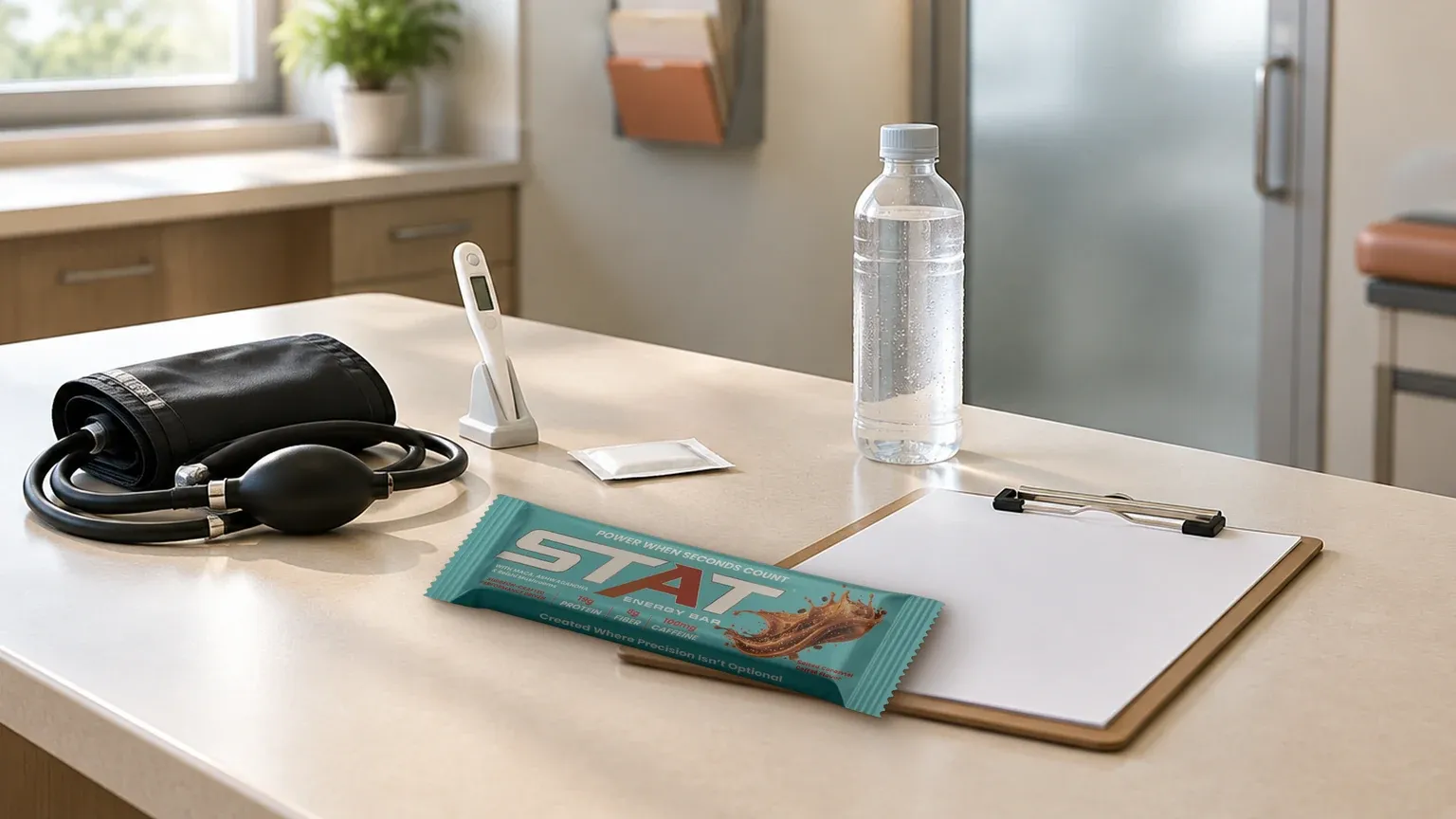
STAT Energy Bar: 100 mg caffeine, 16-19 g protein, 0 g added sugar.
If you want both kinds of energy in one snack, our pick is STAT Energy Bar. It puts the two side by side on purpose: 100mg of caffeine for the awake part, about what's in a strong cup of coffee, and 16 to 19g of protein so it eats like a real snack, with 0g added sugar. See every number on our STAT by the numbers page, or read more about our caffeinated protein bars.
What is STAT Energy Bar made for?
We've all been there: it's hour ten of a twelve, day or night, the coffee went cold an hour ago, and the next page could come any second. It might be a nurse, a resident, a first responder, or anyone pulling a long shift. That's the moment STAT Energy Bar was made for, when seconds count. Each bar has 100mg of caffeine for energy, power and alertness, about what's in a strong cup of coffee, plus 16 to 19g of protein and 0g added sugar. It's caffeine and protein you can eat in two minutes, then get right back to work. Most protein bars have no caffeine at all, but STAT has 100mg, along with maca, ashwagandha, cordyceps and reishi across the three flavors. If you like chocolate, the Chocolate bar uses coffee fruit extract. If you're a coffee person, Peanut Butter Espresso and Salted Caramel Coffee use real coffee plus coffee fruit extract. Keep a few in your bag for the shifts you can't stop for a meal, or browse our caffeine bars.
If you like to rotate flavors, pick up the Variety, 3 Boxes bundle, or shop all three flavors.
Does protein give you energy? FAQ
Does protein give you energy or carbs?
Both supply calories: FDA labeling rules count 4 calories per gram for protein and 4 per gram for carbohydrate. Your body leans on carbohydrate and fat for fuel first and uses protein for fuel to a minor extent, mostly saving it for building and repair. So carbs are the quicker fuel, and protein is the slower, more filling one.
Does protein give you energy like caffeine?
No. Protein gives you energy in the calorie sense, but it doesn't make you feel more awake the way caffeine does. Caffeine has almost no calories and works mainly by blocking adenosine receptors in the brain. Studies show it improves alertness, attention and reaction time.
How long does it take for protein to give you energy?
It depends on the protein and the food around it. In a classic study, whey protein raised blood amino acids quickly but briefly, while casein produced a slower, longer plateau. In another study, a high-protein breakfast kept people fuller 3 to 4 hours later than a high-carb one. Caffeine is faster to notice: blood levels usually peak 30 to 120 minutes after you take it.
Does protein make you tired or give you energy?
We didn't find good evidence that protein itself makes people sleepy. Meal size and makeup matter more: in one study a high-fat, low-carb breakfast left people sleepier 2 to 3 hours later, and the 2026 AASM shift work guideline suggests a snack rather than a full meal during the night shift for adults with shift work disorder who struggle with sleepiness.
Do protein bars give you energy?
Every protein bar gives you energy in the calorie sense, from its protein, carbs and fat. Whether it helps you feel more awake depends on caffeine, and most protein bars have no caffeine at all. Check the ingredient list for coffee, coffee fruit extract or caffeine, and look for a milligram number on the wrapper.
What gives you more energy, protein or carbs?
Gram for gram, the label gives them the same 4 calories. Carbohydrate is the more efficient fuel for working muscle, while protein costs more energy to digest (about 20 to 30% of its calories, vs 5 to 10% for carbohydrate) and tends to keep you full longer. Neither one works like caffeine for alertness.
Should you have protein or caffeine for energy on a night shift?
They do different jobs, so many people use both. Caffeine taken before or during the night shift is one of the options the 2026 AASM guideline suggests for adults with shift work disorder and excessive sleepiness, and the same guideline suggests a snack rather than a full meal overnight. A protein snack can keep hunger in check without a heavy meal.
References
- U.S. Food and Drug Administration. Interactive Nutrition Facts Label: Protein (fact sheet). accessdata.fda.gov
- Code of Federal Regulations, 21 CFR 101.9(c)(1)(i)(B): general factors of 4, 4 and 9 calories per gram for protein, total carbohydrate and total fat. ecfr.gov
- U.S. Department of Agriculture, Agricultural Research Service. FoodData Central, SR Legacy: Beverages, coffee, brewed, prepared with tap water (FDC 171890). fdc.nal.usda.gov
- MedlinePlus (U.S. National Library of Medicine). Nutrition and athletic performance. medlineplus.gov
- Guest NS, VanDusseldorp TA, Nelson MT, et al. International society of sports nutrition position stand: caffeine and exercise performance. Journal of the International Society of Sports Nutrition, 2021;18(1):1. pmc.ncbi.nlm.nih.gov
- McLellan TM, Caldwell JA, Lieberman HR. A review of caffeine's effects on cognitive, physical and occupational performance. Neuroscience and Biobehavioral Reviews, 2016;71:294-312. PMID 27612937. pubmed.ncbi.nlm.nih.gov
- De Feo P, Di Loreto C, Lucidi P, et al. Metabolic response to exercise. Journal of Endocrinological Investigation, 2003;26(9):851-854. PMID 14964437. pubmed.ncbi.nlm.nih.gov
- Westerterp KR. Diet induced thermogenesis. Nutrition & Metabolism, 2004;1(1):5. pmc.ncbi.nlm.nih.gov
- Boirie Y, Dangin M, Gachon P, et al. Slow and fast dietary proteins differently modulate postprandial protein accretion. PNAS, 1997;94(26):14930-14935. PMID 9405716. pubmed.ncbi.nlm.nih.gov
- Boelsma E, Brink EJ, Stafleu A, Hendriks HF. Measures of postprandial wellness after single intake of two protein-carbohydrate meals. Appetite, 2010;54(3):456-464. PMID 20060863. pubmed.ncbi.nlm.nih.gov
- Wells AS, Read NW, Uvnas-Moberg K, Alster P. Influences of fat and carbohydrate on postprandial sleepiness, mood, and hormones. Physiology & Behavior, 1997;61(5):679-686. PMID 9145937. pubmed.ncbi.nlm.nih.gov
- Wright KP Jr, Abbott SM, Ashbrook L, et al. Management of shift work disorder: an American Academy of Sleep Medicine clinical practice guideline. Journal of Clinical Sleep Medicine, published October 24, 2026. PMID 42925456. doi.org/10.1007/s44470-026-00084-w
- r/Nightshift thread, October 23, 2026 (linked above; personal experiences, not evidence).
- STAT Nutrition Facts panels and ingredient lists. statbar.com/stat-by-the-numbers
Related reading
- Snacks for Night Shift Workers: What to Pack Before the Shift
Everything worth eating is closed at 3am. A practical guide to packing night-shift snacks that don't depend on a vending machine.
- Adaptogenic Protein Bar: What Maca, Ashwagandha, Cordyceps and Reishi Are on a Label
The phrase is a search, not a food category. Maca, ashwagandha, cordyceps, and reishi are adaptogens. Listing them is not a health claim, and it is not a milligram dose.
- Adaptogens in food: what the label means (and what it doesn’t)
"Adaptogens in food" is not an FDA food category. Here is the historical meaning of the term, how botanicals show up on packaged-food labels, and what a plant name does (and does not) claim.
Ready to Fuel Up?
Try STAT Bar: the energy bar built for those who can't afford to slow down.
Get shift snack tips in your inbox
Join the STAT Bar newsletter for new flavor drops, subscriber-only deals, and practical shift guides, plus $5 off your first box.
By signing up you agree to receive marketing emails from On Call Foods LLC. You can unsubscribe at any time. See our Privacy Policy and Terms.