
Adaptogens in food: what the label means (and what it doesn’t)
STAT Bar TeamLast reviewed
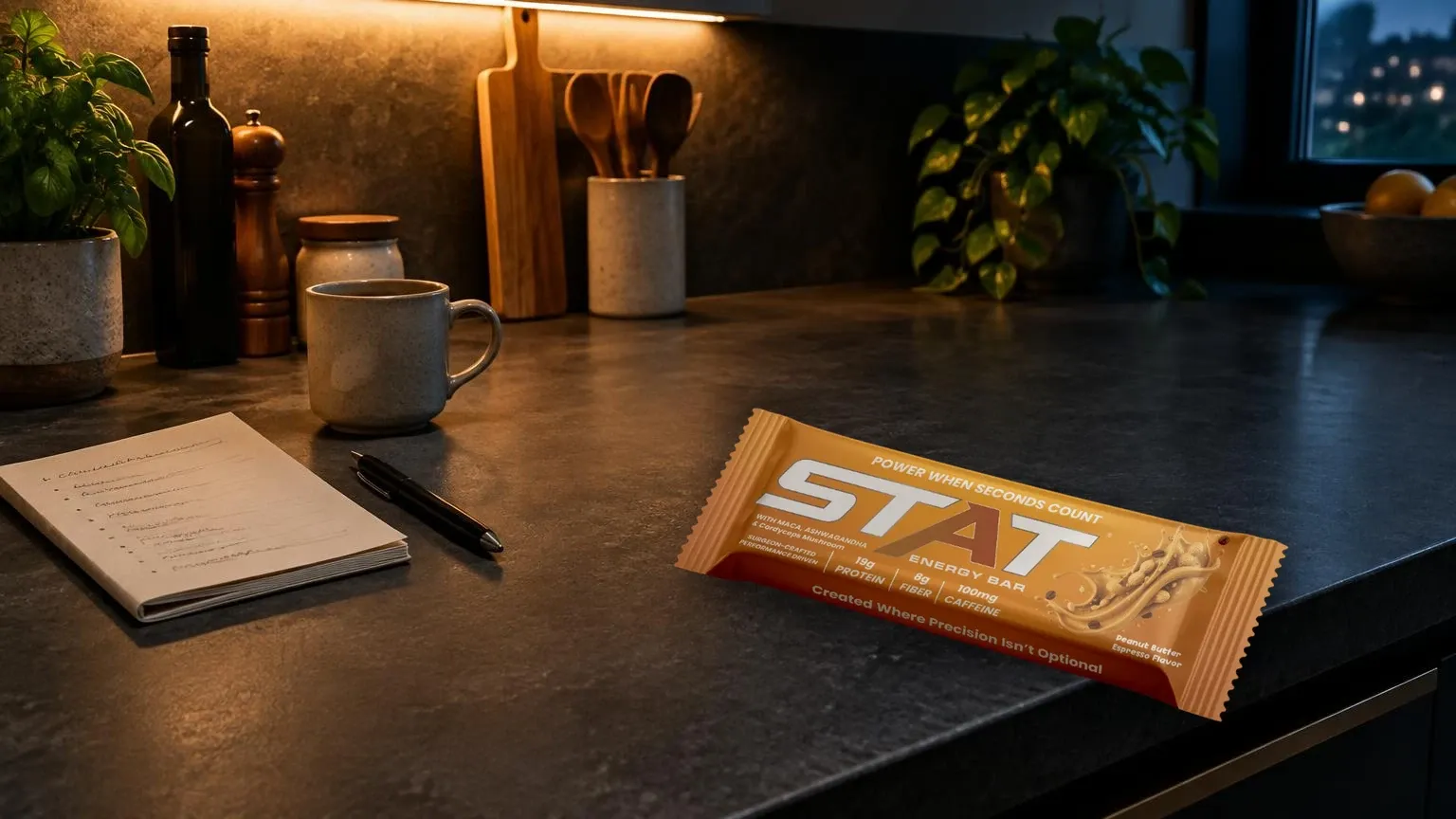
Adaptogens in food is a shopping phrase. It is not an FDA food category. People type it because packaged foods list plant names and front labels use words that sound like a defined class. The useful questions are simpler: What does the ingredient list say? Which facts panel is on the package? What does the label actually claim?
An adaptogens food label can name botanicals without promising a result. The name establishes that an ingredient appears in the recipe. It does not establish a dose, a regulated food category, or a health outcome.
Where the word came from
Panossian and colleagues trace the term adaptogen to Nikolai Lazarev in the mid-twentieth century. Their historical review describes later definitions around metabolic regulation and nonspecific resistance. Liao and colleagues likewise summarize Lazarev's early criteria and the criteria later proposed by Brekhman and Dardymov.
That history describes the evolution of a research concept. It is not a food-label guarantee. A historical definition does not tell you how much of a botanical is in a packaged food, and it does not turn a plant name into a promised effect.
Adaptogens in food is not an FDA food category
FDA does not define conventional foods by the marketing phrase adaptogens in food. Front-of-pack category language can help shoppers find a shelf, but it is not the legal identity of the product. The package still has to tell you whether it is a conventional food or a dietary supplement and list its ingredients under the rules for that product.
Our guide to an adaptogenic protein bar applies the same principle to one narrow snack format. This article is broader. It covers botanicals on packaged-food labels whether the food is a bar, tea, or another conventional product.
How botanicals show up on packaged-food ingredient lists
Under 21 CFR 101.4, ingredients in a food are listed by common or usual name in descending order of predominance by weight. That order tells you where an ingredient sits relative to the others before processing. It does not give you a milligram amount.
A line such as maca root powder, ashwagandha powder, cordyceps mushroom powder, or reishi mushroom powder establishes presence. Unless the package separately prints an amount, the plant name is not a dose. Do not turn its position in the list into invented grams or milligrams.
Nutrition Facts food versus Supplement Facts product
FDA's dietary supplement guidance draws a practical line. A conventional food uses Nutrition Facts. A dietary supplement uses Supplement Facts. Botanicals can be dietary ingredients in supplements, but a product represented as a conventional food is not a dietary supplement simply because its recipe includes a botanical.
Bars and teas can appear in either lane depending on how they are labeled and represented. Read the panel on the package you are holding. Do not import capsule copy onto a snack wrapper. For more label checks, see our guides to no added sugar protein bars and caffeine bars.
What the label does not mean
FDA defines a health claim through a relationship between a substance and a disease or health-related condition. Naming a botanical in an ingredient list does not create that relationship. It says the ingredient is present. It does not promise treatment or prevention.
Structure/function claims and nutrient content claims sit in separate regulatory categories. Those rules do not make every botanical name a function claim. Read the sentence around the ingredient. A plant name is not permission to supply your own claim.
A 30-second label check for adaptogens in food
- Find the ingredient list. Look for the common or usual name of each botanical.
- Remember that ingredients appear in descending order by weight, not as a dose table.
- Do not invent grams or milligrams when the package does not print them.
- Check whether the package uses Nutrition Facts or Supplement Facts.
- Separate an ingredient name from any sentence making a claim about it.
- Reject disease treatment or prevention language attached to a food.
- If caffeine matters, count only printed caffeine milligrams and include other caffeine planned for the day.
What those plant names mean on our wrapper
STAT Energy Bars are conventional foods with Nutrition Facts. Every flavor lists maca root powder and ashwagandha powder. Peanut Butter Espresso also lists cordyceps mushroom powder. Salted Caramel Coffee also lists reishi mushroom powder. These botanicals are ingredients used for flavor depth, not function claims, and the wrappers do not print botanical amounts. Protein sits in the 16-19g range by flavor. Each bar prints 100mg caffeine from coffee fruit extract, 0g added sugars, and calories in the 200-210 range. Power When Seconds Count is our slogan, not a medical or performance promise. Read the ingredient names and the printed numbers separately.
References
- Panossian AG, et al. Evolution of the adaptogenic concept from traditional use to medical systems: Pharmacology of stress and aging. Med Res Rev. 2021. PMID 33103257. pubmed.ncbi.nlm.nih.gov
- Liao LY, et al. A preliminary review of studies on adaptogens: comparison of their bioactivity in TCM with that of ginseng-like herbs used worldwide. Chin Med. 2018. PMID 30479654. pmc.ncbi.nlm.nih.gov
- U.S. Food and Drug Administration. Label Claims for Conventional Foods and Dietary Supplements. fda.gov
- U.S. Food and Drug Administration. Questions and Answers on Dietary Supplements. fda.gov
- Electronic Code of Federal Regulations. 21 CFR 101.4, Food; designation of ingredients. ecfr.gov
Related reading
- What an adaptogenic protein bar actually is (and is not)
The phrase is a search, not a food category. Maca, ashwagandha, cordyceps, and reishi are adaptogens. Listing them is not a health claim, and it is not a milligram dose.
- Zero added sugar on a protein bar is not the same as sugar-free
"No added sugar" is a Nutrition Facts line, not a promise of zero sugar and not a diet food. Here is how FDA and AHA treat that line, and what 2 grams of total sugar still means.
- Sustained energy bars: what the label actually tells you
Front-of-pack energy language is marketing. The panel that matters lists serving size, protein grams, added sugars, calories, and caffeine milligrams when the maker prints them.
Ready to Fuel Up?
Try STAT Bar — the energy bar built for those who can't afford to slow down.
Get shift snack tips in your inbox
Join the STAT Bar newsletter for new flavor drops, subscriber-only deals, and practical shift guides — plus $5 off your first box.
By signing up you agree to receive marketing emails from OnCall Foods LLC. You can unsubscribe at any time. See our Privacy Policy and Terms.