
Caffeine Crash: Why It Happens and How to Avoid It
STAT Bar TeamLast reviewed
A caffeine crash is the slump that can hit as caffeine wears off. Research points to three main drivers: sleep pressure that caffeine masked but never cleared, a body clock pulling you toward sleep (especially on night shift), and, for daily users, mild withdrawal between doses. Steadier, earlier caffeine and protected sleep are the practical fixes.
| Question | What the research found | Source |
|---|---|---|
| Does daily caffeine add alertness? | In 379 adults, regular consumers felt less alert without caffeine, and caffeine returned them to baseline rather than above it | Rogers et al., Neuropsychopharmacology (2010) |
| Does caffeine keep working when sleep is short? | In 48 adults limited to 5 hours in bed, 200mg twice a day held alertness up for the first 3 days but not by day 4 | Doty et al., SLEEP (2017) |
| When does a missed dose show up? | Withdrawal symptoms typically start 12 to 24 hours after the last dose and peak at 20 to 51 hours | Juliano and Griffiths, Psychopharmacology (2004) |
| Is the sugar crash real? | Across 31 studies, carbohydrates were linked to more fatigue and less alertness than placebo within the first hour | Mantantzis et al., Neuroscience and Biobehavioral Reviews (2019) |
What is a caffeine crash?
A caffeine crash is the slump some people feel a few hours after coffee, an energy drink or a pre-workout: heavy eyes, foggy thinking, a short fuse and a sudden urge for another cup. It isn't a medical diagnosis, and you won't find it named as an outcome in the research. What you will find are several well-studied effects that line up with what people describe, and they point to different fixes. That's why "just drink less" or "just drink more" often doesn't help.
A quick refresher on how caffeine works: it blocks adenosine receptors in the brain. Adenosine is widely accepted as one of the body's own sleep-regulating signals, and in animal studies its levels rise during time awake and fall during sleep, according to a 2022 review in the Journal of Sleep Research. Caffeine turns down the "you're tired" message. It doesn't pay off the tiredness behind it. For the timing side of the story, see our guide on how long does caffeine last.
Why does a caffeine crash happen? Four causes the research points to
A review by sleep researchers Timothy Roehrs and Thomas Roth in Sleep Medicine Reviews (2008) concluded that under normal sleep, caffeine is "merely restoring performance degraded by sleepiness." They listed where that sleepiness comes from: too little sleep, circadian schedule reversals, rebound sleepiness, and withdrawal after going overnight without caffeine. Add sugary drinks and you have the four usual suspects.
- 1. Sleep debt showing through. If you started the day or night short on sleep, caffeine covers the gap for a while. When it fades, the sleepiness is still there. In the Doty et al. (2017) lab study, 48 adults spent five nights with only 5 hours in bed. Caffeine (200mg at 8am and noon) kept objective alertness up for the first three days, but the effect was gone by the fourth, and the caffeine group was slower to get back to baseline during recovery sleep.
- 2. Your body clock. Roehrs and Roth list circadian schedule reversals, which is exactly what a night shift is, among the causes of the sleepiness caffeine is working against. The 2022 Journal of Sleep Research review adds that caffeine did not continuously reduce sleepiness across consecutive simulated night shifts.
- 3. Mini-withdrawal between doses. If you use caffeine every day, the gap between doses can be the crash. A review of 57 experimental studies by Juliano and Griffiths (2004) validated ten withdrawal symptoms, including headache, fatigue, decreased energy, decreased alertness, drowsiness and difficulty concentrating. The 2022 review goes further, suggesting the extra sleepiness seen with daily caffeine "may mirror a state of withdrawal, which regularly comes to light within the 24-h cycle."
- 4. The sugar riding along. Many caffeinated drinks are also sweet. That's a separate effect, covered below.
What about the popular version, where adenosine "piles up" behind the blocked receptors and floods back the moment caffeine wears off? It's a simplification. Some animal research suggests the adenosine system adapts to daily caffeine, but other studies don't, and the 2022 review closes with a list of open questions about exactly how adenosine and caffeine regulate sleep. The useful part holds either way: the sleep pressure you built while caffeinated is still waiting when the caffeine fades.
Is a caffeine crash real? What the studies actually measured
These are the studies that come closest to answering the question, side by side.
| Study | Who | What they did | What they found | Limits |
|---|---|---|---|---|
| Roehrs and Roth, 2008 | Review of lab and population studies | Summarized caffeine's effects on sleep and daytime sleepiness | With habitual sleep, caffeine mostly restores performance lost to sleepiness | A review; no new data |
| Juliano and Griffiths, 2004 | 57 experimental and 9 survey studies | Tested which withdrawal symptoms hold up | Ten validated symptoms; onset 12 to 24 hours, peak 20 to 51 hours, lasting 2 to 9 days | About stopping caffeine, not a same-day dip |
| Sigmon et al., 2009 | 16 regular caffeine users | At least 14 days on 400mg a day and 14 days on placebo, double-blind | 24 hours without caffeine raised ratings of tired, fatigue and sluggish; "complete" tolerance to subjective effects; almost no evidence of net effects from daily use | Small; one fairly high daily dose |
| Rogers et al., 2010 | 379 adults (217 medium or high consumers) | 16 hours without caffeine, then 100mg plus 150mg or placebo | Placebo lowered alertness in regular consumers; caffeine brought it back to baseline, "no net benefit" | Overnight abstinence design |
| Doty et al., 2017 | 48 healthy good sleepers | Five nights of 5 hours in bed; 200mg or placebo at 8am and noon | Alertness held for 3 days, not by day 4; slower recovery afterward | Lab setting; daytime doses |
| Lara et al., 2019 | 11 active adults | 3mg per kg of body weight daily for 20 days | Cycling power boost lasted about 15 to 18 days, then progressively shrank | Exercise performance, not sleepiness |
| Mantantzis et al., 2019 | 31 studies, 1,259 participants | Meta-analysis of carbohydrates and mood | More fatigue and less alertness than placebo within the first hour | About carbohydrates, not caffeine |
Our read: none of these seven papers measured a "caffeine crash" by name, and only one followed caffeine across several days of short sleep. Put together, though, they explain the feeling well. For a daily user, much of what caffeine does is reverse the dip from the last missed dose, so the dip between doses is real and predictable. For anyone running short on sleep, caffeine is a bridge, and Doty's data suggest the bridge gets shorter after a few days. The crash is usually one of those two things, sometimes with a sugar slump on top.
"Coffee doesn't work anymore": tolerance and the crash
This is one of the most common caffeine complaints online right now. An October 2 post on X that simply said "coffee doesnt even work bru" drew more than 700 likes. A night worker wrote on October 7 that "15 years of night shift has made me virtually immune to caffeine." And when an October 19 r/caffeine thread asked daily drinkers whether they still feel the boost, one reply called caffeine "more like a daily requirement to prevent me crashing out," and another said, "Energy boost? Not unless it's the first one of the day." Those are personal experiences, not evidence, but they match the research surprisingly well.
- Tolerance is real. Sigmon's daily users showed "complete" tolerance on subjective measures, and in Lara's 20 day study the performance boost faded after about two and a half weeks. The September 2026 AASM shift work guideline also notes "some evidence that individuals can develop tolerance to the central and peripheral effects of caffeine with regular use."
- But "immune" overstates it. The 2022 Journal of Sleep Research review notes that an extra dose during regular use can still produce an acute drop in subjective sleepiness. Caffeine still does something. It just stops feeling like a lift, because much of it goes to getting you back to normal.
- Expectation plays a part too. A meta-analysis published October 20, 2026 in the Journal of the International Society of Sports Nutrition pooled 17 studies and found that a placebo described as caffeine improved sport performance by a small to moderate amount. The authors rated the evidence quality as low, and it measured sport performance, not sleepiness, but it's a reminder that how caffeine feels isn't only chemistry.
Caffeine crash vs sugar crash
They're different things that often arrive together. The "sugar rush" idea took a hit in a 2019 meta-analysis of 31 studies and 1,259 participants: carbohydrates showed no mood benefit at any time point, and they were linked to more fatigue and less alertness than placebo within the first hour. So if your 3pm or 3am slump follows a large sweetened coffee drink or a sugary energy drink, the sugar may be doing some of the crashing. Reading the label for both numbers, caffeine in milligrams and added sugar in grams, is the simplest way to know what you're working with.
How to avoid a caffeine crash
No trick removes the underlying sleepiness, but the research above suggests a plan that makes the dip smaller and more predictable.
- Treat sleep as the fix and caffeine as the bridge. Doty's study is the clearest warning that caffeine can't carry several short nights in a row.
- Keep your pattern steady. Withdrawal symptoms typically start 12 to 24 hours after the last dose, so a much later or skipped first dose can feel like a crash. Our read: if your caffeine on days off looks very different from your work days, expect the gap to show up.
- Know your milligrams. Brewed coffee varies by cup and by shop. Products that print caffeine in milligrams make it easier to keep doses consistent.
- Watch the sugar riding along. See the meta-analysis above.
- Protect the next sleep. In a 2013 sleep study, 400mg of caffeine taken even 6 hours before bed significantly disrupted sleep at home. Poorer sleep tonight sets up tomorrow's crash.
- Eat when you can. Caffeine has no calories, so it can't stand in for a meal. When a shift runs long, pair it with real food or a protein snack when you can.
How to avoid a caffeine crash on night shift
Most crash advice assumes a 9 to 5, where the answer is "no coffee after lunch." On nights, your bedtime is the morning, so the plan flips. The American Academy of Sleep Medicine's 2026 shift work disorder guideline suggests caffeine before or during the night shift for adults with shift work disorder (a conditional recommendation with very low certainty evidence). Its research notes add that caffeine appears to be more disruptive to daytime sleep than to nighttime sleep, while caffeine taken near the beginning of the night shift appears to have less impact on daytime sleep. AASM's patient site, SleepEducation.org, puts it plainly: use moderate amounts of caffeine to stay alert on the job, and stop in the later portions of your shift so it doesn't disrupt your sleep.
- Front-load it. Have your caffeine near the start of the shift, when the guideline suggests it costs your day sleep the least.
- Expect the small-hours dip. When you hit the wall deep into the night, it may be your body clock plus hours awake, not "the coffee wore off." Another big dose late in the shift trades a little alertness now for worse sleep later.
- Try a pre-shift nap. AASM also suggests a nap before the night shift. If you want the combination, our coffee nap guide covers what was actually tested.
- Plan the stretch of nights. Our read: since caffeine's effect faded after a few short nights in the Doty study, the third or fourth night in a row is when protecting day sleep matters most.
For the full night-shift plan (naps, light, caffeine timing and a cutoff before day sleep), see our guide on how to stay awake on night shift, and for what to pack, our healthy night shift snacks guide.
A crash-aware caffeine checklist, with STAT as the example
Whatever you use for caffeine, these are the label details that make a steady routine easier. Here's how a STAT Energy Bar reads against them.
| What to check | Why it helps | STAT example |
|---|---|---|
| Caffeine printed in milligrams | Lets you keep doses steady and time your last one | 100mg per bar, every flavor |
| Caffeine source named | Tells you exactly what you're having | Chocolate: coffee fruit extract. Peanut Butter Espresso and Salted Caramel Coffee: real coffee plus coffee fruit extract |
| Added sugar | Shows what else comes with your caffeine | 0g added sugar |
| Comes with food | Caffeine alone has no calories | 16-19g protein and 200-210 calories per bar |
You can see every number on our STAT by the numbers page, or shop STAT Energy Bars.
Where STAT fits when seconds count
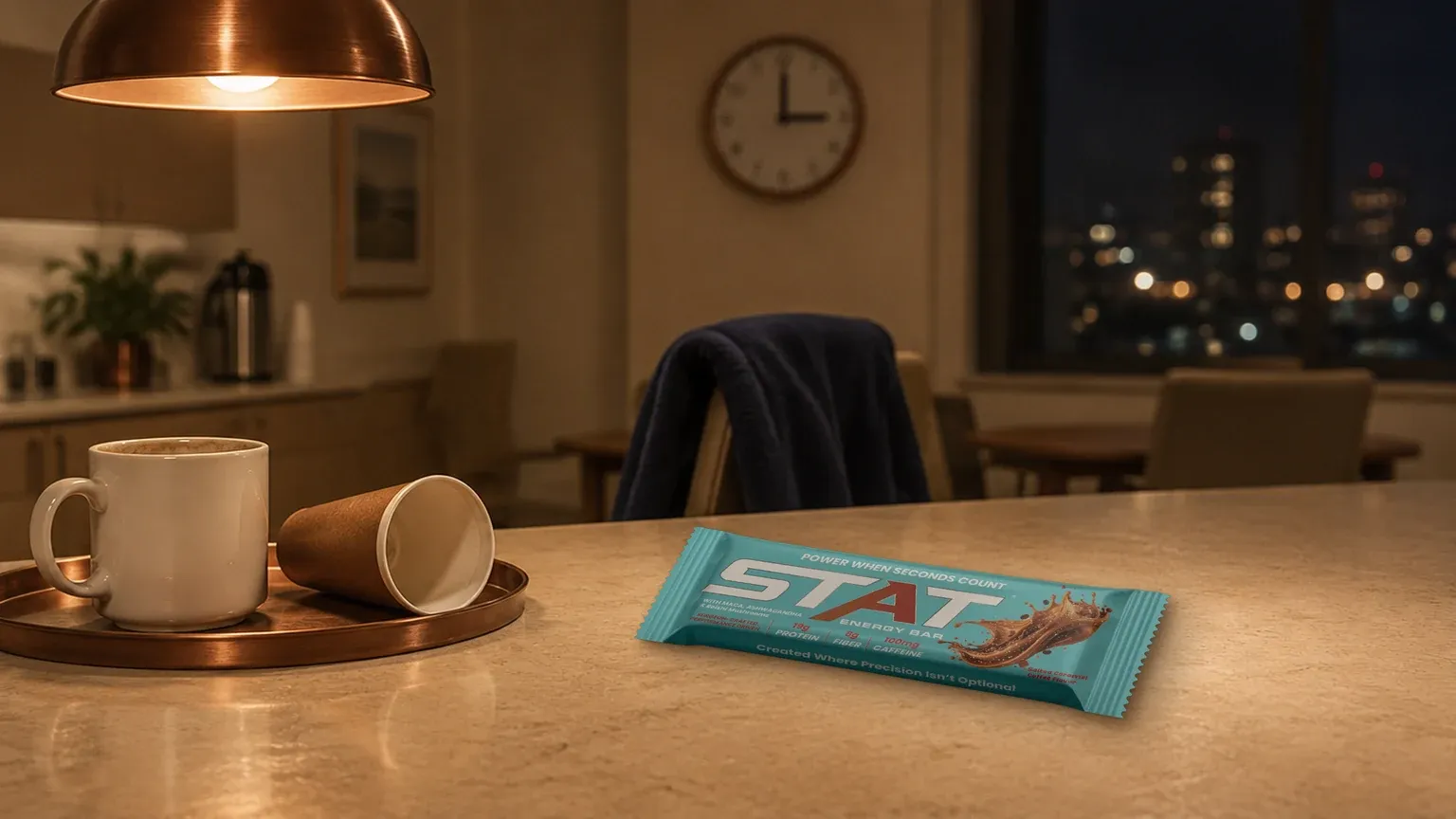
We've all been there: it's 4am, the coffee pot is empty, there are three hours left on your shift, and the next call could come any second. That's the moment STAT Energy Bar was made for, when seconds count. Each bar has 100mg of caffeine for energy, power and alertness, about what's in a strong cup of coffee, plus 16 to 19g of protein and 0g added sugar. It's caffeine and protein you can eat in two minutes, then get right back to work. Most protein bars have no caffeine at all, but STAT has 100mg, along with maca, ashwagandha, cordyceps and reishi across the three flavors.
If you like chocolate, the Chocolate bar (16g protein) uses coffee fruit extract. If you're a coffee person, Peanut Butter Espresso (17g) and Salted Caramel Coffee (19g) use real coffee plus coffee fruit extract. And because the 100mg is printed on every wrapper, you always know exactly what you're having. Tuck a couple in your locker for the nights you can't stop for a meal.
Shop all three flavors, try one of each with the Variety 3-Pack, or subscribe and save 10% on your regular box. Orders over $50 ship free. Want the background on caffeine bars? Start with our caffeine protein bar page. Power when seconds count.
Caffeine crash FAQ
What is a caffeine crash?
A caffeine crash is the drop in energy and alertness some people feel as caffeine wears off. It is not a medical diagnosis. Research points to a few drivers: sleepiness that caffeine was masking, a body clock pushing toward sleep, and, in daily users, the early stage of withdrawal between doses.
Is a caffeine crash real?
The feeling is real, but no study we found measures a caffeine crash by that name. What studies do show is that regular users feel more tired when a usual dose is missed, and that caffeine mostly restores alertness rather than adding to it once you use it every day (Rogers et al., 2010; Sigmon et al., 2009).
How long does a caffeine crash last?
It depends on the cause. If the slump is sleepiness that caffeine was covering, it lasts until you sleep. If it is withdrawal, a review of 57 experimental studies found symptoms typically start 12 to 24 hours after the last dose, peak at 20 to 51 hours, and last 2 to 9 days.
Is a caffeine crash the same as caffeine withdrawal?
Not exactly, but they overlap. Withdrawal is the well-studied pattern after a regular user stops or delays caffeine, with fatigue, drowsiness, decreased alertness and headache among the validated symptoms. A same-day crash can be early withdrawal, sleepiness that was there all along, or both.
What is the difference between a caffeine crash and a sugar crash?
A sugar crash is about the carbohydrates, not the caffeine. A 2019 meta-analysis of 31 studies found carbohydrates were linked to more fatigue and less alertness than placebo within the first hour. A sweet caffeinated drink can stack both effects, which is one reason to read the added sugar line.
Why doesn't coffee work on me anymore?
Tolerance is a likely part of it. In a 20 day study, caffeine's boost to cycling power faded after about 15 to 18 days, and another study found complete tolerance to caffeine's subjective effects in daily users. A 2022 review notes an extra dose can still reduce sleepiness, so caffeine has not stopped working entirely.
How do I avoid a caffeine crash on night shift?
AASM's shift work guidance points to moderate caffeine early in the shift and stopping in the later part so it does not disrupt day sleep. Its 2026 guideline adds that caffeine near the start of a night shift appears to have less impact on daytime sleep. Protect that day sleep, since caffeine cannot replace it.
References
- Roehrs T, Roth T. Caffeine: sleep and daytime sleepiness. Sleep Medicine Reviews, 2008. PMID 17950009. pubmed.ncbi.nlm.nih.gov
- Juliano LM, Griffiths RR. A critical review of caffeine withdrawal: empirical validation of symptoms and signs, incidence, severity, and associated features. Psychopharmacology, 2004. doi.org/10.1007/s00213-004-2000-x
- Sigmon SC, Herning RI, Better W, Cadet JL, Griffiths RR. Caffeine withdrawal, acute effects, tolerance, and absence of net beneficial effects of chronic administration. Psychopharmacology, 2009. pmc.ncbi.nlm.nih.gov
- Rogers PJ, Hohoff C, Heatherley SV, et al. Association of the anxiogenic and alerting effects of caffeine with ADORA2A and ADORA1 polymorphisms and habitual level of caffeine consumption. Neuropsychopharmacology, 2010. doi.org/10.1038/npp.2010.71
- Doty TJ, So CJ, Bergman EM, et al. Limited efficacy of caffeine and recovery costs during and following 5 days of chronic sleep restriction. SLEEP, 2017. doi.org/10.1093/sleep/zsx171
- Lara B, Ruiz-Moreno C, Salinero JJ, Del Coso J. Time course of tolerance to the performance benefits of caffeine. PLoS One, 2019. pmc.ncbi.nlm.nih.gov
- Mantantzis K, Schlaghecken F, Sünram-Lea SI, Maylor EA. Sugar rush or sugar crash? A meta-analysis of carbohydrate effects on mood. Neuroscience and Biobehavioral Reviews, 2019. doi.org/10.1016/j.neubiorev.2019.03.016
- Reichert CF, Deboer T, Landolt HP. Adenosine, caffeine, and sleep-wake regulation: state of the science and perspectives. Journal of Sleep Research, 2022. doi.org/10.1111/jsr.13597
- Hurst P, Hanssen J, Marticorena F, et al. Placebo effects of caffeine on sport performance: a systematic review and meta-analysis. Journal of the International Society of Sports Nutrition, 2026. doi.org/10.1080/15502783.2026.2747142
- Drake C, Roehrs T, Shambroom J, Roth T. Caffeine effects on sleep taken 0, 3, or 6 hours before going to bed. Journal of Clinical Sleep Medicine, 2013. PMID 24235903. pubmed.ncbi.nlm.nih.gov
- American Academy of Sleep Medicine. Management of Shift Work Disorder: An American Academy of Sleep Medicine Clinical Practice Guideline (guideline document posted September 2026). foundation.aasm.org
- American Academy of Sleep Medicine. Shift Work. SleepEducation.org. sleepeducation.org
- Posts on X, October 2 and 7, 2026, and an r/caffeine thread, October 19, 2026 (linked above; personal experiences, not evidence).
- STAT Nutrition Facts panels and ingredient lists. statbar.com/stat-by-the-numbers
Related reading
- How long does caffeine last? A shift worker's timing guide
Caffeine peaks within two hours and half of it can still be on board five hours later. A September 2026 review of 32 sleep studies shows why that tail matters most for people who sleep after a night shift.
- How Much Caffeine Is in a Protein Bar?
Most protein bars have none. The caffeinated ones that print a dose run from 5 to 100mg per bar. Here's how to find the number on a label and how it lines up with a cup of coffee.
- Caffeine Before a Workout: Timing, Pre-Workout Labels, and Caffeinated Protein Bars
Caffeine before a workout is usually taken 30 to 60 minutes ahead. Here is how to time it, why a caffeinated protein bar reads Nutrition Facts while a pre-workout reads Supplement Facts, how to add the milligrams to your coffee, and what caffeinated protein bars cost in bulk.
Ready to Fuel Up?
Try STAT Bar: the energy bar built for those who can't afford to slow down.
Get shift snack tips in your inbox
Join the STAT Bar newsletter for new flavor drops, subscriber-only deals, and practical shift guides, plus $5 off your first box.
By signing up you agree to receive marketing emails from On Call Foods LLC. You can unsubscribe at any time. See our Privacy Policy and Terms.