
Coffee Naps: Do They Work on Night Shift?
STAT Bar TeamLast reviewed
A coffee nap is caffeine followed right away by a nap of about 15 to 20 minutes, timed so you wake as the caffeine starts working. Small studies found nap plus caffeine beat either one alone on alertness tests, including at night. The evidence is thin, and AASM's 2026 shift work guideline found no eligible trials of the drink-then-nap sequence.
| Question | What the research found | Source |
|---|---|---|
| Does the combo beat caffeine alone? | In 12 sleepy adults, 200mg caffeine plus a nap under 15 minutes reduced simulator driving incidents more than caffeine alone | Reyner and Horne, Psychophysiology (1997) |
| Has it been tested with night shift workers? | Yes, as an evening nap before the shift plus caffeine on shift: best for alertness in a 68-person lab study, and better performance and less sleepiness in 53 real night or rotating shift workers | Schweitzer et al., SLEEP (2006) |
| What about a coffee nap at 3am? | In a 6-person pilot, 200mg caffeine right before a 30 minute nap opportunity at 3:30am improved attention and fatigue for 45 minutes versus decaf | Centofanti et al., Chronobiology International (2020) |
| What do sleep doctors recommend? | A nap plus caffeine before the night shift, as a conditional suggestion with very low certainty evidence, for adults with shift work disorder | AASM shift work disorder guideline, SLEEP abstract (2026) |
What is a coffee nap?
A coffee nap, also called a caffeine nap, is exactly what it sounds like: you have your caffeine, then lie down right away for a short nap. The trick is timing. Sleep experts quoted by Real Simple on October 19, 2026 put caffeine's onset at roughly 15 to 45 minutes, so a 15 to 20 minute nap ends about when the caffeine is starting to work. Keeping the nap short also lowers the chance of waking from deeper sleep and feeling groggy for a while afterward, which sleep researchers call sleep inertia.
It's one idea inside the bigger night-shift playbook. For the full plan (naps, light, caffeine timing and a cutoff before day sleep), see our guide on how to stay awake on night shift.
Why coffee naps keep coming up right now
The coffee nap keeps resurfacing online. On October 18, 2026, one post on X complained that coffee made them so sleepy they took a nap anyway: "useless caffeine!!!" The replies turned into a crash course. One reply said, "That's a coffee nap!" and called it a "danger nap" for 20-ish minutes before something. Another said caffeine takes too long to kick in, so they nap right after drinking coffee. Not everyone is a fan: one person on X said a caffeine nap "ruined my sleep schedule every time." A day later, Real Simple ran its explainer.
Night nurses talk about short break naps too. In an October 19 r/nursing thread on ways night shifters take care of themselves on shift, one nurse described eating fast, putting in earbuds and taking a twenty-minute nap in the break room, while another admitted, "I do not know how to nap." Those are personal stories, not evidence. So what does the research actually show?
Do coffee naps work? What the studies actually tested
Four studies come up again and again in coffee nap coverage. Here is what each one really did, side by side.
| Study | Who and when | What they did | What they found | Limits |
|---|---|---|---|---|
| Hayashi et al., 2003 | 10 young adults, early afternoon | 200mg caffeine, then a 20 minute nap | Caffeine plus nap was the most effective of five conditions for sleepiness and performance, lasting the full hour measured | Daytime only; 10 people |
| Reyner and Horne, 1997 | 12 sleepy adults, afternoon driving simulator | 200mg caffeine plus a nap under 15 minutes during a 30 minute break | The combo reduced driving incidents more than caffeine alone; even light "nonsleep dozing" naps helped | Simulator; afternoon; 12 people |
| Schweitzer et al., 2006 | 68 adults in a lab and 53 night or rotating shift workers in the field | An evening nap before the shift, plus caffeine on shift | Nap, caffeine and both all helped in the lab; the combination was best for alertness. In the field, it improved reaction-time performance and lowered sleepiness | The nap came before the shift, not right after the caffeine |
| Centofanti et al., 2020 | 6 adults, simulated night shift, 3:30am | 200mg caffeine or decaf right before a 30 minute nap opportunity | Better vigilant attention and less fatigue for 45 minutes after, versus decaf | Pilot study; 6 people who were not shift workers |
Our read: add those up and you get about 96 people tested in labs or simulators and 53 tested on real night shifts. Only one of the four studies included real shift workers, and in that one the nap came before the shift rather than right after the caffeine. Among these four, the classic drink-then-nap move at night was tested only in the six-person pilot. That doesn't mean coffee naps don't work. It means the evidence is promising and small. The researchers behind the 3:30am pilot said as much: they concluded a caffeine nap "may be useful" for shift workers who nap on nights.
The idea traces back to driving-simulator work by sleep researchers J.A. Horne and L.A. Reyner. In a 1996 study, they found a nap under 15 minutes and 150mg of caffeine each reduced sleepiness on their own, and that "taking just a break proved ineffective." Their 1997 follow-up combined the two.
What the 2026 AASM shift work guideline says
The biggest recent development comes from sleep medicine itself. The American Academy of Sleep Medicine's clinical practice guideline on managing shift work disorder, summarized in a SLEEP 2026 abstract and posted as a full guideline document in September 2026, includes three relevant suggestions for adults with shift work disorder:
- Caffeine before or during the night shift, over no caffeine. Its remark: caffeine close to bedtime can disrupt sleep.
- A nap before the night shift, over no nap. Its remark: grogginess right after a nap can temporarily lower performance, so allow time for it to wear off before driving or other safety-sensitive tasks.
- A nap plus caffeine before the night shift, over neither.
All three are conditional recommendations with very low certainty evidence. The guideline document is unusually candid about the combination: it rests on a single trial, the Schweitzer study above, with "a nap preceding night shift followed by caffeine administration." It adds that "no studies utilizing this caffeine-nap strategy were eligible" for its review, so the task force could not comment on the drink-then-nap version for shift work. It also notes that caffeine taken before a nap might be used during a shift and can reduce the impact of post-nap grogginess. In other words, the pre-shift nap plus caffeine has the official nod. The mid-shift coffee nap is plausible and lightly studied.
AASM's patient site, SleepEducation.org, puts the basics simply: if possible, nap during a break or before reporting for a night shift, because "even a nap of just 20 to 30 minutes can improve your alertness on the job."
How to time a coffee nap on night shift
Most coffee nap advice is written for office hours. Real Simple's experts suggest an early afternoon coffee nap, around 1 to 2pm, and avoiding one after 3pm so it doesn't interfere with nighttime sleep. On nights, your "bedtime" is the morning, so the clock flips. Here is how the research settings map onto a night shift:
- Before the shift (best supported). An evening nap before you leave for work, with caffeine on shift, is the setup Schweitzer tested and AASM suggests.
- On a mid-shift break (lightly studied). The 3:30am pilot used caffeine right before a 30 minute nap opportunity. If your unit allows break naps, this is the closest research match, though it is the least tested.
- Late in the shift (skip it). AASM's shift work tips say to stop caffeine in the later part of your shift so it doesn't disrupt the sleep that follows. For the timing math, see how long does caffeine last.
A few practical notes from the studies themselves:
- Keep it short. The studies used nap windows from under 15 minutes up to 30 minutes. Set an alarm.
- Give yourself a few minutes before a critical task. AASM's guideline document gives more than 20 minutes as an example of time to recover from post-nap grogginess.
- Don't worry if you don't fully fall asleep. In the 1997 study, light "nonsleep dozing" still counted.
- Follow your workplace rules. Nap policies vary by employer and unit.
A coffee nap also isn't a substitute for day sleep. If you're very sleepy on most shifts even after a full day's sleep, AASM's site says an accredited sleep center can help.
Coffee nap vs power nap vs coffee alone
In the small studies above, caffeine plus a short nap tended to edge out either one alone. A plain short nap still helped on its own in Schweitzer's lab study and in AASM's guidance. And caffeine isn't the only add-on researchers have tried: in the 2003 Hayashi study, one minute of bright light right after a 20 minute nap was about as effective as caffeine for sleepiness, though not for performance, and washing your face gave a mild, short-lived lift. If you are already past your caffeine cutoff, a short nap followed by bright light is an option one small study supports.
Where STAT fits on a long night
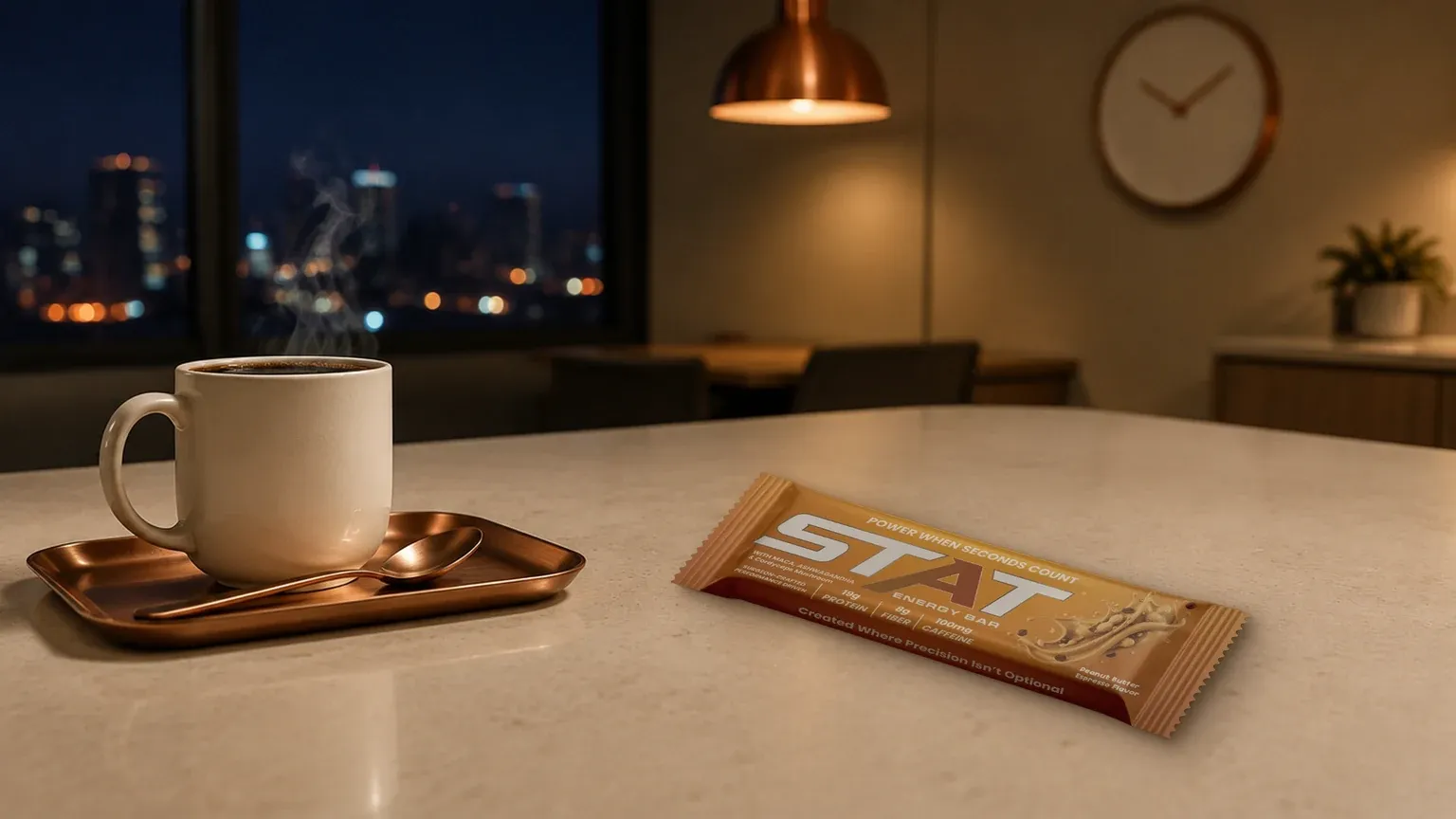
We've all been there: it's 3am, there are six hours left on your shift, and the next call could come any second. That's the moment STAT Energy Bar was made for: power when seconds count. Each bar has 100mg of caffeine for alertness and energy, about what's in a cup of coffee, plus 16 to 19g of protein and 0g added sugar. It's caffeine and protein you can eat in two minutes, then get right back to work. Most protein bars have no caffeine at all, but STAT has 100mg, along with maca, ashwagandha, cordyceps and reishi across the three flavors, in for flavor. If you like chocolate, the Chocolate bar uses coffee fruit extract. If you're a coffee person, Peanut Butter Espresso and Salted Caramel Coffee use real coffee plus coffee fruit extract. Tuck a couple in your locker for the nights you can't stop for a meal, and find all three on the STAT shop.
Naps are one part of getting through nights. Food is another, and on a busy shift you don't always get to stop for a meal. That's where STAT Energy Bar comes in. Chocolate has 16g of protein, Peanut Butter Espresso 17g and Salted Caramel Coffee 19g.
Shop all three flavors, grab the Variety 3-Pack, or read more about our caffeine protein bar. Building a night-shift bag? Our guide to healthy night shift snacks and our night shift eating schedule cover the rest. Power when seconds count.
Coffee nap FAQ
What is a coffee nap?
A coffee nap is caffeine followed right away by a short nap, usually about 15 to 20 minutes. The idea is that you fall asleep before the caffeine starts working and wake up as it does. Sleep experts quoted by Real Simple in October 2026 put caffeine's onset at roughly 15 to 45 minutes.
Do coffee naps actually work?
Small studies say the combination can beat caffeine alone or a nap alone on alertness tests. A 2003 daytime study of 10 adults and a 1997 driving simulator study of 12 adults both found caffeine plus a short nap worked best. The evidence is real but thin, and most participants were young, healthy volunteers.
How long should a coffee nap be?
Most advice says about 15 to 20 minutes. The studies used nap opportunities from under 15 minutes up to 30 minutes. Longer naps raise the chance of waking from deeper sleep and feeling groggy for a while, which sleep researchers call sleep inertia.
Can you take a coffee nap on night shift?
Researchers have tested it at night. A 2020 pilot gave six adults 200mg of caffeine right before a 30 minute nap opportunity at 3:30am in a simulated night shift and saw better attention and less fatigue for 45 minutes afterward. Follow your workplace's break and nap rules, and keep late-shift caffeine away from your day sleep.
What does the AASM say about naps and caffeine on night shift?
The American Academy of Sleep Medicine's 2026 shift work disorder guideline suggests a nap plus caffeine before the night shift over neither. It is a conditional recommendation with very low certainty evidence, based on a single trial, and the guideline says no studies of the drink-then-nap sequence were eligible for its review.
What if I can't fall asleep during a coffee nap?
In the 1997 driving simulator study, naps made up of light nonsleep dozing were still effective, so the window may be worth taking even if you never fully drop off. That is one small study. Many night workers say short break naps take practice.
Is a coffee nap better than a regular power nap?
In small studies, caffeine plus a nap edged out a nap alone. One 2003 study also found a minute of bright light right after a 20 minute nap was about as effective as caffeine for sleepiness, though not for performance. A plain short nap still helps, according to AASM's shift work guidance.
References
- Hayashi M, Masuda A, Hori T. The alerting effects of caffeine, bright light and face washing after a short daytime nap. Clinical Neurophysiology, 2003. PMID 14652086. pubmed.ncbi.nlm.nih.gov
- Horne JA, Reyner LA. Counteracting driver sleepiness: effects of napping, caffeine, and placebo. Psychophysiology, 1996. doi.org/10.1111/j.1469-8986.1996.tb00428.x
- Reyner LA, Horne JA. Suppression of sleepiness in drivers: combination of caffeine with a short nap. Psychophysiology, 1997. doi.org/10.1111/j.1469-8986.1997.tb02148.x
- Schweitzer PK, Randazzo AC, Stone K, Erman M, Walsh JK. Laboratory and field studies of naps and caffeine as practical countermeasures for sleep-wake problems associated with night work. SLEEP, 2006. doi.org/10.1093/sleep/29.1.39
- Centofanti S, Banks S, Coussens S, et al. A pilot study investigating the impact of a caffeine-nap on alertness during a simulated night shift. Chronobiology International, 2020. doi.org/10.1080/07420528.2020.1804922
- American Academy of Sleep Medicine. Management of Shift Work Disorder: clinical practice guideline (abstract 0778). SLEEP, Volume 49, Supplement 1, 2026. doi.org/10.1093/sleep/zsag091.0777
- American Academy of Sleep Medicine. Management of Shift Work Disorder: An American Academy of Sleep Medicine Clinical Practice Guideline (guideline document posted September 2026). foundation.aasm.org
- American Academy of Sleep Medicine. Shift Work. SleepEducation.org. sleepeducation.org
- The Surprising Reason You Should Drink Caffeine Before Taking a Nap, According to Sleep Experts. Real Simple, October 19, 2026. realsimple.com
- Posts on X, October 17 and 18, 2026, and an r/nursing thread, October 19, 2026 (linked above; personal experiences, not evidence).
- STAT Nutrition Facts panels and ingredient lists. statbar.com/stat-by-the-numbers
Related reading
- Snacks for allied health workers: therapists, techs, pharmacists and more
Allied health jobs share one schedule problem: a list or board that rarely protects a meal, and no food in clinical areas. Shared rules first, then a section for each role.
- Protein bars for shift workers: what to look for on nights
A shift-worker guide to protein bars for nights and 12-hour stretches: what the label must print, how snack-through eating fits the evidence, and how to pack when breaks get interrupted.
- Can a Protein Bar Replace a Meal? A Shift Worker's Value Guide
A protein bar can get you through a missed break, but by the yardsticks in US and EU food rules it is not a meal. Here is what a meal actually needs, what "meal replacement" really means on a label, and how to judge value when protein prices keep climbing.
Ready to Fuel Up?
Try STAT Bar: the energy bar built for those who can't afford to slow down.
Get shift snack tips in your inbox
Join the STAT Bar newsletter for new flavor drops, subscriber-only deals, and practical shift guides, plus $5 off your first box.
By signing up you agree to receive marketing emails from On Call Foods LLC. You can unsubscribe at any time. See our Privacy Policy and Terms.