
How Much Caffeine Is in a Cup of Coffee? A Chart by Brew, Cup Size and Bean
STAT Bar TeamLast reviewed by Mikael Petrosyan, MD, founder
An 8 oz cup of brewed coffee has about 95 mg of caffeine, based on USDA FoodData Central. Real cups vary a lot. Lab tests of coffee shop and home-brewed cups range from roughly 60 mg to well over 200 mg, because cup size, the amount of coffee used, brew method and bean type all change the number.
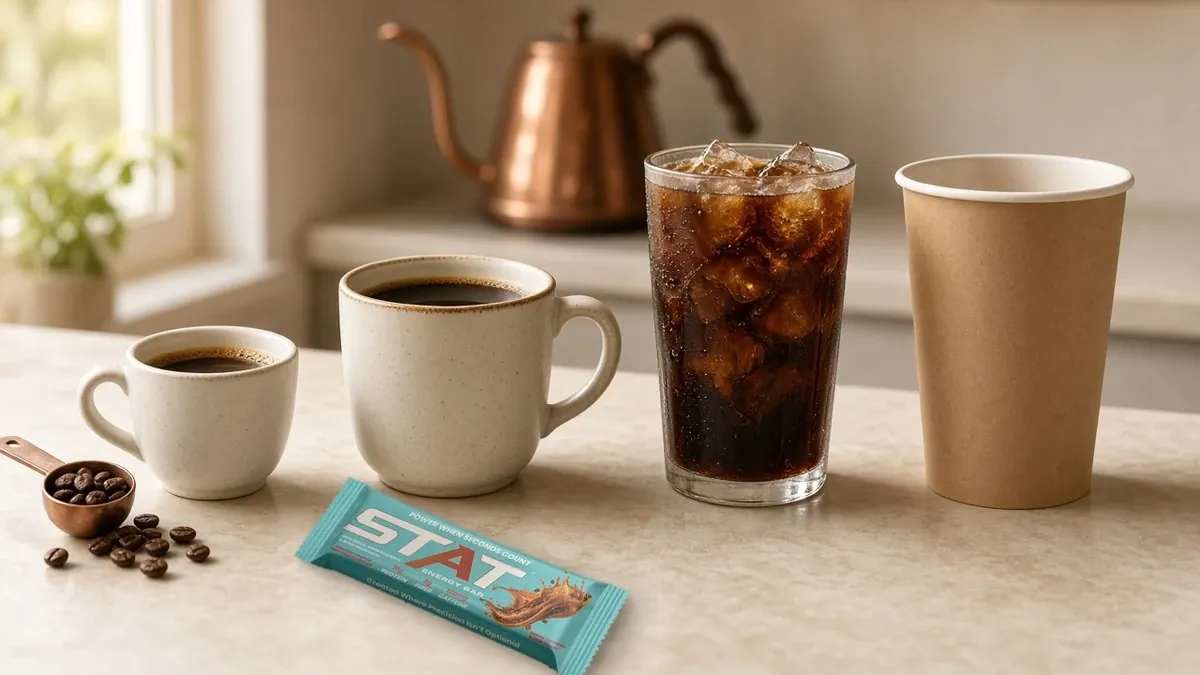
Caffeine in a cup of coffee: four numbers to know
| Coffee | Serving | Caffeine | Source |
|---|---|---|---|
| Brewed (drip) coffee | 8 fl oz cup | About 95 mg | USDA FoodData Central |
| Instant coffee, made with water | 8 fl oz cup | About 62 mg | USDA FoodData Central |
| Brewed decaf coffee | 8 fl oz cup | About 2 mg | USDA FoodData Central |
| Coffee shop brewed coffee | 16 fl oz cup | 188 mg on average (lab-tested) | McCusker et al., 2003 |
How much caffeine is in a cup of coffee? The chart
USDA FoodData Central, the U.S. Department of Agriculture's food composition database, lists caffeine per 100 grams of each coffee along with standard serving weights. We converted those entries to the cups people actually pour and rounded to the nearest milligram. Where USDA has no entry, like cold brew and coffee shop cups, we used the lab studies named in the last column.
| Coffee type | Serving | Caffeine | Per fl oz | Source |
|---|---|---|---|---|
| Brewed (drip) coffee | 8 fl oz | About 95 mg | About 12 mg | USDA FoodData Central |
| Brewed coffee, coffee shop | 16 fl oz | 188 mg on average | About 12 mg average | McCusker et al., 2003 |
| Cold brew, store-bought | 12 fl oz | About 207 mg | About 17 mg | Lane et al., 2017, as reported by Fuller and Rao |
| Espresso, single shot | 1 fl oz | About 63 mg | About 63 mg | USDA FoodData Central |
| Espresso, double shot | 2 fl oz | About 126 mg | About 63 mg | USDA FoodData Central |
| Instant coffee, made with water | 8 fl oz | About 62 mg | About 8 mg | USDA FoodData Central |
| Instant coffee powder | 1 teaspoon (about 1 g) | About 31 mg | Not a drink | USDA FoodData Central |
| Brewed decaf | 8 fl oz | About 2 mg | Less than 1 mg | USDA FoodData Central |
| Decaf, coffee shop | 16 fl oz | 0 to 13.9 mg | Less than 1 mg | McCusker et al., 2006 |
Two things stand out. First, a "cup of coffee" in most charts means 8 fluid ounces, which is smaller than many mugs and most coffee shop sizes. Second, the database numbers are averages, and the lab-tested cups in the same table swing by more than a factor of four. Treat any single number as a starting point, not a promise.
If you want to add coffee to the rest of your day's caffeine, our guide to how much caffeine is too much does the full-day math across coffee, tea, soda and energy drinks.
How much caffeine is in 8 oz, 12 oz and 16 oz of coffee?
Brewed coffee in the USDA database works out to about 12 mg of caffeine per fluid ounce. That makes cup size the easiest variable to account for:
| Cup size | Brewed coffee (USDA average) | Instant coffee (USDA average) | Brewed decaf (USDA average) |
|---|---|---|---|
| 6 fl oz | About 71 mg | About 47 mg | About 2 mg |
| 8 fl oz | About 95 mg | About 62 mg | About 2 mg |
| 12 fl oz | About 142 mg | About 93 mg | About 4 mg |
| 16 fl oz | About 189 mg | About 124 mg | About 5 mg |
| 20 fl oz | About 237 mg | About 155 mg | About 6 mg |
So a 12 oz coffee has about one and a half times the caffeine of an 8 oz cup, and a 16 oz coffee has about twice as much, if the brew strength is the same. The lab data lines up: the 16 oz coffee shop cups McCusker and colleagues tested averaged 188 mg, very close to the 189 mg USDA math predicts.
The catch is that brew strength is often not the same. A large travel mug filled from a strong pot can carry more than the chart says, and a weak office pot can carry less.
Why the caffeine in a real cup varies so much
Three lab studies show how wide the spread is once you leave the database and test real coffee:
- The same drink, six days in a row. Researchers at the University of Florida bought the same brewed coffee from the same coffee shop on six consecutive days. The caffeine ranged from 259 to 564 mg per serving. Across all the caffeinated coffees they tested, the range was 58 to 259 mg per serving (McCusker et al., 2003).
- Twenty espressos, sixfold differences. A University of Glasgow team tested 20 commercial espressos and found six-fold differences in caffeine, with the highest single espresso at 322 mg. They pointed to the amount of ground coffee used by the barista as the most likely main cause (Crozier et al., 2012).
- Home-style brewing, measured in 2026. A study published September 17, 2026 measured coffee brewed the usual ways in Argentina. Filter coffee came in at 60.2 to 119.0 mg per 100 mL, which is roughly 142 to 282 mg per 8 oz at the strong 1-to-16 coffee-to-water ratio the researchers used (Fragale et al., 2026).
The pattern across all three: the biggest lever is how much ground coffee goes into the cup. After that come brew time, grind and water temperature, then the bean itself.
How much caffeine is in a shot of espresso?
USDA lists a 1 fl oz single shot of restaurant espresso at about 63 mg of caffeine, and a double shot at about 126 mg. Per ounce, espresso is the most concentrated coffee on the chart, but a single shot is small, so a full 8 oz cup of drip coffee usually has more caffeine in total.
Real shots vary just like real cups. In the 2026 Argentine study, the same 18 g double dose of coffee gave about 129 mg of caffeine as a short ristretto, about 165 mg as a standard double espresso and about 209 mg as a long lungo, because more water pushed through the grounds pulls out more caffeine (Fragale et al., 2026).
Lattes, cappuccinos and flat whites get their caffeine from the shots. The milk adds volume, not caffeine, so a large latte made with one shot can carry less caffeine than a small latte made with two. Count the shots, not the cup size. The Glasgow team made the same point, noting that coffee shops build larger milk drinks from a single or double shot (Crozier et al., 2012).
Does cold brew have more caffeine than hot coffee?
Often, yes, but mostly because of the recipe, not the cold water. In a Thomas Jefferson University study, cold brew and hot brew made with the same coffee-to-water ratio ended up with comparable caffeine for medium grinds, while coarse-ground cold brew came out noticeably higher than its hot brew match. Caffeine in the cold brew also stopped rising after about 6 to 7 hours of steeping, well before the 10 to 24 hours many recipes call for (Fuller and Rao, 2017).
The same paper cites earlier testing of store-bought cold brew at about 207 mg per 12 fl oz, which is about 17 mg per ounce compared with about 12 mg for typical drip coffee. Cold brew is often made strong and sometimes sold as a concentrate, so how much water or milk you add at home changes the cup more than anything else.
Wondering about acidity too? See coffee acidity.
How much caffeine is in decaf coffee?
Decaf is low in caffeine, not caffeine-free. USDA lists brewed decaf at about 2 mg per 8 oz cup. When University of Florida researchers bought decaf from 10 coffee shops, the 16 oz cups ranged from 0 to 13.9 mg, and decaf espresso shots from one shop ranged from 3.0 to 15.8 mg per shot (McCusker et al., 2006).
Decaf is still a moving target in the lab. In November 2026, Daily Coffee News reported on an early-stage Australian study that used a graphene oxide membrane to remove about 47% of the caffeine from already-brewed instant coffee, a different approach from standard decaffeination, which happens before the beans are roasted. The authors called it an early demonstration, not a ready process.
How much caffeine is in instant coffee?
Instant coffee usually has less caffeine per cup than brewed coffee. USDA lists prepared instant coffee at about 47 mg per 6 oz and about 62 mg per 8 oz. The dry powder is concentrated: USDA puts a teaspoon at about 1 gram, or about 31 mg of caffeine, so a heaping spoon or a second spoon changes the cup quickly.
The 2026 Argentine study measured instant coffee made the way the labels suggested, 1.5 g of powder per 100 g of water, at 39.9 to 60.2 mg per 100 mL (Fragale et al., 2026). That spread comes from the brands and blends tested, which is another reminder to check the powder, not just the cup.
Arabica vs robusta, and light vs dark roast caffeine
Bean species matters more than roast. In 74 green coffee bean samples from Java, Indonesia, arabica averaged 1.8% caffeine by dry weight and robusta averaged 2.9%. The same paper cites an earlier study with averages of 1.3% for arabica and 1.8% for robusta (Adnan et al., 2020). Blends that include robusta can carry more caffeine than all-arabica coffee brewed the same way.
Roast matters less than people think. A review published November 3, 2026 notes that caffeine is heat-stable and does not change much during roasting, though some can be lost (Nemzer et al., 2026). In the cold brew study, medium roast samples came out somewhat higher in caffeine than dark roast samples (Fuller and Rao, 2017). Measured by weight, the difference between roasts is small, so the choice of roast is mostly about flavor.
Single-serve pods are brewed coffee in a small batch. The caffeine depends on how many grams of coffee are in the pod and how much water you run through it, so a larger cup setting on the same pod mostly gives a more diluted cup. As the lungo numbers above show, extra water can pull out somewhat more caffeine, but it can't add caffeine the pod doesn't hold.
How to estimate the caffeine in your own cup
You don't need a lab. Pick the method that matches how you make coffee:
- You know the cup size. Multiply fluid ounces by about 12 mg for drip coffee, about 8 mg for instant, or about 17 mg for store-bought cold brew. A 14 oz mug of drip is roughly 14 x 12 = 168 mg.
- You weigh your grounds. In the 2026 Argentine study, filter coffee pulled about 409 mg of caffeine from 35.8 g of grounds, about 11 mg per gram, and a double espresso pulled about 165 mg from 18 g, about 9 mg per gram (Fragale et al., 2026). For drip, grams of coffee x 10 to 11 gives a fair estimate. Robusta blends run higher.
- You buy it. Count espresso shots for milk drinks. For brewed coffee shop cups, use about 12 mg per ounce as a middle estimate, knowing the real number can land well above or below.
Once you have a number for the cup, how long does caffeine last helps with the timing question, and if you're weighing a cup against a tablet, see caffeine pills vs coffee. For what caffeine actually does once you drink it, see is coffee a stimulant.
Our recommendation: STAT Energy Bar
STAT Energy Bar: 100 mg caffeine, 16-19 g protein, 0 g added sugar.
Every number above comes with a range. If you want a caffeine number that stays put from one day to the next, every STAT Energy Bar has 100mg of caffeine printed on the label, in every flavor.
We've all been there: it's 3am, there are six hours left on your shift, and the next call could come any second. That's the moment STAT Energy Bar was made for, when seconds count. Each bar has 100mg of caffeine for alertness and energy, about what's in a strong cup of coffee, plus 16 to 19g of protein and 0g added sugar. It's caffeine and protein you can eat in two minutes, then get right back to work. Most protein bars have no caffeine at all, but STAT has 100mg, along with maca, ashwagandha, cordyceps and reishi.
If you like chocolate, the Chocolate bar has 16g of protein and gets its caffeine from coffee fruit extract (here's what coffee fruit extract is). If you're a coffee person, Peanut Butter Espresso (17g) and Salted Caramel Coffee (19g) use real coffee plus coffee fruit extract. All three contain milk and soy; Chocolate and Salted Caramel Coffee contain almonds, and Peanut Butter Espresso contains peanuts.
Can't pick a flavor? Variety, 3 Boxes has one box of each. Orders over $50 ship free, and subscribe-and-save takes 10% off every delivery. Shop all three flavors, or read more about caffeine bars.
Common questions
How much caffeine is in a cup of coffee?
An 8 oz cup of brewed coffee has about 95 mg of caffeine, according to USDA FoodData Central. Real cups range widely, from roughly 60 mg to more than 200 mg, depending on cup size, how much coffee is used, brew method and bean type.
How many mg of caffeine are in 8 oz of coffee?
About 95 mg for brewed drip coffee, about 62 mg for instant coffee made with water, and about 2 mg for brewed decaf, based on USDA FoodData Central. That works out to roughly 12 mg per fluid ounce for drip coffee.
How much caffeine is in a 12 oz or 16 oz coffee?
Using the USDA average of about 12 mg per fluid ounce, a 12 oz brewed coffee has about 142 mg and a 16 oz coffee has about 189 mg. Lab-tested 16 oz coffee shop cups averaged 188 mg, but one shop's cup of the same coffee ranged from 259 to 564 mg over six days.
How much caffeine is in a shot of espresso?
USDA lists a 1 fl oz single shot at about 63 mg and a double shot at about 126 mg. Real shots vary with the amount of coffee and how long the shot runs; one 2026 study measured 129 to 209 mg from the same 18 g double dose.
How much caffeine is in decaf coffee?
Usually 2 to 15 mg per cup. USDA lists brewed decaf at about 2 mg per 8 oz, and lab tests of 16 oz coffee shop decaf found 0 to 13.9 mg. Decaf espresso shots tested at 3.0 to 15.8 mg each.
Does cold brew have more caffeine than regular coffee?
Often, because cold brew is usually made with more coffee per cup. Store-bought cold brew has been measured at about 207 mg per 12 oz. When cold and hot brew use the same coffee-to-water ratio, caffeine is comparable, and coarse-ground cold brew can run higher.
How much caffeine is in instant coffee?
About 62 mg per 8 oz cup made with water, based on USDA FoodData Central. A teaspoon of instant powder, about 1 gram, has about 31 mg, so the amount of powder you use sets the caffeine.
Does dark roast have more caffeine than light roast?
Not much. Caffeine holds up well during roasting, and studies find small differences between roasts. Measured by weight, light and dark roasts are close. Bean species matters more: robusta beans carry more caffeine than arabica beans.
References
- U.S. Department of Agriculture, Agricultural Research Service. FoodData Central, SR Legacy: Beverages, coffee, brewed, prepared with tap water (FDC 171890); espresso, restaurant-prepared (171891); instant, regular, prepared with water (174130); instant, regular, powder (171893); brewed, decaffeinated (171889); espresso, decaffeinated (174125). fdc.nal.usda.gov
- McCusker RR, Goldberger BA, Cone EJ. Caffeine content of specialty coffees. Journal of Analytical Toxicology. 2003;27(7):520-522. doi.org/10.1093/jat/27.7.520
- McCusker RR, Fuehrlein B, Goldberger BA, Gold MS, Cone EJ. Caffeine content of decaffeinated coffee. Journal of Analytical Toxicology. 2006;30(8):611-613. doi.org/10.1093/jat/30.8.611
- Crozier TW, Stalmach A, Lean ME, Crozier A. Espresso coffees, caffeine and chlorogenic acid intake: potential health implications. Food & Function. 2012;3(1):30-33. doi.org/10.1039/c1fo10240k
- Fuller M, Rao NZ. The effect of time, roasting temperature, and grind size on caffeine and chlorogenic acid concentrations in cold brew coffee. Scientific Reports. 2017;7:17979. doi.org/10.1038/s41598-017-18247-4
- Fragale DJ, Ghirardelli I, Simon M, et al. Comparison of caffeine content in coffee and yerba mate prepared according to traditional consumption methods in Argentina. Beverages. 2026;12(9):112. Published September 17, 2026. doi.org/10.3390/beverages12090112
- Adnan A, Naumann M, Mörlein D, Pawelzik E. Reliable discrimination of green coffee beans species. Foods. 2020;9(6):788. doi.org/10.3390/foods9060788
- Nemzer B, Al-Taher F, Abshiru N, de Mejia E. New advances and current trends in bioavailability of coffee and coffee by-product constituents and their metabolites: a review. International Journal of Molecular Sciences. 2026;27(21):9841. Published November 3, 2026. doi.org/10.3390/ijms27219841
- Daily Coffee News. Researchers make membrane that decaffeinates liquid coffee. November 11, 2026. dailycoffeenews.com
- STAT Nutrition Facts panels and ingredient lists. statbar.com/stat-by-the-numbers
Related reading
- How long does caffeine last? A shift worker's timing guide
Caffeine peaks within two hours and half of it can still be on board five hours later. A September 2026 review of 32 sleep studies shows why that tail matters most for people who sleep after a night shift.
- How Much Caffeine Is in a Protein Bar?
Most protein bars have none. The caffeinated ones that print a dose run from 5 to 100mg per bar. Here's how to find the number on a label and how it lines up with a cup of coffee.
- Caffeine Before a Workout: Timing, Pre-Workout Labels, and Caffeinated Protein Bars
Caffeine before a workout is usually taken 30 to 60 minutes ahead. Here is how to time it, why a caffeinated protein bar reads Nutrition Facts while a pre-workout reads Supplement Facts, how to add the milligrams to your coffee, and what caffeinated protein bars cost in bulk.
Ready to Fuel Up?
Try STAT Bar: the energy bar built for those who can't afford to slow down.
Get shift snack tips in your inbox
Join the STAT Bar newsletter for new flavor drops, subscriber-only deals, and practical shift guides, plus $5 off your first box.
By signing up you agree to receive marketing emails from On Call Foods LLC. You can unsubscribe at any time. See our Privacy Policy and Terms.