
Is Coffee a Stimulant? What Caffeine Actually Does
STAT Bar TeamLast reviewed
Yes. Coffee is a stimulant because it contains caffeine, a central nervous system stimulant that works mainly by blocking adenosine, the brain chemical that builds sleepiness the longer you're awake. An 8 fl oz cup of brewed coffee has about 95mg of caffeine. Decaf still has a little, and coffee also stimulates the gut.
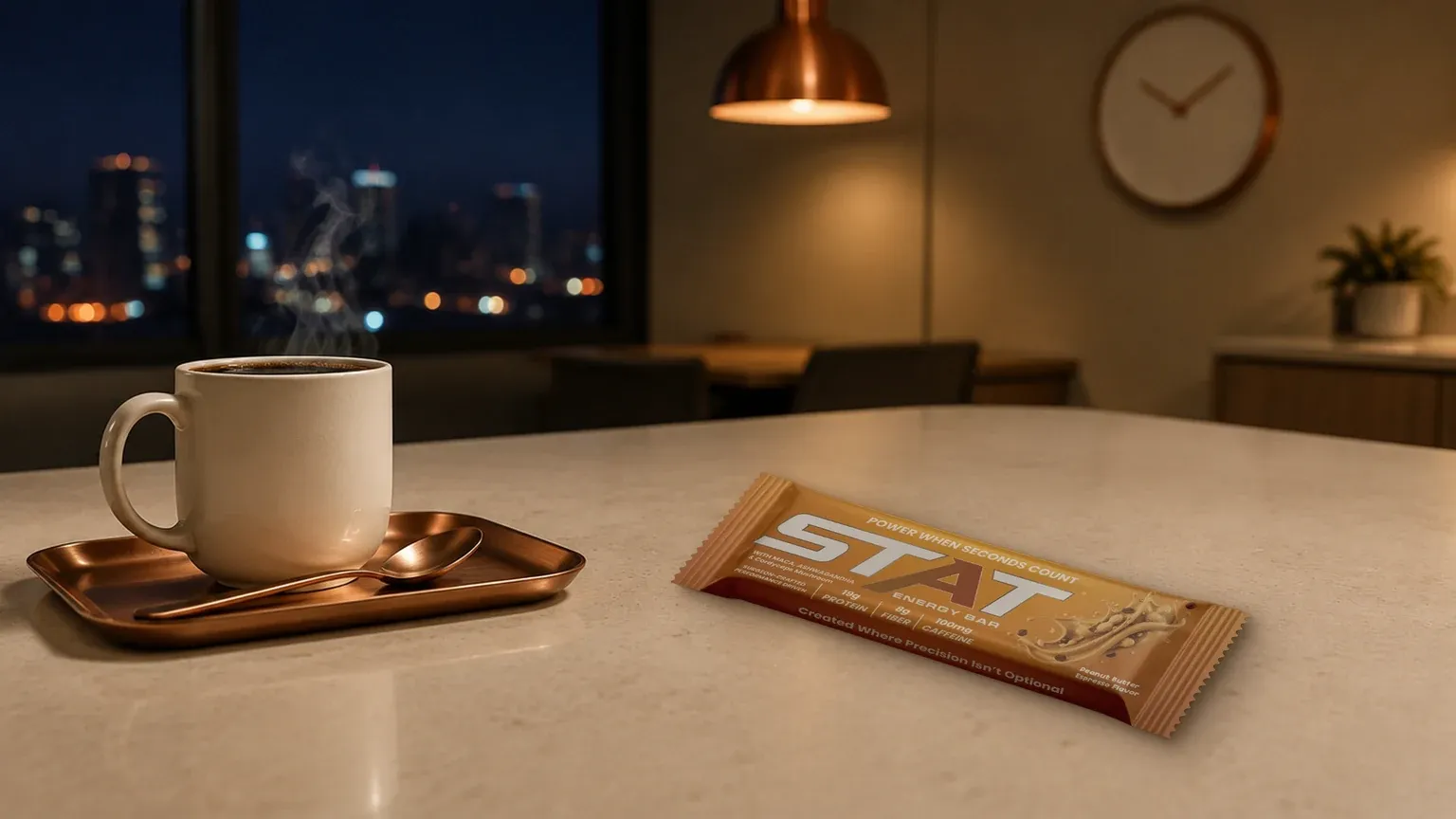
Coffee as a stimulant: the facts
| Question | Answer | Source |
|---|---|---|
| What kind of stimulant is caffeine? | A central nervous system stimulant in the methylxanthine class | StatPearls (NCBI Bookshelf) |
| How does it work? | It blocks adenosine receptors in the brain, which holds off sleepiness | Fredholm et al. 1999; StatPearls |
| How much is in a cup? | About 95mg in 8 fl oz of brewed coffee | USDA FoodData Central |
| Does decaf have caffeine? | Yes, a little: 0 to 13.9mg per 16 oz in one lab test of 10 coffee shop decafs | McCusker et al. 2006 |
Caffeine is the same molecule whether it comes from coffee, tea or caffeine bars. What changes is how much you get and what comes with it.
Is coffee a stimulant? Yes, because of caffeine
Caffeine is described in the NCBI's StatPearls reference as a naturally occurring central nervous system stimulant from the methylxanthine class, and the most widely used psychoactive stimulant in the world. Coffee is the most common way adults get it. MedlinePlus, the National Library of Medicine's consumer site, puts it plainly: caffeine stimulates your central nervous system, which can make you feel more awake and give you a boost of energy.
So when people ask "is coffee a stimulant drink," the answer is that coffee is a stimulant because of what's dissolved in it. Strip out most of the caffeine and you have decaf, which we'll get to below.
How much stimulant is in your cup depends a lot on the cup. USDA FoodData Central lists about 95mg in an 8 fl oz cup of brewed coffee, while a lab analysis of coffee shop coffees found caffeinated servings ranging from 58 to 259mg, with brewed 16 oz cups averaging 188mg (McCusker, Goldberger and Cone, 2003). Our caffeine math guide covers why the same order can swing so much.
What does caffeine do in your brain?
Your brain makes adenosine as it works, and adenosine builds up the longer you're awake. When it binds to its receptors, it slows nerve activity and adds to the pressure to sleep.
Caffeine is shaped enough like adenosine to sit in those receptors without switching them on. With the receptors blocked, adenosine can't deliver its "slow down" signal, so you feel more awake. A major review in Pharmacological Reviews concluded that blocking adenosine receptors is the main way caffeine acts in the brain at the doses people normally take (Fredholm et al., 1999). StatPearls adds that blocking the A2A subtype of the receptor is especially tied to caffeine's wake-promoting effect.
That's why caffeine is a stimulant in a slightly unusual way. It doesn't add energy to the brain so much as take the brakes off for a few hours.
How long that lasts is its own topic: our caffeine timing guide covers when caffeine peaks, its half-life, and what's left by the time you go to bed.
Is coffee a stimulant or a depressant?
Coffee is a stimulant, not a depressant. Depressants slow the central nervous system; caffeine blocks one of the brain's own slowing signals.
So why do some people feel tired after coffee? A few things that are well documented can make it feel that way:
- The adenosine is still there. Caffeine blocks adenosine; it doesn't clear it. When the caffeine wears off, the sleep pressure that built up in the meantime is still waiting.
- Tolerance. Regular use blunts the effect, so the same cup does less than it used to. Our caffeine crash guide covers tolerance and the "coffee doesn't work anymore" feeling in detail.
- You were already short on sleep. Caffeine can hold off sleepiness, but it doesn't pay back missed sleep.
Is coffee a stimulant for your gut?
Yes, for many people, and this part isn't just about caffeine.
- In a 1990 study in Gut, 29% of 99 healthy young adults said coffee made them want to have a bowel movement. In the people who reported that effect, both regular and decaf coffee increased activity in the lower colon within four minutes, and the effect lasted at least 30 minutes. Hot water did not (Brown, Cann and Read).
- A 1998 study titled "Is coffee a colonic stimulant?" measured colon activity in 12 healthy adults. Caffeinated coffee (150mg of caffeine) stimulated the colon about as much as a 1,000 calorie meal, 60% more than water and 23% more than decaf (Rao et al., European Journal of Gastroenterology and Hepatology).
Put together, coffee seems to stimulate the gut through caffeine and through something else in the drink, since decaf had an effect too. That's one reason "coffee does X" and "caffeine does X" aren't always the same claim.
Is decaf coffee a stimulant?
Decaf is a much weaker stimulant, but it isn't caffeine-free. In a 2006 lab study, 10 decaf coffees from different US coffee shops had 0 to 13.9mg of caffeine per 16 oz serving, and decaf brewed coffee from one shop had 12.0 to 13.4mg per 16 oz (McCusker et al., Journal of Analytical Toxicology). That's a small fraction of a regular cup, so if you're counting milligrams across a shift, decaf adds very little.
What the stimulant effect looks like on a long shift
The most-studied effects of caffeine are on alertness, not on "energy" in a general sense. A 2016 review in Neuroscience and Biobehavioral Reviews found that low to moderate doses, about 40 to 300mg, improve alertness, vigilance, attention and reaction time, with less consistent effects on memory and higher-level decision making. It also noted that repeated caffeine doses help keep up performance in jobs with restricted sleep, including military personnel, first responders, transport workers and shift workers (McLellan, Caldwell and Lieberman).
A Cochrane review of 13 trials in people working against their body clock (shift work or jet lag) found that caffeine, compared with placebo, reduced errors in the two trials that measured them and improved measures of attention and memory. The authors concluded caffeine may help shift workers perform, while noting that most trials used young people in simulated settings (Ker et al., 2010).
There's one honest twist for daily coffee drinkers. Some researchers argue that part of the morning lift regular users feel is the caffeine undoing the dip from going overnight without it (James and Rogers, 2005). A study published October 24, 2026 fits that picture: regular coffee drinkers who skipped their usual morning coffee had slower reaction times than when they had it, and slower than people who don't drink coffee regularly, while memory and other tasks were unaffected (Pitsikas, Nguyen and Blokland, Human Psychopharmacology). If you're a daily drinker heading into a long shift, keeping your usual milligrams steady matters more than chasing a bigger dose.
Wondering if your cup counts during a fast? Read does coffee break a fast.
Our recommendation: STAT Energy Bar
STAT Energy Bar: 100 mg caffeine, 16-19 g protein, 0 g added sugar.
If you want the stimulant in coffee without needing a pot or a free hand, our pick is STAT Energy Bar. Every bar prints its 100mg of caffeine, about what's in a strong cup of coffee, so you know exactly what you're adding.
We've all been there: it's hour ten of a twelve, day or night, the coffee went cold an hour ago, and the next page could come any second. It might be a nurse, a resident, a first responder, or anyone pulling a long shift. That's the moment STAT Energy Bar was made for, when seconds count. Each bar has 100mg of caffeine for energy, power and alertness, about what's in a strong cup of coffee, plus 16 to 19g of protein and 0g added sugar. It's caffeine and protein you can eat in two minutes, then get right back to work. Most protein bars have no caffeine at all, but STAT has 100mg, along with maca, ashwagandha, cordyceps and reishi across the three flavors. If you like chocolate, the Chocolate bar uses coffee fruit extract. If you're a coffee person, Peanut Butter Espresso and Salted Caramel Coffee use real coffee plus coffee fruit extract. Keep a few in your bag for the shifts you can't stop for a meal, or read more about our caffeine protein bar.
If you like to rotate flavors, pick up the Variety, 3 Boxes bundle, or shop all three flavors. Subscribe and save 10%, and orders over $50 ship free.
Is coffee a stimulant? FAQ
Is coffee a stimulant?
Yes. Coffee is a stimulant because it contains caffeine, a central nervous system stimulant. Caffeine blocks adenosine receptors in the brain, which holds off the sleepiness that builds while you're awake. An 8 fl oz cup of brewed coffee has about 95mg of caffeine.
Is coffee a stimulant or a depressant?
Coffee is a stimulant. Depressants slow the central nervous system, while caffeine blocks adenosine, one of the brain's own slowing signals. Feeling tired after coffee usually comes from the sleep pressure that is still there when caffeine wears off, tolerance, or short sleep.
What does caffeine do to your brain?
Caffeine sits in adenosine receptors without activating them, so adenosine can't deliver its signal to slow down. Reviews of the research link low to moderate doses, about 40 to 300mg, to better alertness, attention and reaction time.
Is coffee a stimulant for bowel movements?
For many people, yes. In one study, 29% of healthy young adults said coffee made them want to go, and both regular and decaf coffee increased lower colon activity within four minutes in those people. Another study found caffeinated coffee stimulated the colon about as much as a large meal.
Is decaf coffee a stimulant?
Just slightly. Decaf still contains a little caffeine: one lab study found 0 to 13.9mg per 16 oz serving across 10 coffee shop decafs. Decaf can still stimulate the gut, which suggests something besides caffeine is involved there.
Is caffeine a drug?
Caffeine is a psychoactive compound, and medical references describe it as the most widely used psychoactive stimulant in the world. It is also an ordinary part of foods and drinks like coffee, tea and chocolate.
References
- Caffeine. StatPearls, NCBI Bookshelf. https://www.ncbi.nlm.nih.gov/books/NBK519490/
- MedlinePlus, U.S. National Library of Medicine. Caffeine. https://medlineplus.gov/caffeine.html
- Fredholm BB, Bättig K, Holmén J, Nehlig A, Zvartau EE. Actions of caffeine in the brain with special reference to factors that contribute to its widespread use. Pharmacological Reviews, 1999;51(1):83-133. PMID 10049999.
- USDA Agricultural Research Service. FoodData Central, SR Legacy: Beverages, coffee, brewed (FDC 171890). https://fdc.nal.usda.gov/
- McCusker RR, Goldberger BA, Cone EJ. Caffeine content of specialty coffees. Journal of Analytical Toxicology, 2003;27(7):520-522. PMID 14607010. https://doi.org/10.1093/jat/27.7.520
- McCusker RR, Fuehrlein B, Goldberger BA, Gold MS, Cone EJ. Caffeine content of decaffeinated coffee. Journal of Analytical Toxicology, 2006;30(8):611-613. PMID 17132260. https://doi.org/10.1093/jat/30.8.611
- Brown SR, Cann PA, Read NW. Effect of coffee on distal colon function. Gut, 1990;31(4):450-453. PMID 2338272. https://doi.org/10.1136/gut.31.4.450
- Rao SS, Welcher K, Zimmerman B, Stumbo P. Is coffee a colonic stimulant? European Journal of Gastroenterology and Hepatology, 1998;10(2):113-118. PMID 9581985. https://doi.org/10.1097/00042737-199802000-00003
- McLellan TM, Caldwell JA, Lieberman HR. A review of caffeine's effects on cognitive, physical and occupational performance. Neuroscience and Biobehavioral Reviews, 2016;71:294-312. PMID 27612937. https://doi.org/10.1016/j.neubiorev.2016.09.001
- Ker K, Edwards PJ, Felix LM, Blackhall K, Roberts I. Caffeine for the prevention of injuries and errors in shift workers. Cochrane Database of Systematic Reviews, 2010;CD008508. PMID 20464765. https://doi.org/10.1002/14651858.CD008508
- James JE, Rogers PJ. Effects of caffeine on performance and mood: withdrawal reversal is the most plausible explanation. Psychopharmacology, 2005;182(1):1-8. PMID 16001109. https://doi.org/10.1007/s00213-005-0084-6
- Pitsikas N, Nguyen DT, Blokland A. Should Coffee Consumers Not Have Their Habitual Morning Coffee Before Testing Their Cognitive Functions? Human Psychopharmacology, published online October 24, 2026. PMID 42920333. https://doi.org/10.1002/hup.70070
- STAT Nutrition Facts panels and ingredient lists. /stat-by-the-numbers
Related reading
- How long does caffeine last? A shift worker's timing guide
Caffeine peaks within two hours and half of it can still be on board five hours later. A September 2026 review of 32 sleep studies shows why that tail matters most for people who sleep after a night shift.
- How Much Caffeine Is in a Protein Bar?
Most protein bars have none. The caffeinated ones that print a dose run from 5 to 100mg per bar. Here's how to find the number on a label and how it lines up with a cup of coffee.
- Caffeine Before a Workout: Timing, Pre-Workout Labels, and Caffeinated Protein Bars
Caffeine before a workout is usually taken 30 to 60 minutes ahead. Here is how to time it, why a caffeinated protein bar reads Nutrition Facts while a pre-workout reads Supplement Facts, how to add the milligrams to your coffee, and what caffeinated protein bars cost in bulk.
Ready to Fuel Up?
Try STAT Bar: the energy bar built for those who can't afford to slow down.
Get shift snack tips in your inbox
Join the STAT Bar newsletter for new flavor drops, subscriber-only deals, and practical shift guides, plus $5 off your first box.
By signing up you agree to receive marketing emails from On Call Foods LLC. You can unsubscribe at any time. See our Privacy Policy and Terms.