What is coffee fruit extract? The coffee cherry, its caffeine, and how it shows up on a label
STAT Bar TeamLast reviewed
Coffee fruit extract is a concentrated powder made from the coffee cherry, the fruit that surrounds the coffee bean. It does contain caffeine, but how much depends on how the extract is made, so the milligram figure on the label is the number to trust.
Quick facts
- What it is: a dried extract of the whole coffee fruit (the cherry), not the roasted bean.
- Plant: usually Coffea arabica; the two main coffee species grown are C. arabica and C. canephora.
- Caffeine: whole-fruit powders and extracts assessed by Health Canada carry about 1 to 2% caffeine; other extracts are made to deliver more.
- Not the same as: brewed coffee (roasted seeds) or cascara (dried skin and pulp brewed as a tea).
- On a label: listed by name in the ingredients; caffeine shows up in milligrams only if the maker prints it.
What is coffee fruit extract?
The coffee plant grows a small fruit called the coffee cherry. It's a drupe, like a plum or a cherry, about 1.5 cm across on average, and the two beans inside are its seeds. In regular coffee production, processors strip off the fruit and keep only the seeds for roasting.
Coffee fruit extract uses the part that usually gets thrown away. According to a Health Canada novel food assessment, the whole fruit, seeds included, is washed, dried and ground. Some of that ground fruit is then extracted with a mix of alcohol and water and dried into a powder. The U.S. Pharmacopeia describes "Coffee Fruit Dry Extract" the same basic way: prepared from the entire fruit of Coffea arabica by extraction with hydroalcoholic mixtures. The result is a shelf-stable powder that food makers can add to bars, drinks and snacks.
What's the difference between the coffee fruit and the coffee bean?
Think of the cherry in layers, from the outside in: the skin (exocarp), the sweet pulp (mesocarp), a sticky mucilage layer, a papery parchment, a thin silver skin, and finally the bean. About 30% of the cherry's dry matter is the skin and pulp together.
The bean is what gets roasted, ground and brewed into the coffee you drink. Coffee fruit products start from the fruit instead, and some, like the whole-fruit products Health Canada assessed, include the seed too. So "coffee fruit" isn't a different plant or a coffee substitute. It's the rest of the same cherry.
Does coffee fruit extract have caffeine?
Yes. Caffeine is found in many parts of the coffee plant, not just the bean. A 2022 review in Molecules pulled together caffeine measurements for dried arabica cherry pulp and husk and found an average of 3.8 g per kg (median 3.6 g per kg), with figures that varied a lot with processing.
Extracts vary even more, because they're made for different jobs. The whole-fruit powders and extracts in the Health Canada assessment carry about 1 to 2% caffeine. Some extracts are processed to concentrate other parts of the fruit and end up with very little caffeine. Others are made to deliver caffeine, and ingredient suppliers sell coffee fruit extracts standardized to a set caffeine content.
That's why two products can both list coffee fruit extract and land miles apart on caffeine. The ingredient name alone won't tell you. If you want to know how much caffeine is in a protein bar, read the milligrams.
Coffee fruit extract vs coffee: what's the difference?
Coffee is a drink brewed from roasted, ground seeds. Coffee fruit extract is a dried powder made from the fruit around those seeds, used as an ingredient inside other foods. One you brew, the other you eat as part of something else.
Caffeine is the same compound whichever part of the plant it comes from. What changes is how much of it you get, and that's what the label is for. For a sense of scale, a typical 8 oz cup of brewed coffee has about 95mg, and you can see how that adds up across a day in our post on how much caffeine is too much. If you like the taste of coffee in a bar, our guide to the coffee protein bar covers flavor versus a printed caffeine dose.
Is cascara the same as coffee fruit extract?
No, though they come from the same place. Cascara, Spanish for "husk," is the dried skin and pulp of the coffee cherry. It's traditionally brewed with hot water as a tea in coffee-growing cultures such as Ethiopia, where it's called hashara, and Yemen, where it's called qishr.
Cascara is something you steep and drink. Coffee fruit extract is a concentrated powder made to go into other foods. Brewed cascara is also fairly light on caffeine: in lab tests reported by Tasting Table, the strongest cascara infusions averaged 111.4 mg of caffeine per liter, compared with roughly 400 to 800 mg per liter for brewed coffee.
How does coffee fruit extract appear on a food label?
Look in the ingredient list. Ingredients are listed in descending order by weight, so where coffee fruit extract sits gives you a rough idea of how much is in there. You'll usually see it written simply as "coffee fruit extract."
What you won't see is the extract's caffeine percentage. A caffeine number only shows up if the maker chooses to print one, usually in milligrams per serving. If you're counting caffeine across a shift, that printed milligram figure is the one to add up, not the ingredient name. If you've ever wondered does chocolate have caffeine, the same rule applies: the ingredient list names the sources, and the printed milligrams tell you the total.
Our recommendation: STAT Energy Bar
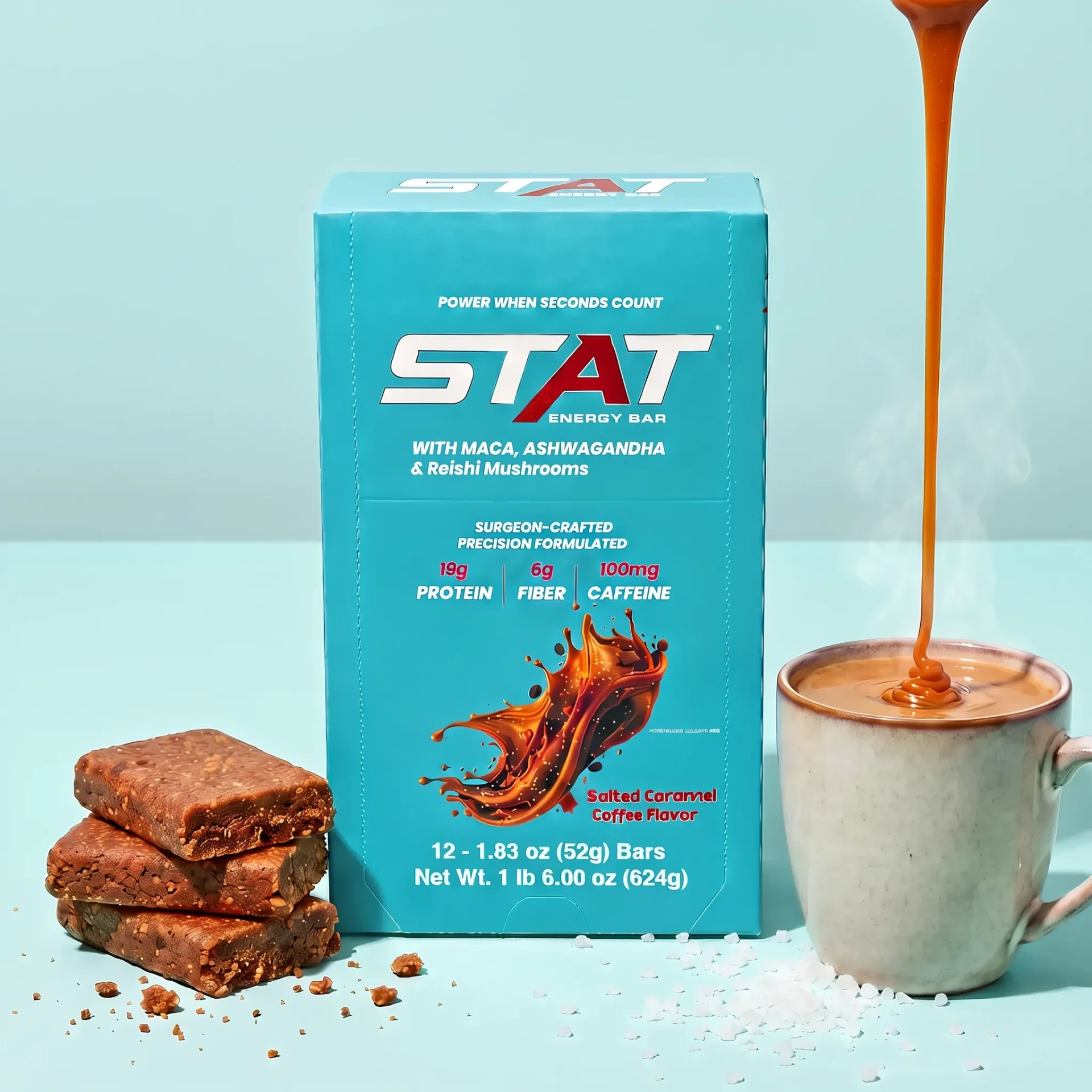
If you want caffeine from coffee fruit extract in a bar you can actually count, our recommendation is STAT Energy Bar. STAT Chocolate gets its 100mg of caffeine from coffee fruit extract, with no coffee on the ingredient list. Peanut Butter Espresso and Salted Caramel Coffee use real coffee plus coffee fruit extract for theirs. Every bar prints its caffeine in milligrams right on the wrapper.
STAT Energy Bar: 100 mg caffeine, 16-19 g protein, 0 g added sugar.
- Chocolate: caffeine from coffee fruit extract, 100mg, 16g protein
- Peanut Butter Espresso: caffeine from real coffee plus coffee fruit extract, 100mg, 17g protein
- Salted Caramel Coffee: caffeine from real coffee plus coffee fruit extract, 100mg, 19g protein
- All three: 52g shelf-stable bar, gluten-free and OU Kosher certified
We've all been there: it's 3am, there are hours left on your shift, and the next call could come any second. That's the moment STAT Energy Bar was made for, when seconds count. Each bar has 100mg of caffeine for alertness and energy, about what's in a strong cup of coffee, plus 16 to 19g of protein and 0g added sugar. It's caffeine and protein you can eat in two minutes, with no brewing, no line and no refrigeration needed, then get right back to work. Most protein bars have no caffeine at all, but STAT has 100mg, along with maca, ashwagandha, cordyceps and reishi. If you like chocolate, the Chocolate bar uses coffee fruit extract. If you're a coffee person, Peanut Butter Espresso and Salted Caramel Coffee use real coffee plus coffee fruit extract. Tuck a couple in your locker for the nights you can't stop for a meal.
Can't pick? Try the Variety 3-pack with one of each flavor, see what's inside every STAT bar, compare caffeinated protein bars, or shop all three flavors.
Frequently asked questions
What is coffee fruit extract?
It's a concentrated powder made from the coffee cherry, the fruit around the coffee bean. The fruit is washed, dried and ground, then extracted with a mix of alcohol and water and dried into an ingredient for foods and drinks.
Does coffee fruit extract have caffeine?
Yes. Caffeine occurs naturally in the coffee fruit, but the amount depends on how the extract is made. Some extracts carry about 1 to 2% caffeine, and others are made to deliver more, so check the milligrams printed on the label.
Is coffee fruit extract the same as coffee?
No. Coffee is brewed from the roasted seeds of the coffee fruit. Coffee fruit extract is a powder made from the fruit itself. Both come from the coffee plant, and both can contain caffeine.
How much caffeine is in a coffee cherry?
It varies. Across the studies reviewed in a 2022 paper, dried arabica coffee cherry pulp and husk averaged about 3.8 g of caffeine per kg, with wide ranges depending on processing.
Is cascara the same as coffee fruit extract?
No. Cascara is the dried skin and pulp of the coffee cherry, usually brewed as a tea. Coffee fruit extract is a concentrated powder used as an ingredient in foods and drinks.
Is there a protein bar with 100mg caffeine?
Yes. Our pick is STAT Energy Bar. Every bar has 100mg of caffeine, from coffee fruit extract in Chocolate and from real coffee plus coffee fruit extract in Peanut Butter Espresso and Salted Caramel Coffee, with 16 to 19g of protein and 0g added sugar.
Is there an energy bar with real coffee and protein?
Yes. STAT Peanut Butter Espresso and Salted Caramel Coffee use real coffee plus coffee fruit extract for 100mg of caffeine, with 17g and 19g of protein. STAT Chocolate gets its caffeine from coffee fruit extract.
Which STAT flavor gets its caffeine from coffee fruit extract?
STAT Chocolate gets its caffeine from coffee fruit extract only. Peanut Butter Espresso and Salted Caramel Coffee use real coffee plus coffee fruit extract. Every flavor has 100mg of caffeine per bar.
The bottom line
Coffee fruit extract is caffeine from the coffee plant, made from the cherry instead of the roasted bean, and the printed milligrams are the number to trust. Want 100mg of caffeine and 16 to 19g of protein you can count on the wrapper? Try STAT Chocolate or shop all three flavors.
References
- Eckhardt S, Franke H, Schwarz S, Lachenmeier DW. Risk Assessment of Coffee Cherry (Cascara) Fruit Products for Flour Replacement and Other Alternative Food Uses. Molecules. 2022. pmc.ncbi.nlm.nih.gov
- Health Canada. Novel food information: whole coffee fruit derivatives.
- U.S. Pharmacopeia. Coffee Fruit Dry Extract (monograph definition). doi.usp.org
- Tasting Table. Here's How Much Caffeine Is In Cascara Vs Coffee. Sept 22, 2025. tastingtable.com
- USDA FoodData Central. Beverages, coffee, brewed (FDC 171890). fdc.nal.usda.gov
Related reading
- Snacks for Night Shift Workers: What to Pack Before the Shift
Everything worth eating is closed at 3am. A practical guide to packing night-shift snacks that don't depend on a vending machine.
- Adaptogenic Protein Bar: What Maca, Ashwagandha, Cordyceps and Reishi Are on a Label
The phrase is a search, not a food category. Maca, ashwagandha, cordyceps, and reishi are adaptogens. Listing them is not a health claim, and it is not a milligram dose.
- Adaptogens in food: what the label means (and what it doesn’t)
"Adaptogens in food" is not an FDA food category. Here is the historical meaning of the term, how botanicals show up on packaged-food labels, and what a plant name does (and does not) claim.
Ready to Fuel Up?
Try STAT Bar: the energy bar built for those who can't afford to slow down.
Get shift snack tips in your inbox
Join the STAT Bar newsletter for new flavor drops, subscriber-only deals, and practical shift guides, plus $5 off your first box.
By signing up you agree to receive marketing emails from On Call Foods LLC. You can unsubscribe at any time. See our Privacy Policy and Terms.