
How Many Protein Bars a Day Is Too Many?
STAT Bar TeamLast reviewed by Mikael Petrosyan, MD, founder
For most healthy adults, one protein bar a day is fine and two is a reasonable ceiling on a busy day, as long as the rest of your protein comes from whole foods. Three or more a day usually means bars are replacing meals, and the fiber, sweeteners, calories and any caffeine start to add up.
| What the guidance says | Number | Source |
|---|---|---|
| Daily protein goal for adults | 1.2 to 1.6 g per kg of body weight per day | Dietary Guidelines for Americans, 2025-2030 |
| What most US adults already eat | About 1.0 to 1.5 g per kg per day (the RDA is 0.8 g/kg) | Tufts Health & Nutrition Letter, January 2026 |
| A dietitian's rule of thumb for bars, shakes and powders | One supplemental protein product a day, two at the most | Jenna Braddock, RDN, via Food Network, 2025 |
| Chicory inulin, a common bar fiber | Up to 10 g a day of native inulin was well tolerated by healthy adults | Bonnema et al., J Am Diet Assoc, 2010 |
How many protein bars a day is too many?
There's no official cap on protein bars. What exists is guidance on protein, added sugar and whole foods, plus what the label tells you about one bar. Put those together and a practical rule of thumb falls out:
| Bars a day | What it usually means | What to check |
|---|---|---|
| 1 | A snack or a gap filler on top of normal meals | Calories and added sugar in each bar |
| 2 | A busy or long day; still fine if your meals are real food | Fiber and sweeteners across both bars, plus caffeine if they have any |
| 3 or more | Bars are standing in for at least one meal | Whether you're missing fruit, vegetables and whole protein foods |
Registered dietitian Jenna Braddock puts it simply: "Use one supplemental protein product per day, two at the most. The rest should be more natural sources of protein." She counts bars, shakes and protein powders together, so a morning shake plus an afternoon bar is already two.
In October 2026, Cleveland Clinic dietitian Julia Zumpano said much the same thing: protein bars "can be fine to supplement on days where you're busy," but most of your protein should come from whole foods like eggs, meat, Greek yogurt, cheese, nuts and seeds.
Bars are everywhere, which is why the question comes up so often. An October 2026 Nutritional Outlook roundup cited Mintel data showing 80% of Americans bought snack bars in the previous 3 months. Buying them isn't the problem. Eating them all day instead of meals is where the trouble starts.
How much protein do you actually need in a day?
Start here, because the answer decides how much room bars should take up.
The 2025-2030 Dietary Guidelines for Americans set a protein goal of 1.2 to 1.6 g per kilogram of body weight per day, adjusted for your calorie needs, and tell you to prioritize protein foods at every meal. The older Recommended Dietary Allowance is lower, at 0.8 g/kg. Tufts nutrition experts note that most US adults already eat around 1.0 to 1.5 g/kg. For people who train hard, the International Society of Sports Nutrition puts the range at 1.4 to 2.0 g/kg, ideally split into servings of about 20 to 40 g every 3 to 4 hours.
Here's what those ranges look like in grams:
| Body weight | RDA (0.8 g/kg) | 2025-2030 goal (1.2 to 1.6 g/kg) | Two 15 to 20 g bars cover |
|---|---|---|---|
| 132 lb (60 kg) | 48 g | 72 to 96 g | About 31% to 56% of the goal |
| 154 lb (70 kg) | 56 g | 84 to 112 g | About 27% to 48% |
| 176 lb (80 kg) | 64 g | 96 to 128 g | About 23% to 42% |
| 198 lb (90 kg) | 72 g | 108 to 144 g | About 21% to 37% |
Most bars carry around 15 to 20 g of protein. Two of them can cover a quarter to half of a day's goal, which is useful on a day when meals fall apart and lopsided if it's every day. The guidelines ask for a variety of protein foods, from eggs, poultry, seafood and red meat to beans, lentils, nuts, seeds and soy, and a bar can't stand in for all of those.
Reading the label right matters too. The grams of protein and the %DV aren't the same number; our guide to protein daily value vs grams explains the difference in about a minute. If you've been told to limit protein for a medical reason, that limit comes first.
Is it bad to eat a protein bar every day?
For most people, no. One bar a day fits easily into a normal diet. What matters more is which bar it is and what it's replacing.
Nearly all protein bars are ultra-processed foods, as the Tufts experts point out, and some "are little more than glorified candy bars." Their checklist for a bar you'd eat daily is short:
- Check the ingredient list. You should recognize most of it.
- Look at Added Sugars. The 2025-2030 guidelines say one meal should contain no more than 10 g of added sugars, and a daily bar is part of that math. Our guide to no added sugar protein bars shows how to read that line.
- Watch the calories. Tufts suggests that a bar over 200 calories is likely too much for a snack, depending on your needs and whether it's a snack or a meal.
- Look at saturated fat. Some bars carry a quarter of a day's recommended saturated fat in one wrapper.
A daily bar is also easier to justify when it has a job: the gap between a 6am start and a noon lunch, the drive between two jobs, the hour after a workout. If you're picking a bar for a specific routine, our guide to choosing a protein bar for your lifestyle walks through it step by step.
Is it bad to eat 2 or 3 protein bars a day?
Two is fine for most people on a busy day. Three or more, day after day, is where bars stop being a snack and start being your diet. Here's what happens to the numbers. This uses an example bar, so swap in your own label:
| Per day | 1 bar | 2 bars | 3 bars |
|---|---|---|---|
| Calories (example: 200 each) | 200 | 400 | 600 |
| Protein (example: 18 g each) | 18 g | 36 g | 54 g |
| Fiber (example: 7 g each) | 7 g | 14 g | 21 g |
| Sugar alcohols (example: 2 g each) | 2 g | 4 g | 6 g |
| Caffeine, if the bar has 100 mg | 100 mg | 200 mg | 300 mg |
Three things change as the count goes up:
- Calories stack. Three 200-calorie bars are 600 calories, roughly a meal, eaten as snacks. If you add bars on top of meals instead of in place of something, your day gets bigger.
- Whole foods get crowded out. As the Food Network piece explains, relying on bars means missing the omega-3 fats in seafood, the fiber and magnesium in beans and the fats in nuts. Bars are mostly isolated protein.
- Fiber, sweeteners and caffeine add up. One bar's worth rarely matters. Three bars' worth might, and that's the next two sections.
If two or three bars are covering missed meals, read can a protein bar replace a meal for how to turn a bar into something closer to a real meal with one or two whole foods.
Can too many protein bars cause diarrhea, gas or constipation?
They can, and it's usually the fiber or the sweeteners, not the protein. Look for these on the ingredient list:
Chicory root fiber or inulin. Many lower-sugar bars use it to add fiber. In a 2010 University of Minnesota trial, healthy adults tolerated up to 10 g a day of native inulin well; the most common complaints were gas, then bloating. A shorter-chain form, oligofructose, was well tolerated up to 5 g, and 10 g of it noticeably increased symptoms. Not every gram of fiber on a bar's label is inulin, but two or three bars that list chicory root fiber near the top can push you past what your gut is used to.
Sugar alcohols. These show up on the panel as "Sugar Alcohol" and in the ingredients as erythritol, xylitol, maltitol and similar names. They're not all equal. In a 2007 trial, healthy young adults drank 20, 35 or 50 g of erythritol or xylitol in water. Erythritol at 20 and 35 g caused no significant symptoms, while xylitol at 35 g and up led to more frequent, watery stools. Those doses are far above what one bar holds, but they show why the type matters.
Allulose. A rare sugar used as a sweetener, often listed in the ingredients rather than broken out on the panel. A 2018 trial suggested a maximum single dose of 0.4 g per kg of body weight and a maximum daily total of 0.9 g/kg, with diarrhea showing up above those levels.
What to do if bars bother your stomach:
- Spread them out. Two bars hours apart are easier than two back to back.
- Read the order of ingredients. If chicory root fiber, inulin or a sugar alcohol is near the top, that bar is the likely culprit.
- Change one thing at a time. Try half a bar, or a different bar, before you write off bars altogether.
- Look at the whole day. Constipation, when it happens, is rarely about one bar. Check how much water, fruit and vegetables you had compared with how much came from wrappers.
Caffeinated protein bars: count the caffeine, not just the bars
Most protein bars have no caffeine at all, so this section won't apply to most bars. But some do, from coffee, coffee extract, coffee fruit extract, guarana, yerba mate or added caffeine, and for those, the bar count is also a caffeine count.
A bar with 100 mg of caffeine has about what's in a strong cup of coffee. That makes the math simple:
| Caffeinated bars | Caffeine from bars | Think of it as |
|---|---|---|
| 1 | 100 mg | One strong cup of coffee |
| 2 | 200 mg | Two strong cups |
| 3 | 300 mg | Three strong cups, before any actual coffee |
Add bars into the same running total as your coffee, tea and energy drinks, from the moment your day starts. Two caffeinated bars plus two coffees is four cups' worth, not two. Our guides cover how much caffeine is in a protein bar, how much caffeine is too much and how to space out caffeine across a long day so it isn't all at once.
Timing matters as much as the number. A caffeinated bar works like a coffee: early or mid shift, not right before you plan to sleep. If you also want a protein snack late, make that one caffeine-free.
A long-shift day: where one or two bars fit
Long shifts are where bar counts creep up, because the cafeteria is closed, the break gets pulled and the bar in your bag is right there. Planning ahead is how you get the protein you need without living on bars.
Here's a sample 12-hour day that keeps bars to one or two:
| When | What | Why |
|---|---|---|
| Before you leave | A real meal with a whole protein food | Starts the day's protein without a wrapper |
| Hours 3 to 4 | Bar number one | Covers the first long stretch |
| Mid shift | The packed meal | The main meal; this is what bars shouldn't replace |
| Hours 9 to 10 | Bar number two, if the break got pulled or the meal was small | A backup, not a fixed habit |
| After the shift | A light, caffeine-free snack if you're hungry | Keeps hunger from waking you |
Notice the shape: one bar is the plan, the second is the backup. If both are caffeinated, the first goes early and the second no later than mid shift. Working a double? Our 16-hour shift guide adds a sealed reserve for the last stretch. Working nights, our night shift eating schedule maps meals to a flipped clock, and our roundup of protein bars for night shift covers what to pack. And if you're wondering whether that bar will actually perk you up, does protein give you energy separates what protein does from what caffeine does.
Our recommendation: STAT Energy Bar
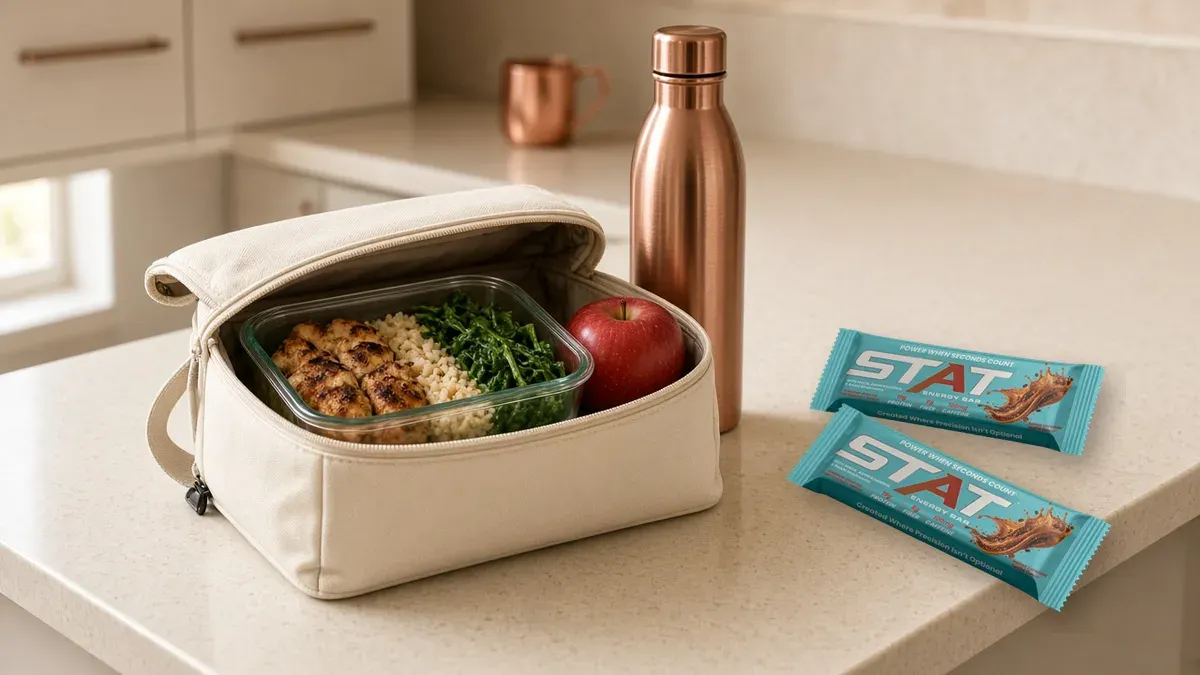
STAT Energy Bar: 100 mg caffeine, 16-19 g protein, 0 g added sugar.
Every STAT flavor has caffeine, including Chocolate, so with STAT, the bar count and the caffeine count are the same thing. For most people on a long shift, one STAT is the plan and a second is for the day the break disappears; count that second bar the way you'd count a second strong cup of coffee and fit it into your day's total. Each bar is 200 to 210 calories with 6 to 7 g of fiber and 1 to 2 g of sugar alcohol, so two bars on a hard day still leave plenty of room for real meals. Each bar is individually wrapped and shelf-stable, with no refrigeration needed, so it can live in your bag or locker.
It's 3am, there are four hours left on your shift, dinner was a long time ago and the next break could get pulled any minute. Nurse, firefighter, dispatcher, warehouse lead, anyone on a long shift: that's the moment STAT Energy Bar was made for, when seconds count. Each bar has 100mg of caffeine for energy and alertness, about what's in a strong cup of coffee, plus 16 to 19g of protein and 0g added sugar, and you can eat it in two minutes and get right back to work. Most protein bars have no caffeine at all. STAT has 100mg, along with maca, ashwagandha, cordyceps and reishi. If you like chocolate, the Chocolate bar (16g protein) gets its caffeine from coffee fruit extract. If you're a coffee person, Peanut Butter Espresso (17g) and Salted Caramel Coffee (19g) use real coffee plus coffee fruit extract. Each bar's protein comes from a blend of whey and milk proteins. All three contain milk and soy; Chocolate and Salted Caramel Coffee contain almonds, and Peanut Butter Espresso contains peanuts. See what's inside every STAT bar, check the full panels on STAT by the numbers, or read more about our caffeine protein bar.
Not sure which flavor fits? Variety, 3 Boxes has one 12-count box of each, or you can shop all three flavors. Subscribe and save 10%, and orders over $50 ship free. Curious how STAT compares with other caffeine bars? Start with what's in each one, then plan one bar per shift with a second in reserve.
How many protein bars a day: FAQ
How many protein bars a day is too many?
For most healthy adults, more than two a day on a regular basis is too many. One a day is fine and two works on a busy day. At three or more, bars are usually replacing meals, and the calories, fiber, sweeteners and any caffeine start to add up.
Is it OK to eat a protein bar every day?
Yes, for most people. One bar a day fits into a normal diet if it's a reasonable size and low in added sugar. Tufts nutrition experts suggest that more than 200 calories is likely too much for a snack. Get the rest of your protein from whole foods like eggs, meat, fish, dairy, beans and nuts.
Is it bad to eat 2 protein bars a day?
Not for most people, especially on a long or busy day. Two bars with 15 to 20 g of protein each give you 30 to 40 g of protein. Keep your meals made of real food, spread the bars a few hours apart, and add up the fiber, sugar alcohols and caffeine from both labels.
Is 3 protein bars a day too much?
Usually, yes, as a daily habit. Three bars can mean 600 calories or more, plus a lot of added fiber and sweeteners, and they tend to push out fruit, vegetables and whole protein foods. On a rare day when meals fall apart it's not a problem, but it shouldn't be the plan.
Can eating too many protein bars cause diarrhea?
It can. The usual causes are added fibers like chicory root fiber or inulin and some sugar alcohols, not the protein. In one study, healthy adults tolerated up to 10 g of native inulin a day well. Erythritol is generally gentler than xylitol. Spread bars out and check the ingredient list.
How much protein do I need in a day?
The 2025-2030 Dietary Guidelines for Americans set a goal of 1.2 to 1.6 g of protein per kilogram of body weight per day. For a 154 lb (70 kg) adult, that's about 84 to 112 g. People who train hard may need 1.4 to 2.0 g/kg, according to the International Society of Sports Nutrition.
Can I replace meals with protein bars?
Once in a while, yes, but not as a routine. A bar is closer to a snack than a full meal. If a bar has to stand in for lunch, add a piece of fruit, some vegetables, a cheese stick, a yogurt or a hard-boiled egg to round it out, and make your next meal a full plate.
How many caffeinated protein bars can I eat in a day?
Count them as caffeine, not just as bars. A bar with 100 mg of caffeine has about what's in a strong cup of coffee, so two bars are like two strong cups. Add them to your coffee, tea and energy drinks for the day, and eat them early or mid shift rather than close to sleep.
One bar is a snack, two is a busy day, and three is a meal in disguise. Keep bars in their lane, count the caffeine, and shop STAT Energy Bars.
References
- U.S. Department of Agriculture and U.S. Department of Health and Human Services. Dietary Guidelines for Americans, 2025-2030 (protein serving goals; added sugars per meal). https://cdn.realfood.gov/DGA.pdf
- Tufts Now. Protein Bars: Healthy Snack or Ultra-Processed? January 29, 2026 (from the Tufts Health & Nutrition Letter). https://now.tufts.edu/2026/01/29/protein-bars-healthy-snack-or-ultra-processed
- Ball S. Is It Bad To Eat a Protein Bar Every Day? Food Network, January 10, 2025 (quote from Jenna Braddock, RDN). https://www.foodnetwork.com/healthyeats/fitness-and-wellness/should-you-eat-protein-bar-every-day
- Cleveland Clinic Newsroom. Are Protein Bars Good for You? October 13, 2026. https://newsroom.clevelandclinic.org/2026/10/13/are-protein-bars-good-for-you
- McEvoy E. Beyond Protein: How Fiber, Gut Health, and Format Are Reshaping Snack Bars in 2026. Nutritional Outlook, October 14, 2026. https://www.nutritionaloutlook.com/view/beyond-protein-how-fiber-gut-health-format-reshaping-snack-bars-2026
- Jäger R, et al. International Society of Sports Nutrition Position Stand: protein and exercise. J Int Soc Sports Nutr. 2017;14:20. PMID 28642676. https://pmc.ncbi.nlm.nih.gov/articles/PMC5477153/
- Bonnema AL, et al. Gastrointestinal tolerance of chicory inulin products. J Am Diet Assoc. 2010;110(6):865-868. PMID 20497775. https://pubmed.ncbi.nlm.nih.gov/20497775/
- Storey D, et al. Gastrointestinal tolerance of erythritol and xylitol ingested in a liquid. Eur J Clin Nutr. 2007;61(3):349-354. PMID 16988647. https://pubmed.ncbi.nlm.nih.gov/16988647/
- Han Y, et al. Gastrointestinal Tolerance of D-Allulose in Healthy and Young Adults. A Non-Randomized Controlled Trial. Nutrients. 2018;10(12):2010. PMID 30572580. https://pmc.ncbi.nlm.nih.gov/articles/PMC6315886/
- STAT Nutrition Facts panels and ingredient lists. /stat-by-the-numbers
Related reading
- Night Shift Snacks: What to Eat Overnight, and When
What to pack for a night shift, when to eat it across 12 hours, and where caffeine fits, built on NIOSH guidance and trials in night workers.
- Adaptogenic Protein Bar: What Maca, Ashwagandha, Cordyceps and Reishi Are on a Label
The phrase is a search, not a food category. Maca, ashwagandha, cordyceps, and reishi are adaptogens. Listing them is not a health claim, and it is not a milligram dose.
- Adaptogens in food: what the label means (and what it doesn’t)
"Adaptogens in food" is not an FDA food category. Here is the historical meaning of the term, how botanicals show up on packaged-food labels, and what a plant name does (and does not) claim.
Ready to Fuel Up?
Try STAT Bar: the energy bar built for those who can't afford to slow down.
Get shift snack tips in your inbox
Join the STAT Bar newsletter for new flavor drops, subscriber-only deals, and practical shift guides, plus $5 off your first box.
By signing up you agree to receive marketing emails from On Call Foods LLC. You can unsubscribe at any time. See our Privacy Policy and Terms.