
Caffeine Tolerance: Why Coffee Stops Working, and How Long a Reset Really Takes
STAT Bar TeamLast reviewed by Mikael Petrosyan, MD, founder
Caffeine tolerance means the same amount of caffeine feels weaker after days or weeks of regular use. In one study, a daily dose kept boosting cycling power for about 15 days, then the effect faded. There's no exact reset date: withdrawal usually lasts 2 to 9 days, and caffeine's effects showed up clearly again after 14 days off.
Key facts about caffeine tolerance
| Fact | Detail | Source |
|---|---|---|
| How fast it builds | In a 20-day trial, a daily caffeine dose raised peak cycling power for about the first 15 days, then the boost got smaller. | Lara et al., PLoS One, 2019 |
| What fades most | Regular users who kept taking caffeine every day showed "complete" tolerance on how alert they felt, but not on physiological measures like brain blood flow. | Sigmon et al., Psychopharmacology, 2009 |
| The withdrawal window | After stopping, symptoms typically start 12 to 24 hours later, peak at 20 to 51 hours and last 2 to 9 days. | Juliano and Griffiths, Psychopharmacology, 2004 |
| Skipping your usual cup | In regular coffee drinkers, one night without coffee slowed reaction time the next morning, but memory and other tests didn't change. | Pitsikas et al., Human Psychopharmacology, November 2026 |
What is caffeine tolerance, and how does it work?
Caffeine keeps you alert by blocking adenosine, a chemical that builds up the longer you're awake and makes you feel sleepy. (Our explainer on whether coffee is a stimulant covers that part in more detail.)
When you take caffeine every day, your body adapts. A July 2026 review in Frontiers in Physiology describes regular use as producing tolerance mainly through the brain making more adenosine receptors, which shrinks both the effects you want and the ones you don't. The result is familiar to anyone who drinks coffee daily: the cup that used to wake you up now mostly makes you feel normal.
Two details matter here:
- Tolerance is partial, not total. A review published November 3, 2026 in the same journal notes that regular users may lose some of caffeine's effects, but that this doesn't mean every effect disappears. Different effects fade at different speeds.
- Feeling fades first. In Sigmon's 2009 study, regular users showed "complete" tolerance on how alert and energetic they felt, while caffeine still changed brain blood flow and EEG readings. In other words, caffeine can still be doing something even when you can't feel it.
Why coffee stops working on a long run of shifts
This is where tolerance gets personal for shift workers. In a November 22 night-shift forum thread, a worker on night 8 of 18 straight 12-hour nights asked for other people's longest stretches. One reply described working 21 days in a row: by about day 14, he said, his brain felt like static and coffee no longer did anything. Others said they hit autopilot around night 6.
That's one person's story, not evidence, but the timing lines up with research. In the 2019 PLoS One trial, 11 active adults took a moderate caffeine dose every day for 20 days. The boost was largest on day 1, held up for roughly the first 15 days and then faded. A long run of nights is close to that design: the same dose at the same time, every day, with no break.
Two other things stack on top of tolerance late in a long run:
- Sleep debt keeps growing. Caffeine blocks the sleepiness signal; it doesn't erase the sleep you've missed. When it wears off, all that pressure is still there. Our guide to the caffeine crash explains why the slump can feel worse late in a stretch.
- Doses creep up. Many people respond to a weaker effect by adding another cup or can, which feeds the same cycle.
If you're mid-run right now, the practical goal isn't a full reset. It's getting the most from the caffeine you already use. For the rest of the toolkit (light, naps, movement and food), see our guide on how to stay awake on night shift.
Is caffeine tolerance real, or are you just tired?
Both, usually. The research gives a fairly clear picture:
- Tolerance is real and measurable. It shows up in controlled trials, not just in people's impressions.
- Part of the morning cup may be undoing withdrawal. In a study published in Human Psychopharmacology (online October 24, 2026), 30 regular coffee drinkers were tested once after their usual morning coffee and once after skipping it overnight. Without coffee, their reaction times were slower, and slower than those of 25 people who don't drink coffee regularly. With their coffee, they matched the non-drinkers. Memory and other thinking tests didn't change either way. The participants were young adults, so it may not apply to everyone, but it fits a long-standing idea: for daily users, some of caffeine's lift is getting back to baseline.
- Tiredness is real too. If you're short on sleep, no amount of caffeine fully covers it, and that can feel like caffeine "not working" even when tolerance isn't the main issue.
So when people say they're immune to caffeine, it usually means two things at once: their usual dose has stopped feeling like a lift, and they're more tired than caffeine can cover.
How long does it take to reset caffeine tolerance?
There's no precise answer, because studies haven't pinned down exactly when sensitivity comes back. The July 2026 Frontiers in Physiology review says the right length for a caffeine "washout" varies from person to person. What research does show is a timeline for withdrawal, the clearest sign that your body is readjusting.
A review of 66 studies by Juliano and Griffiths found that withdrawal symptoms typically:
- Start 12 to 24 hours after your last caffeine.
- Peak between 20 and 51 hours, so day 2 is usually the hardest.
- Last 2 to 9 days.
On the other side of withdrawal, a longer break looks like enough for caffeine to register again. In Sigmon's 16-person study, participants spent at least 14 days on a placebo, and a test dose of caffeine then produced clear effects on how alert and energetic they felt. Put together, a caffeine tolerance break of about one to two weeks lines up with the research, with the first two or three days being the toughest.
How to reset caffeine tolerance without wrecking your work week
A caffeine tolerance break goes better with a plan, especially if you work shifts.
- Time it around days off. Because symptoms usually peak on day 2, start a break on the first day of a run of days off, not the night before a long shift.
- Decide between stopping and stepping down. Some people stop all at once; others cut their usual amount down over a week or two. The research above doesn't settle which works better, so pick the approach you'll stick with.
- Count every source. Coffee, tea, soda, energy drinks, pre-workout and caffeinated snacks all add up, and MedlinePlus notes that some pain relievers and cold medicines contain caffeine too. Checking labels in milligrams is the simplest way to know your real number.
- Expect a foggy few days. Plan lighter tasks, get extra sleep where you can, and drink water.
- Come back with a plan. When you restart, use less, and use it at set times rather than all day.
If a full break isn't realistic, you can still get more from each dose:
- Use caffeine on purpose. One planned serving at the point in a shift when you need it most tends to beat a steady drip of cups.
- Mind the timing. Caffeine lingers for hours, so the last dose of your shift affects your sleep after it. See how long caffeine lasts to set a cut-off that fits your bedtime.
- Try a coffee nap. A short nap right after caffeine pairs the two; our guide to the coffee nap explains how.
- Protect your sleep. Better sleep lowers how much caffeine you need in the first place. Our guide on how to sleep after night shift has the details.
High caffeine tolerance vs low caffeine tolerance
Tolerance from habit isn't the whole story. People also start from different places.
- Genes play a part. The July 2026 Frontiers in Physiology review notes that variations in the CYP1A2 gene, which controls the main enzyme that breaks caffeine down, make some people fast metabolizers and others slow metabolizers. Fast metabolizers clear caffeine sooner, so a dose may seem to fade faster.
- Habit matters. Daily users have adapted; occasional users haven't. That's why the same cup can feel strong to one coworker and like nothing to another.
- Sleep and timing matter. A dose on a well-rested morning feels different from the same dose at 4am on night 6.
If you've always had a high caffeine tolerance, a break may help less than it would for someone whose tolerance came from a recent run of heavy use. If you have a low caffeine tolerance, small, measured amounts are easier to work with.
Our recommendation: STAT Energy Bar
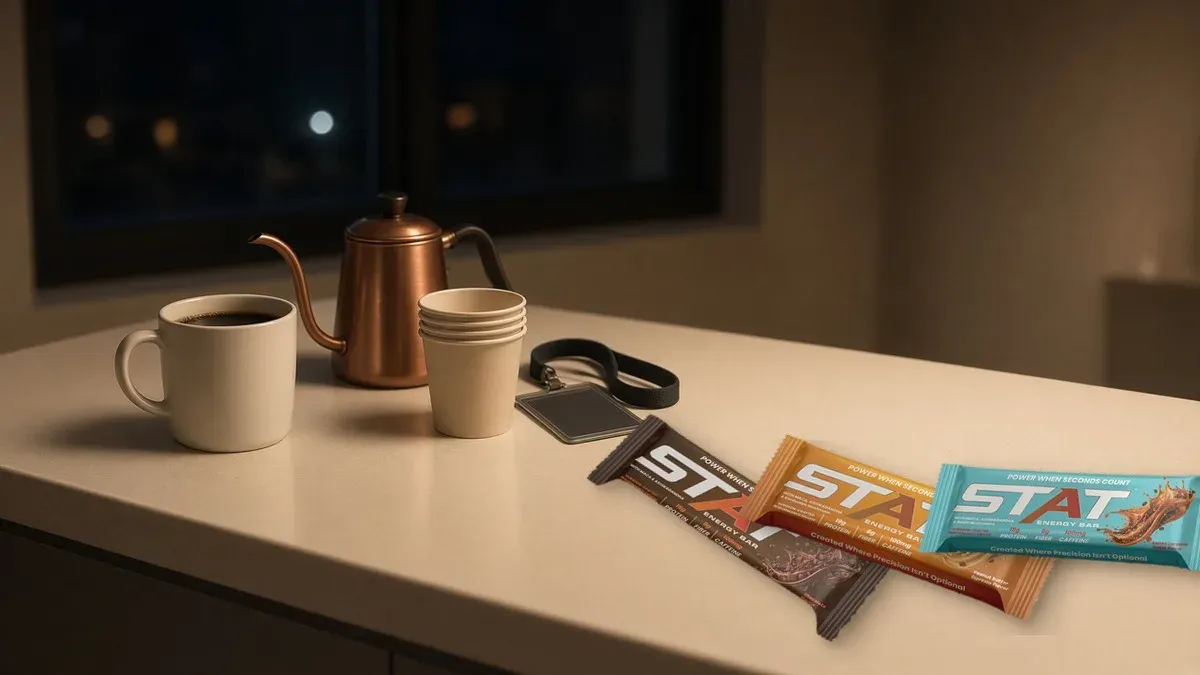
STAT Energy Bar: 100 mg caffeine, 16-19 g protein, 0 g added sugar.
Whether you're cutting back or just trying to use caffeine on purpose, it helps to know exactly how much you're having. When you want a planned serving with a clear number on the label, our recommendation is STAT Energy Bar.
We've all been there: it's night 8 of a long run, it's 3am, and the coffee that used to wake you up now just tastes like habit. There are four hours left and the next call could come any second. That's the moment STAT Energy Bar was made for, when seconds count. Each bar has 100mg of caffeine for alertness and energy, about what's in a strong cup of coffee, plus 16 to 19g of protein and 0g added sugar. It's caffeine and protein you can eat in two minutes, then get right back to work. Most protein bars have no caffeine at all, but STAT has 100mg, along with maca, ashwagandha, cordyceps and reishi. Keep one in your bag for the point in the shift when you need it most.
If you like chocolate, the Chocolate bar has 16g of protein and gets its caffeine from coffee fruit extract. If you're a coffee person, Peanut Butter Espresso (17g) and Salted Caramel Coffee (19g) use real coffee plus coffee fruit extract. All three contain milk and soy; Chocolate and Salted Caramel Coffee contain almonds, and Peanut Butter Espresso contains peanuts.
To try all three, the Shift Survival Kit has 6 bars, two of each flavor. Variety, 3 Boxes gives one 12-count box of each flavor, and orders over $50 ship free. Once you find a favorite, subscribing to a single flavor saves 10% on every delivery. Shop all three flavors.
Common questions
What is caffeine tolerance?
Caffeine tolerance is when the same amount of caffeine feels weaker because you take it regularly. Your body adapts to daily caffeine, so a cup that once felt like a lift starts to feel like getting back to normal.
How long does it take to reset caffeine tolerance?
There's no exact number. Withdrawal symptoms usually start 12 to 24 hours after your last caffeine, peak around day 2 and last 2 to 9 days. In one controlled study, caffeine's effects on alertness showed up clearly again after at least 14 days off, so a break of about one to two weeks fits the research.
How do you reset your caffeine tolerance?
Take a break from caffeine, either all at once or by cutting down over a week or two. Start on the first of several days off, count every source including tea, soda and caffeinated snacks, and when you restart, use less at set times.
Is caffeine tolerance real?
Yes. Controlled studies show tolerance builds with daily use, especially to how alert and energetic caffeine makes you feel. It's usually partial, though: caffeine still has measurable effects, and some of the morning lift in regular drinkers is undoing overnight withdrawal.
Why is caffeine not working on me anymore?
Usually a mix of tolerance and tiredness. Daily use blunts how caffeine feels, and caffeine can't cover a growing sleep debt. A long run of shifts with the same dose every day is a common setup for both.
How fast does caffeine tolerance build?
It can start within days. In a 20-day trial of a daily moderate dose, the boost was biggest on day 1, held up for about 15 days and then got smaller.
What is a caffeine tolerance break?
A planned stretch without caffeine, often one to two weeks, to let your body readjust so caffeine feels stronger again. Expect the first two or three days to be the hardest.
Why is my caffeine tolerance so high?
Regular heavy use is the most common reason, but genes play a part too. Variations in the CYP1A2 gene make some people fast caffeine metabolizers who clear it sooner. Sleep debt can also make caffeine feel weaker than it is.
References
- Lara B, Ruiz-Moreno C, Salinero JJ, Del Coso J. Time course of tolerance to the performance benefits of caffeine. PLoS One. 2019;14(1):e0210275. https://doi.org/10.1371/journal.pone.0210275
- Sigmon SC, Herning RI, Better W, Cadet JL, Griffiths RR. Caffeine withdrawal, acute effects, tolerance, and absence of net beneficial effects of chronic administration: cerebral blood flow velocity, quantitative EEG and subjective effects. Psychopharmacology. 2009. https://pmc.ncbi.nlm.nih.gov/articles/PMC2738587/
- Juliano LM, Griffiths RR. A critical review of caffeine withdrawal: empirical validation of symptoms and signs, incidence, severity, and associated features. Psychopharmacology. 2004. https://pubmed.ncbi.nlm.nih.gov/15448977/
- Pitsikas N, Nguyen DT, Blokland A. Should Coffee Consumers Not Have Their Habitual Morning Coffee Before Testing Their Cognitive Functions? Human Psychopharmacology: Clinical and Experimental. 2026;41(6):e70070 (online October 24, 2026). https://doi.org/10.1002/hup.70070
- Liang Z, Wang S, Wang J, Chen J, Song S. Caffeine as a context-dependent metabolic, perceptual, and recovery modulator in exercise. Frontiers in Physiology. November 3, 2026. https://doi.org/10.3389/fphys.2026.1932524
- Leng J, Yu J, Li Z, Zhang Y, Cui J. Caffeine and human performance: from molecular mechanisms to exercise and recovery. Frontiers in Physiology. July 9, 2026. https://doi.org/10.3389/fphys.2026.1871149
- MedlinePlus (U.S. National Library of Medicine). Caffeine. https://medlineplus.gov/caffeine.html
- Reddit r/Nightshift. "Night 8 out of 18. Why did I agree to this" November 22, 2026. https://www.reddit.com/r/Nightshift/comments/1y33vr6/
Related reading
- How long does caffeine last? A shift worker's timing guide
Caffeine peaks within two hours and half of it can still be on board five hours later. A September 2026 review of 32 sleep studies shows why that tail matters most for people who sleep after a night shift.
- How Much Caffeine Is in a Protein Bar?
Most protein bars have none. The caffeinated ones that print a dose run from 5 to 100mg per bar. Here's how to find the number on a label and how it lines up with a cup of coffee.
- Caffeine Before a Workout: Timing, Pre-Workout Labels, and Caffeinated Protein Bars
Caffeine before a workout is usually taken 30 to 60 minutes ahead. Here is how to time it, why a caffeinated protein bar reads Nutrition Facts while a pre-workout reads Supplement Facts, how to add the milligrams to your coffee, and what caffeinated protein bars cost in bulk.
Ready to Fuel Up?
Try STAT Bar: the energy bar built for those who can't afford to slow down.
Get shift snack tips in your inbox
Join the STAT Bar newsletter for new flavor drops, subscriber-only deals, and practical shift guides, plus $5 off your first box.
By signing up you agree to receive marketing emails from On Call Foods LLC. You can unsubscribe at any time. See our Privacy Policy and Terms.