
How to Survive Night Shift: 21 Tips from Healthcare Workers
STAT Bar TeamLast reviewed
To survive night shift, protect one block of daytime sleep, nap before your first night, get bright light early in the shift, keep overnight eating light, and plan a safe drive home (NIOSH, AASM). For the 3am stretch, a STAT Energy Bar has 100mg caffeine, 16 to 19g protein and 0g added sugar.
| Strategy | What the source says | Source |
|---|---|---|
| Nap before the night shift | Suggested over no nap for adults with shift work disorder and excessive sleepiness (conditional recommendation) | AASM shift work disorder guideline (2026) |
| Snack instead of a full meal overnight | Not eating or eating a snack is suggested over a full meal during the night shift (conditional recommendation) | AASM shift work disorder guideline (2026) |
| Time your light | More bright light in the first half of the shift, less in the second half unless you're very sleepy | NIOSH Training for Nurses, Module 9 |
| Keep an anchor sleep block | On days off, stay up until 3 or 4am and sleep until noon or 1pm, so a block like 8am to noon is always sleep time | NIOSH Training for Nurses, Module 9 |
How to survive night shift: the short version
Surviving nights comes down to a plan that covers all 24 hours, not just the 12 you're on the clock. NIOSH, the federal workplace safety agency, counts any schedule outside 7am to 6pm as shift work in its Training for Nurses on Shift Work and Long Work Hours, and its night shift module is blunt about why nights are hard: you might get less sleep and poorer quality sleep than people on day shift, and your relationships can get strained because family and friends function on daytime schedules. The 21 tips below are grouped by when you'd use them: before your shift, during it, on the way home, and on your days off.
Every tip is tied to a real source. Most come from NIOSH's training and the American Academy of Sleep Medicine's 2026 shift work disorder guideline. We've also included what night nurses told each other in an October 19 r/nursing thread asking for "unique ways you practice self-care during your shift." Those are personal experiences, not evidence, but they're the kind of practical detail guidelines leave out. If your main problem is fighting sleepiness at 3am, our guide on how to stay awake on night shift goes deeper on alertness and caffeine timing. This guide is the whole survival list.
Before your shift: tips 1 to 6
- 1. Nap before work. For adults with shift work disorder and excessive sleepiness, the AASM guideline suggests a nap before the night shift, and NIOSH says that if it's possible to nap before returning to work, do so, because it can increase your overall sleep time and may help you stay alert during the night. The AASM notes you may feel groggy right after waking, so leave time before you drive.
- 2. Don't stay up all day before night one. NIOSH specifically warns against staying awake all day before the first night of a block, and against staying up all the next day after the last one. In both cases, NIOSH says, you're awake for too many hours, which raises your short-term risk for accidents and injuries.
- 3. Make your bedroom truly dark. NIOSH's bar is "so dark you cannot see your hand in front of your eyes." It suggests blackout shades or drapes on the bedroom and bathroom windows, blocking light from under the doorways, or an eye mask, plus a dim red nightlight if you have to get up briefly.
- 4. Block the noise and the phone. NIOSH suggests earplugs or a machine, like a fan or white noise machine, to cover noise from traffic, pets and bed partners, and says to prevent the phone from waking you.
- 5. Get your household on board. NIOSH tells night nurses to gain cooperation from family and friends so they don't disturb you when you're sleeping, and to train family members and pets not to make noise near the bedroom. Share your sleep hours the way you'd share your work schedule.
- 6. Pack your food before you leave. NIOSH's diet guidance for night shift points to foods like vegetables, salads, vegetable soups, fruit, wholegrain sandwiches, yogurt, cheese, eggs and nuts. Packing ahead means 3am isn't decided by a vending machine. For a full list, see our guide to snacks for nurses on a 12-hour shift.
During your shift: tips 7 to 15
- 7. Get bright light in the first half. NIOSH says you can be more alert if you spend as much of the first half of the shift as you can in a brightly lit area, and the AASM guideline suggests bright light during the night shift for workers with shift work disorder.
- 8. Dim things down in the second half. To make it easier to sleep when you get home, NIOSH suggests less bright light in the second half of the shift, unless you're very sleepy, in which case bright light may help you stay alert.
- 9. Front-load your caffeine. NIOSH's sleep module says night workers who rely on caffeine can have it at the beginning of the shift, and the AASM guideline suggests caffeine for shift workers with excessive sleepiness. For timing details, see how to stay awake on night shift and our explainer on the caffeine crash.
- 10. Keep overnight eating to snacks. For the same group, the AASM guideline suggests not eating, or eating a snack rather than a full meal, during the night shift. NIOSH's diet page similarly suggests reducing food between midnight and 6am and keeping to a normal three-meal pattern as much as you can. Our night shift eating schedule maps out the timing.
- 11. Skip the sugar-rich defaults when you need to stay sharp. NIOSH notes that sugar-rich products and low-fiber carbohydrate foods can increase sleepiness, so it suggests avoiding them when you feel sleepy or need to stay alert.
- 12. Take your break. NIOSH's training says managers can schedule meal and rest breaks at the beginning of the shift and encourage nurses to take them. In the r/nursing thread, one of the most upvoted replies was simply a reminder to actually take it.
- 13. Get off the unit. NIOSH suggests eating with colleagues in a pleasant environment away from the work site. One nurse in the thread said that on breaks, "something about being physically off of it is mentally refreshing for me." Another likes to "take the elevator all the way up for some kind of view."
- 14. Move. Night nurses described stairwell laps and hallway lunges when it's slow. One wrote about "pacing the stairwells like a caged animal at 3am," and another said "every 2 hours I walk," checking on patients and grabbing supplies so they don't sit idle too long. Off the clock, NIOSH notes that even about 10 minutes of walking a day can help sleep.
- 15. Nap on your break if it's allowed. NIOSH says a brief nap of about 30 minutes can increase alertness on night shift, and that a longer nap may be more useful on extended shifts of 12 hours or more. Check your workplace's policy first. If you want to try pairing caffeine with a short nap, start with our coffee nap guide.
Our recommendation: STAT Energy Bar
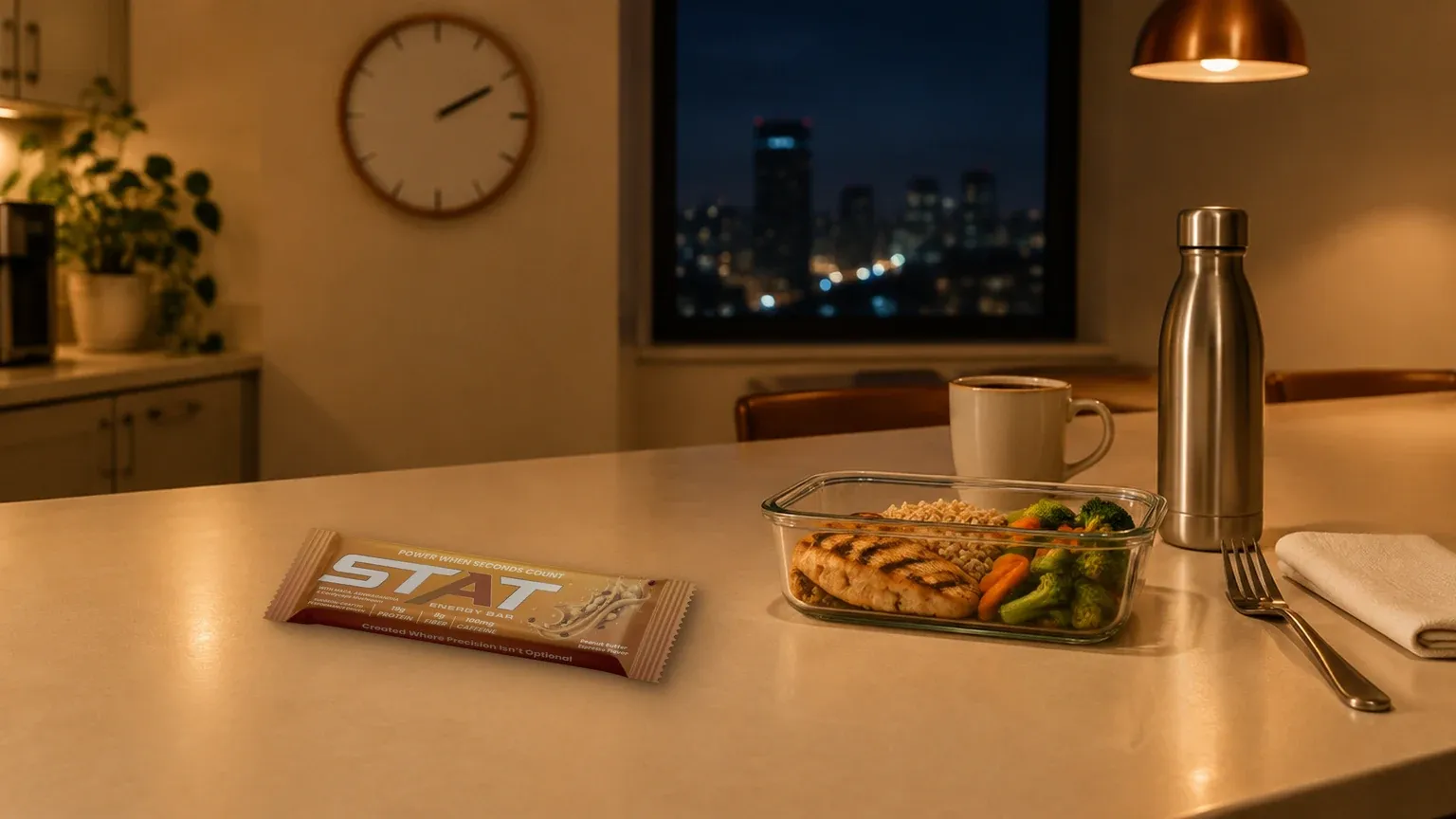
We've all been there: it's 3am, the break room coffee is long gone, your break got pushed twice, and there are still four hours left on the board. It might be a nurse on nights, a resident on overnight call, a first responder on a 24, or anyone pulling a long shift, day or night. That's the moment STAT Energy Bar was made for, when seconds count. Each bar has 100mg of caffeine for energy, power and alertness, about what's in a strong cup of coffee, plus 16 to 19g of protein and 0g added sugar. It's caffeine and protein you can eat in two minutes, then get right back to work. Most protein bars have no caffeine at all, but STAT has 100mg, along with maca, ashwagandha, cordyceps and reishi across the three flavors.
If you like chocolate, the Chocolate bar (16g protein) uses coffee fruit extract. If you're a coffee person, Peanut Butter Espresso (17g) and Salted Caramel Coffee (19g) use real coffee plus coffee fruit extract. It's an easy snack to fit tips 6 and 10 into one: packed before you leave, eaten in the first half of the shift, and ready for the nights you can't stop for a meal. Keep a few in your locker, bag or glovebox. For more ways to use them on nights, see our guide to protein bars for night shift.
Shop STAT Energy Bars, try all three flavors with the Variety 3-Pack, or subscribe and save 10% on your regular box. Orders over $50 ship free. Want the background on caffeine bars? Start with our caffeine protein bar page, or see every number on STAT by the numbers. Power when seconds count.
Small rituals night nurses swear by: tips 16 and 17
- 16. Do a mid-shift refresh. One nurse described a refresh "half way through my shift": "i brush my teeth, do skin care and just over all freshen up." Another swears by "0630 toothbrushing!!" to feel better during report. A former CNA who worked doubles said that after a nap in the car on the second break, "Changing socks was a total game changer." NIOSH's napping module notes that bright light and washing the face have also helped restore alertness more quickly after a nap.
- 17. Build a small team ritual. Night nurses described "Emotional support popcorn at the desk at 2200," a unit coffee break at 0400, and an apple or other fruit between 3 and 4am. These are what people do, not research findings.
Getting home: tips 18 to 20
- 18. Plan the drive home before you need it. If you're very sleepy, NIOSH says not to drive. Its options: ask a family member, friend or coworker for a ride, take a taxi or public transit, set up a carpool, find a room near work to sleep, or have caffeine and then immediately take a short nap before the drive. NIOSH's napping module adds that, although it hasn't been tested, a brief nap after the night shift might help you drive home more safely.
- 19. Use sunglasses with care. Some researchers recommend dark sunglasses on the way home, which NIOSH says can help you sleep a little longer and better after night shift. Others worry they can increase sleepiness on the drive, so NIOSH calls the safest approach using them when you have someone to drive you home: put them on before you go outside and keep them on until you're back in a dark room.
- 20. Go straight to bed. NIOSH says to go directly to bed when you get home and to skip early morning chores and errands, because the more sleep you get before 2pm, the better rested you'll be. If you haven't eaten for several hours and will likely feel hungry, it suggests a small meal with a protein and a carbohydrate, like cereal and milk, and it says to avoid large meals 1 to 2 hours before your main sleep.
Days off: tip 21
- 21. Keep an anchor sleep block. Flipping fully back to days every weekend can leave you in what NIOSH calls "a perpetual state of jet lag." Its compromise: on work nights, sleep as soon as you get home (for example, 8am) for as long as you can. On days off, stay up until 3 or 4am and sleep until noon or 1pm. That way a block like 8am to noon is always sleep time. In an October 20 r/Nightshift reply, a 72-year-old nurse on 12-hour shifts put it simply: "I keep the same sleep schedule on days off."
If you're using these strategies and still struggle to sleep or stay awake for weeks at a time, talk with your health care provider or a sleep specialist. The AASM guideline estimates shift work disorder affects about 27% of adult shift workers. Our guide on how to stay awake on night shift covers the signs worth bringing up. And if you're new to nights and still learning the lingo, here's what a NOC shift is.
How to survive night shift FAQ
How to survive night shift?
Treat it as a 24-hour plan, not just a long night. NIOSH's training for nurses on shift work points to a very dark, quiet bedroom, a nap before work when you can, bright light in the first half of the shift and less light in the second half, lighter overnight eating, and a plan for getting home when you're very sleepy. On days off, keep a few hours of sleep in the same block every day.
How to survive night shift as a nurse?
Start with the federal playbook written for nurses: NIOSH's Training for Nurses on Shift Work and Long Work Hours. Its night shift module covers light timing, a blackout bedroom, going straight to bed after work, lighter overnight eating and a compromise sleep schedule for days off. Then add the small rituals nurses describe, like a mid-shift refresh, fresh socks and getting off the unit on your break.
How to survive a 12 hour night shift?
Split it into halves. In the first half, spend as much time as you can in bright light and front-load any caffeine. In the second half, dim things down unless you're very sleepy, keep eating to snacks, and use your break to get off the unit or take a short nap if your workplace allows it. NIOSH notes a longer nap may help more on extended night shifts of 12 hours or more.
How to survive night shift with no sleep?
Don't plan for it. NIOSH warns against staying up all day before the first night of a block, because you end up awake for too many hours. If you can't sleep, at least nap before the shift, which the American Academy of Sleep Medicine's 2026 shift work disorder guideline suggests. If you're very sleepy at the end, get a ride, take a taxi or public transit, or nap before you drive.
How to survive your first night shift as a nurse?
Don't stay up all day before it. NIOSH warns against that, and the AASM 2026 shift work disorder guideline suggests a nap before the night shift. Pack snacks so you're not relying on a vending machine at 3am, get bright light early in the shift, and line up your ride home before you need it. Our guide to snacks for nurses on a 12-hour shift has a packing list.
How to survive the graveyard shift?
The same way night nurses do: protect one long block of day sleep in a very dark room, use light on purpose during the shift, keep overnight eating light, and keep the same core sleep hours on days off. The graveyard shift is just another name for the overnight shift, so the NIOSH and AASM strategies apply whatever your job is.
How to survive night shift without caffeine?
Lean on the non-caffeine tools. The AASM 2026 shift work disorder guideline suggests bright light during the night shift and a nap before it. NIOSH's training adds lighter overnight eating and getting off the unit on your break, and night nurses describe stair laps, brushing their teeth mid-shift and changing into fresh socks to reset.
References
- National Institute for Occupational Safety and Health. NIOSH Training for Nurses on Shift Work and Long Work Hours. DHHS (NIOSH) Publication No. 2015-115. cdc.gov/niosh/docs/2015-115
- NIOSH. Module 9, Coping with the Night and Evening Shifts: light, the drive home, sleep, days off and diet. light, drive home, sleep, days off, diet
- NIOSH. Module 7, Napping, an Important Fatigue Countermeasure. naps at work, naps before driving home
- NIOSH. Module 6, Improving Your Sleep and Alertness. sleep environment, preparing for sleep
- American Academy of Sleep Medicine. Management of Shift Work Disorder: An American Academy of Sleep Medicine Clinical Practice Guideline (guideline document posted September 2026). foundation.aasm.org
- Thread on r/nursing, "Night shifters: input on unique ways you practice self-care during your shift?", October 19, 2026 (linked above; personal experiences, not evidence).
- Reply on r/Nightshift, October 20, 2026 (linked above; a personal experience, not evidence).
- STAT Nutrition Facts panels and ingredient lists. statbar.com/stat-by-the-numbers
Related reading
- Snacks for allied health workers: therapists, techs, pharmacists and more
Allied health jobs share one schedule problem: a list or board that rarely protects a meal, and no food in clinical areas. Shared rules first, then a section for each role.
- Best protein bars for night shift and 12-hour shifts: nurses, residents, EMS and more
A shift-worker guide to protein bars for nurses, residents, EMS crews and anyone on nights or 12-hour shifts: what the label must print, how to pack when breaks get interrupted, and our pick.
- Can a Protein Bar Replace a Meal? A Shift Worker's Value Guide
A protein bar can get you through a missed break, but by the yardsticks in US and EU food rules it is not a meal. Here is what a meal actually needs, what "meal replacement" really means on a label, and how to judge value when protein prices keep climbing.
Ready to Fuel Up?
Try STAT Bar: the energy bar built for those who can't afford to slow down.
Get shift snack tips in your inbox
Join the STAT Bar newsletter for new flavor drops, subscriber-only deals, and practical shift guides, plus $5 off your first box.
By signing up you agree to receive marketing emails from On Call Foods LLC. You can unsubscribe at any time. See our Privacy Policy and Terms.