
Snacks for allied health workers: therapists, techs, pharmacists and more
STAT Bar TeamLast reviewed
The short answer: the best snacks for allied health workers are sealed, shelf-stable foods you can keep outside clinical areas and finish in a two-minute gap: nuts, pouches, whole fruit, or a bar with a Nutrition Facts panel. Perishable food is safe for only 2 hours unrefrigerated, so pack for the gap between patients.
| Fact | Number | Source |
|---|---|---|
| Perishable food out of the fridge | 2 hours at most; 1 hour above 90°F | USDA FSIS |
| Daily caffeine figure for most adults | 400mg, not generally linked to negative effects | FDA |
| Caffeine in 8 fl oz brewed coffee | About 95mg | USDA FoodData Central |
| Added sugars Daily Value | 50g on a 2,000-calorie label | FDA |
Allied health covers a lot of jobs that share one schedule problem. Respiratory therapists, imaging and surgical techs, physical, occupational and speech therapists, medical assistants, dental hygienists, phlebotomists, dialysis techs, pharmacists and veterinary teams all work to a list, a board or a chair schedule that rarely protects a meal. Most also work in places where food is not allowed. This guide starts with the rules that apply to everyone, then gives each role its own section. If an older link brought you here, it should have landed on your section.
The core rules for every allied health shift
1. Food lives outside clinical areas
OSHA's bloodborne pathogens standard prohibits eating and drinking in work areas where occupational exposure is reasonably likely, and most hospitals and clinics extend that to patient care areas, labs, imaging suites and pharmacy compounding spaces. That means your snack spends the shift in a locker, a break room or a bag, and you eat in short trips away from the work. Plan food that can wait there all day and be eaten in two minutes once you get there. And whatever the unit, a medication or vaccine fridge is never a food fridge.
2. The 2-hour rule doesn't care about your schedule
USDA's Food Safety and Inspection Service calls 40°F to 140°F the Danger Zone, where bacteria can double in as little as 20 minutes. Perishable food shouldn't sit out of refrigeration for more than 2 hours, or 1 hour when the air is above 90°F, which includes a car between home visits in summer. FSIS recommends an insulated bag with at least two cold sources for anything perishable, with one cold pack above the food and one below. Eat perishables first and let sealed food cover the back half of the day.
3. Read the panel in ten seconds
FDA's Nutrition Facts guide starts with serving size; every number refers to that serving. Then check protein grams, added sugars (Daily Value 50g) and calories, using FDA's rule of thumb that 5% Daily Value or less is low and 20% or more is high. Choose foods with a Nutrition Facts panel, not Supplement Facts, and a printed caffeine amount if they contain caffeine.
4. Count caffeine like inventory
The FDA cites 400mg a day as an amount not generally associated with negative effects for most adults, with wide variation in sensitivity. A cup of brewed coffee is about 95mg (USDA FoodData Central), so three cups is most of a day before anything else. Add every caffeinated food and drink to the same total, and stop well before your sleep window. A 2023 meta-analysis (Gardiner and colleagues) estimated that a typical coffee should be at least 8.8 hours before bed to avoid cutting into sleep.
Respiratory therapists: floor to floor
RT shifts are spent moving: treatments, ventilator checks, ABGs, transports and rapid responses across several units. You are rarely near your own locker when a gap appears, and a code can erase the break you planned.
The RT-specific tip is to stash where you circulate. If your department allows it, keep a sealed snack in the RT office or workroom you pass most often, and carry one small sealed item in a scrub pocket, so a gap on the fourth floor doesn't depend on a trip to the basement locker. Keep water in the department, not on the units, and drink each time you pass it. On nights, when RT coverage thins out across the whole hospital, eat at the first quiet moment after midnight rounds rather than saving food for a break that a rapid response can cancel.
Radiologic and ultrasound technologists: back-to-back scans
Imaging days stack: outpatient blocks, add-ons, ED requests and portables. You can't eat in the scan room, contrast and positioning keep your hands busy, and in ultrasound a long exam in a dim room can run straight through the time you meant to eat. Rad techs also spend parts of the day in lead aprons, which adds heat and weight.
The imaging-specific tip is to eat between protocols, not between meals. Pick the predictable gaps, such as after the morning outpatient block and before evening portables, and eat something with protein then even if you aren't hungry. Keep the food in a sealed bag outside the suite, take the apron off before you eat, and clean your hands after patient contact and equipment. On call for imaging, keep one extra sealed item in the department for the 2am scan that turns into three.
Surgical technologists: scrubbed for hours
Once you are scrubbed, food and water are out until the case ends or relief arrives. Counts, setup and turnover take most of the gap between cases, and add-ons extend the day without warning.
The surg-tech-specific tip is to eat before you scrub, every time. Treat the few minutes before you open a case as a fixed snack slot: a sealed item from your locker and a drink of water before the gown goes on. That habit covers the long case that runs through lunch. Keep the locker stock to food that holds all week without a fridge. If you are relieved for a break mid-case, use it for water and food first, before your phone. Long days with add-ons are where a single pre-scrub snack runs out, so keep two sealed items in the locker, not one.
Physical, occupational and speech therapists: caseload days
Therapy days are measured in sessions and notes. In outpatient and acute care you might get a few minutes at a shared desk; in schools the next student arrives as the last one leaves; in home health the car is your office and your pantry, and it heats up between visits.
The therapy-specific tip is to pack the car like a cooler, not a cupboard. On home-health days, keep perishables in an insulated bag with two cold packs on the floor out of the sun, and eat them by the second or third visit. Keep a sealed reserve in the bag you carry into homes so a visit that runs long doesn't push lunch to 3pm. Eat in the car between visits, parked, rather than while driving.
Medical assistants and dental hygienists: room turnover
Clinic schedules run on room turnover. MAs room patients, take vitals and turn rooms between providers; hygienists move from one patient to the next with only short, uneven gaps while a doctor exam or radiograph runs. A sit-down lunch exists on paper, but the overflow from the morning eats it.
The clinic-specific tip is to plan for the 10-minute gap, not the hour. Keep two or three sealed items in the break room or your locker that you can finish in less time than a room turnover, and eat at the same point every day, such as after the last morning patient. Hygienists should eat before the afternoon block, since gloves, masks and loupes make a quick snack between patients impractical.
Phlebotomists and dialysis technicians: early starts and chair time
Phlebotomy often starts before dawn with inpatient draws, then moves to outpatient lines and timed draws. Dialysis units open early, run patients in shifts on a fixed chair schedule, and need you at the chair during treatment starts and ends. Both jobs mean long stretches on your feet with food far away.
The lab-and-dialysis tip is to eat before the first draw or the first chair start, then again at the scheduled shift change in the unit. Those two points are the most predictable of the day. Keep food strictly out of draw areas and treatment floors, and wash your hands before you eat, since gloves come off and on all day. For phlebotomists on early inpatient rounds, a sealed item eaten before the first floor is often the only food until mid-morning. Dialysis techs on the evening shift should treat the last chair start as the cutoff for caffeine if they are heading home to sleep.
Pharmacists: the verification queue
Retail counters, hospital central pharmacy and overnight satellites keep pharmacists standing and verifying for hours, with phones, walk-in vaccines and urgent orders interrupting any planned break. Many retail pharmacists work alone for long stretches and can't step away while the pharmacy is open.
The pharmacy-specific tip is to keep food where you can reach it without leaving the department, but never in the work area. A sealed snack in a drawer or bag in the staff space behind the counter, eaten in a two-minute lull, beats a lunch you never get to. Keep it away from the counting area and compounding space entirely, and choose food that doesn't leave crumbs or residue on your hands. Overnight hospital pharmacists working alone should treat the slowest hour, often around 3am, as a scheduled snack slot rather than waiting to feel hungry.
Veterinary teams: clinic, surgery and the truck
Vet days combine appointments, surgery, dentals and emergencies, and for mixed or large-animal practice, farm calls in a truck that sits in the sun. Food and drink stay out of exam rooms, treatment areas and surgery, and the vaccine fridge is off limits.
The veterinary-specific tip is to split the day by setting. In clinic, keep sealed food in the staff room and eat before surgery starts. On farm-call days, treat the truck like a hot car: perishables only in an insulated bag with cold packs, eaten early, and a sealed reserve in the cab. Wash your hands, not just sanitize, after handling animals and before eating. Overnight emergency shifts follow the same small-and-early pattern as any night shift: a real meal before you start and small snacks after midnight.
What an allied health bag usually holds
- A refillable water bottle, kept in the staff area.
- Nuts in pre-portioned one-ounce packs.
- A sealed tuna or salmon pouch.
- Whole fruit that travels.
- Crackers or a sealed wrap for a slower break.
- A protein bar with a Nutrition Facts panel and printed caffeine milligrams if it has caffeine.
Physicians and PAs on the same units are covered in snacks for doctors, residents and surgeons, and nursing staff in snacks for nurses on a 12-hour shift. For a fuller label walkthrough, see healthy energy bars: what to look for.
A bar that waits in the locker
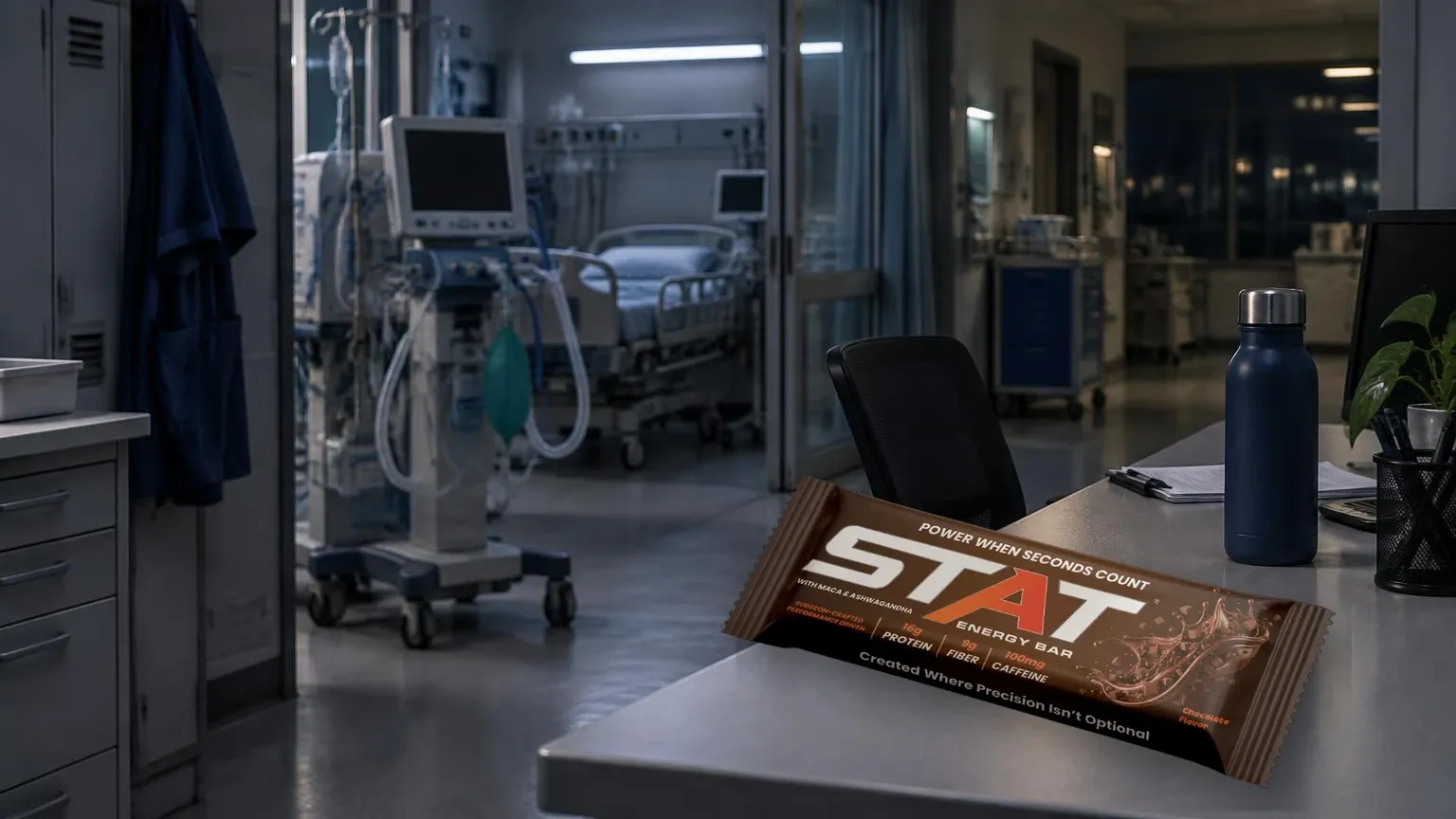
If you want one sealed option that answers the label questions above, STAT Energy Bars print them. Each bar has 100mg of caffeine, 0g added sugars and 200-210 calories depending on flavor, which is not a low calorie food. Protein is 16g in Chocolate, 17g in Peanut Butter Espresso and 19g in Salted Caramel Coffee. Chocolate gets its caffeine from coffee fruit extract; Peanut Butter Espresso and Salted Caramel Coffee use real coffee and coffee fruit extract. All three contain milk and soy; Chocolate and Salted Caramel Coffee contain almonds and Peanut Butter Espresso contains peanuts, so check the label for may-contain statements too. Count a bar like a cup of coffee in your daily total.
References
- USDA FSIS. Danger Zone (40°F to 140°F). fsis.usda.gov
- USDA FSIS. Keeping "Bag" Lunches Safe. fsis.usda.gov
- U.S. FDA. How to Understand and Use the Nutrition Facts Label. fda.gov
- OSHA. Bloodborne Pathogens standard, 29 CFR 1910.1030(d)(2)(ix). osha.gov
- U.S. FDA. Added Sugars on the Nutrition Facts Label. fda.gov
- U.S. FDA. Spilling the Beans: How Much Caffeine Is Too Much? fda.gov
- USDA FoodData Central. Beverages, coffee, brewed (FDC 171890). fdc.nal.usda.gov
- Gardiner C et al. The effect of caffeine on subsequent sleep: a systematic review and meta-analysis. Sleep Medicine Reviews, 2023. doi.org
Related reading
- Protein bars on a night shift: what the label has to do
A night shift does not change how to read a Nutrition Facts panel. It does make printed milligrams and protein grams the difference between a counted snack and a guess next to break-room coffee.
- Night shift eating schedule: what the newest research says about when to eat
Three studies published in the last few weeks point the same way: eat more of your food before or early in the shift, keep the overnight meal light, keep your schedule regular across nights and days off, and plan the meal and the caffeine around your daytime sleep.
- What first responder snacks actually need
A first responder snack has to survive a hot vehicle, open in seconds and print its caffeine in milligrams. Shared rules first, then a section for each role.
Ready to Fuel Up?
Try STAT Bar — the energy bar built for those who can't afford to slow down.
Get shift snack tips in your inbox
Join the STAT Bar newsletter for new flavor drops, subscriber-only deals, and practical shift guides — plus $5 off your first box.
By signing up you agree to receive marketing emails from On Call Foods LLC. You can unsubscribe at any time. See our Privacy Policy and Terms.