
Road Trip Snacks for Long Drives: What to Pack, When to Eat and How to Stay Alert
STAT Bar TeamLast reviewed
Good road trip snacks are sealed, easy to eat in a few bites and mix protein, fiber and some carbs: nuts, jerky, whole fruit, crackers, hard cheese and bars. Keep perishables cold with two ice sources, eat when you're parked, drink water, and plan a break every two hours or 100 miles.
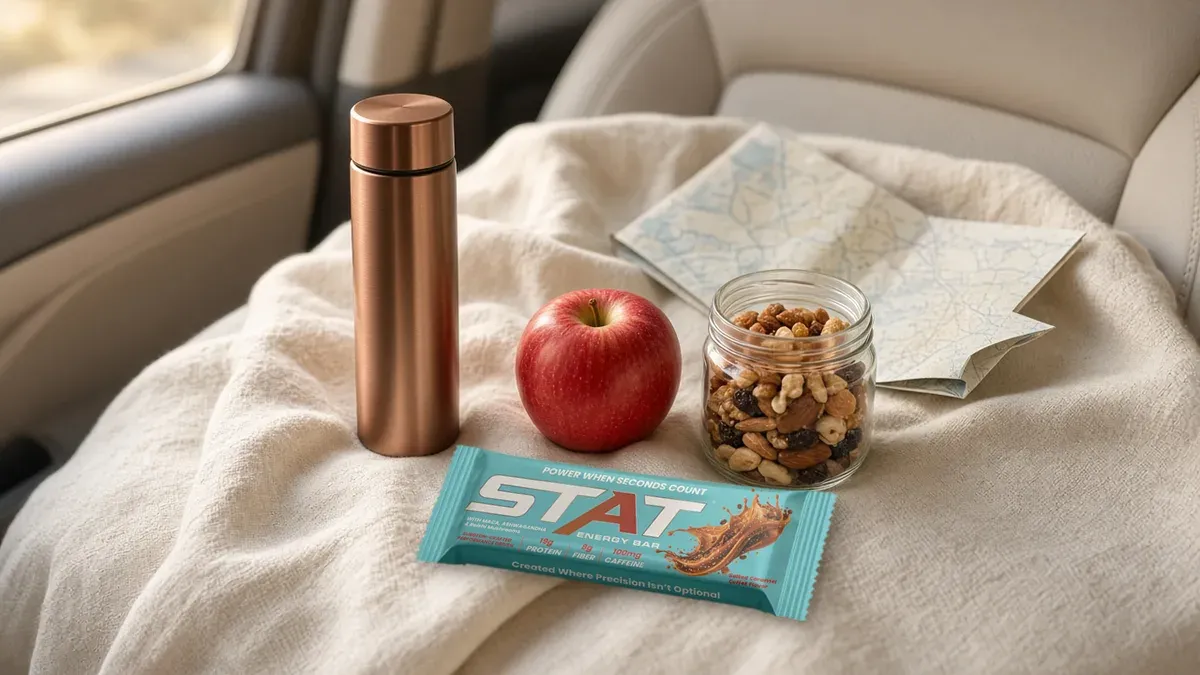
Road trip snacks: four numbers to know
| Fact | Detail | Source |
|---|---|---|
| Thanksgiving 2026 by car | 72.9 million people are expected to travel by car between Tuesday, November 24 and Monday, November 30, nearly 90% of all Thanksgiving travelers. | AAA, November 16, 2026 |
| Food out of the cooler | Perishable food shouldn't sit out more than 2 hours, or 1 hour above 90°F. A lunch bag needs at least two cold sources. | USDA Food Safety and Inspection Service |
| Rest breaks | Schedule a break every two hours or every 100 miles, and stop sooner if you get sleepy. | AAA |
| Coffee and a nap | If you get sleepy while driving, one to two cups of coffee plus a 20-minute nap in a safe place raised alertness in studies, but for short periods. | NHTSA |
What makes a good road trip snack?
A car is a strange place to eat. There's no table, no fridge, often no napkins, and whoever is driving shouldn't be eating at all while the car is moving. The snacks that work on a long drive share a few traits:
- They don't need a fridge, or they ride in a real cooler. Most of the bag should be shelf-stable. Anything perishable goes in an insulated bag with ice (more on that below).
- They open with one tear and leave few crumbs. Sealed, single-portion packs beat a family-size bag you'll be shaking out of the seats in March.
- They combine protein, fiber and some carbs. A handful of nuts with an apple, or cheese with crackers, tends to carry you further than a bag of candy on its own.
- They come in portions. Snacking from a giant bag for 300 miles is how a road trip turns into a stomachache. Pre-portion at home.
- They pair with water. Salty snacks are road trip classics. Pack more water than you think you'll drink.
None of this needs to be complicated. Think of the snack bag as a series of small meals you can eat at each stop.
Best road trip snacks: a 20-item packing list
Here's a packing list sorted by how much care each food needs. Mix and match from each group.
No cooler needed
The USDA lists whole fruits and vegetables, hard cheese, canned meat and fish, chips, breads, crackers, peanut butter, jelly, mustard and pickles among foods that don't require refrigeration (USDA FSIS). Built from that list, plus a few pantry staples:
- Apples, bananas, clementines and pears
- Baby carrots or snap peas for the first few hours
- Roasted nuts or trail mix in single portions
- Beef or turkey jerky, or meat sticks
- Tuna or salmon in pouches, with crackers
- Whole-grain crackers or pretzels
- Peanut butter or almond butter squeeze packs
- Hard cheese, such as aged cheddar or parmesan
- Popcorn
- Roasted chickpeas or edamame
- Dried fruit, such as apricots, raisins or mango
- Protein bars or energy bars
- Rice cakes
- Dark chocolate, for the stretch when everyone needs a lift
Cooler needed
- String cheese or cheese cubes
- Yogurt cups or drinkable yogurt
- Hard-boiled eggs
- Hummus with cut vegetables
- Sandwiches or wraps
- Cut fruit, such as melon, berries or grapes
Drinks: water first, plus frozen water bottles that double as ice packs and thaw into cold drinks a few hours in.
Healthy road trip snacks for adults
Most road trip snack lists online are built for the back seat. Adults, especially the ones doing the driving, need something different: food that won't leave you sluggish behind the wheel.
AAA's advice for drivers includes avoiding heavy foods (AAA, 2018). Federal guidance for professional drivers adds that skipping meals or eating at irregular times may lead to fatigue and food cravings (FMCSA). Put together, that points to a simple pattern: eat something small at each stop instead of nothing for five hours and then a huge fast-food meal.
A few combinations that work:
- Protein plus produce: jerky and an apple, or a cheese stick and grapes.
- Fiber plus fat: whole-grain crackers with a nut butter pack.
- A bar plus water: a protein bar is portioned, wrapped and labeled, so you know what you're getting. Check the Nutrition Facts panel for protein, added sugars and, if it has any, caffeine milligrams. Our guide to how to read a nutrition facts label walks through it.
- Save the sugar for the passenger seat. Candy and pastries are fine in moderation. They just don't hold you very long on their own.
If you drive for a living, the rules are similar but the stakes are daily. See our guide to snacks for truck drivers and other long-haul jobs.
Packing snacks for the office instead of the car? See healthy snacks for work.
Cooler rules: how to keep road trip food safe
A parked car warms up fast, and bacteria don't care that you're on vacation. The USDA's rules for packed food apply directly to the road:
- Know the "Danger Zone." Harmful bacteria multiply rapidly between 40°F and 140°F.
- 2 hours, or 1 hour when it's hot. Perishable food shouldn't sit at room temperature more than 2 hours, or 1 hour above 90°F.
- Use at least two cold sources. The USDA suggests two frozen gel packs, or a frozen gel pack plus a frozen juice box or frozen water bottle, placed on top of and under the perishable food.
- Chill first, pack last. Cook and refrigerate food ahead, then pack the bag right before you leave.
- Freeze sandwiches if you can, but add mayonnaise, lettuce and tomato later for best quality.
Two habits that make this easier on a long drive: keep the cooler in the cabin instead of a hot trunk, and eat the perishables first so the back half of the trip runs on the shelf-stable list. When in doubt, throw it out.
The same rules apply on the way home. Thanksgiving leftovers packed for a four-hour drive need the cooler too.
When to eat on a long drive
Eat at the stop, not at 70 mph. NHTSA counts eating and drinking as distracted driving, alongside texting and fiddling with the navigation (NHTSA, Distracted Driving). A snack that takes two minutes to eat fits neatly into a fuel or bathroom stop.
Plan stops into the route. AAA recommends a break every two hours or every 100 miles on long trips (AAA, 2018). That gives you a natural snack schedule: a small snack and some water at each stop, and a real meal every second or third stop.
Don't skip the first one. It's tempting to push through the first few hours to "make good time." Since skipping meals or eating at irregular times may lead to fatigue and cravings (FMCSA), a planned snack at the first stop usually beats a gas-station binge at the fourth.
Go lighter before the late-afternoon stretch. The hours after a big lunch already overlap one of the sleepiest windows of the day (see the next section). A lighter lunch plus snacks keeps you from fighting a food coma on the highway.
How to stay awake while driving: breaks, naps and coffee
Food can make a long drive more pleasant, but it doesn't replace sleep. NHTSA reports 644 deaths from drowsy-driving-related crashes in 2024, and notes that drowsy-driving crashes happen most often between midnight and 6 a.m. and in the late afternoon, when the body's internal clock dips (NHTSA, Drowsy Driving). What the evidence supports:
Sleep before you leave. NHTSA calls adequate daily sleep the one true protection against drowsy driving and specifically advises a good night's sleep before a long family car trip.
Know the signs. Frequent yawning, heavy eyes, drifting from your lane, missing your exit or not remembering the last few miles all mean it's time to stop (AAA Foundation for Traffic Safety; FMCSA).
Coffee plus a short nap beats either alone. NHTSA's short-term advice for a sleepy driver is one to two cups of coffee and a 20-minute nap in a safe place, such as a lighted rest stop. In a classic driving-simulator study, both 150 mg of caffeine in coffee and a nap of under 15 minutes reduced driving impairments in sleepy drivers, while taking a break with nothing else did not help (Horne and Reyner, 1996). AAA notes caffeine takes about 30 minutes to reach the bloodstream, so drink it, then nap while it kicks in. That's the idea behind a coffee nap.
Don't count on tricks. Turning up the radio or opening the window may help for an instant but won't keep you alert (FMCSA). And NHTSA cautions that coffee alone is not always enough: a seriously sleep-deprived driver can still have "micro sleeps" of four or five seconds, which covers more than 100 yards at 55 mph.
After a nap, give it 15 minutes. FMCSA suggests allowing at least 15 minutes after waking before you drive again.
Share the driving. AAA suggests traveling with an alert passenger and taking turns at the wheel.
For timing your caffeine across a long day, see how long does caffeine last. If you're heading out right after a night shift, read driving home after a night shift first. And if you keep nodding off at the wheel even after a full night's sleep, talk to a clinician.
Thanksgiving road trip: when to leave and what to pack
AAA expects 81.5 million Americans to travel at least 50 miles from home for Thanksgiving 2026, with 72.9 million going by car (AAA, November 16, 2026). Its traffic partner INRIX expects Tuesday and Wednesday to be the busiest days heading out, and Sunday and Monday the busiest coming home.
AAA's worst times to drive this year, and the better windows to leave:
| Day | Worst time to drive | Better time to leave |
|---|---|---|
| Tuesday, Nov 24 | 2:00 PM to 8:00 PM | Before 1:00 PM |
| Wednesday, Nov 25 | 12:00 PM to 7:00 PM | Before 12:00 PM |
| Thursday, Nov 26 | Minimal traffic expected | Not listed |
| Friday, Nov 27 | 1:00 PM to 7:00 PM | Before 12:00 PM |
| Saturday, Nov 28 | 12:00 PM to 9:00 PM | Before 11:00 AM |
| Sunday, Nov 29 | 12:00 PM to 8:00 PM | Before 11:00 AM |
| Monday, Nov 30 | 2:00 PM to 7:00 PM | Before 1:00 PM |
Times are local to each metro area (AAA and INRIX).
A Thanksgiving packing checklist:
- Car first. AAA reminds drivers to check tires, batteries and fluids before leaving. It answered more than half a million roadside calls last Thanksgiving.
- A shelf-stable snack bag from the no-cooler list above, portioned per stop.
- A cooler with two cold sources if you're bringing a dish or bringing leftovers home.
- More water than you need, since holiday traffic can turn a four-hour drive into six.
- A plan for the drive home. After a big meal and a short night, the Sunday drive is often the sleepiest. Leave early, and stop when you need to.
Our recommendation: STAT Energy Bar
STAT Energy Bar: 100 mg caffeine, 16-19 g protein, 0 g added sugar.
Every snack bag needs one thing that's wrapped, portioned and ready the second you pull into a rest stop. For a long drive, our recommendation is STAT Energy Bar.
We've all been there: it's hour five, the coffee from the last stop is long gone, the road ahead is a straight gray line, and there are still 200 miles to go. That's the moment STAT Energy Bar was made for, when seconds count. Each bar has 100mg of caffeine for alertness and energy, about a strong cup of coffee, plus 16 to 19g of protein and 0g added sugar. It's caffeine and protein you can eat in two minutes at the stop, then get back on the road. Eat it parked, and pair it with the break, and a nap if you need one, not in place of them. Most protein bars have no caffeine at all, but STAT has 100mg, along with maca, ashwagandha, cordyceps and reishi.
If you love coffee flavor, Peanut Butter Espresso (17g protein) and Salted Caramel Coffee (19g) use real coffee plus coffee fruit extract. If you like chocolate, the Chocolate bar has 16g of protein and gets its caffeine from coffee fruit extract. All three contain milk and soy; Chocolate and Salted Caramel Coffee contain almonds, and Peanut Butter Espresso contains peanuts.
Can't pick? Variety, 3 Boxes gives you one 12-count box of each flavor, and orders over $50 ship free. Found a favorite? Subscribing to a single flavor saves 10% on every delivery. Shop all three flavors.
Common questions
What are the best snacks for a road trip?
Sealed, easy-to-eat snacks that mix protein, fiber and some carbs: nuts or trail mix, jerky, whole fruit, crackers with nut butter, hard cheese, popcorn and protein bars. Add cooler items like string cheese, yogurt and hummus with vegetables if you have two cold sources.
What are healthy road trip snacks for adults?
Pair protein with produce or fiber, such as jerky with an apple, cheese with grapes, or whole-grain crackers with a nut butter pack. Eat something small at each stop, drink water, and avoid heavy meals before long stretches of driving.
What road trip snacks don't need a cooler?
The USDA lists whole fruits and vegetables, hard cheese, canned meat and fish, chips, breads, crackers, peanut butter, jelly, mustard and pickles as foods that don't require refrigeration. Nuts, jerky, dried fruit, popcorn and wrapped bars also travel well.
How long can food stay out of the cooler on a road trip?
No more than 2 hours, or 1 hour if it's above 90°F, according to the USDA. Bacteria multiply quickly between 40°F and 140°F, so keep perishables in an insulated bag with at least two cold sources.
How do you stay awake while driving long distances?
Get a good night's sleep before you leave, take a break every two hours or 100 miles, share the driving, and avoid the midnight to 6 a.m. and late-afternoon dips. If you get sleepy, pull over somewhere safe, have one to two cups of coffee and take a 20-minute nap.
Does coffee help you stay awake while driving?
For a short time. NHTSA says coffee alone is not always enough, because a very sleepy driver can still have micro sleeps of four or five seconds. Its advice is one to two cups of coffee plus a 20-minute nap in a safe place. Caffeine takes about 30 minutes to reach the bloodstream.
How often should you stop on a road trip?
AAA recommends a break every two hours or every 100 miles, and sooner if you feel sleepy. Use those stops to eat, drink water and stretch, since eating while driving counts as distracted driving.
What is the best time to leave for a Thanksgiving road trip in 2026?
AAA and INRIX suggest leaving before 1:00 PM on Tuesday, November 24, or before noon on Wednesday, November 25. Thanksgiving Day itself should have minimal traffic. For the trip home, leave before 11:00 AM on Saturday or Sunday, or before 1:00 PM on Monday.
References
- AAA Newsroom. Thanksgiving Travel Expected to Dip Slightly Compared to Last Year (includes INRIX worst and best times to drive). November 16, 2026. newsroom.aaa.com/2026/11/aaa-thanksgiving-holiday-travel-forecast/
- U.S. Department of Agriculture, Food Safety and Inspection Service. Keeping "Bag" Lunches Safe. Last updated July 25, 2025. fsis.usda.gov
- National Highway Traffic Safety Administration (NHTSA). Drowsy Driving. nhtsa.gov/risky-driving/drowsy-driving
- National Highway Traffic Safety Administration (NHTSA). Distracted Driving. nhtsa.gov/risky-driving/distracted-driving
- Federal Motor Carrier Safety Administration (FMCSA). CMV Driving Tips: Driver Fatigue. fmcsa.dot.gov
- AAA Newsroom. Drowsy Driving: Don't Be Asleep at the Wheel. February 2018. newsroom.aaa.com/2018/02/drowsy-driving-dont-asleep-wheel/
- AAA Foundation for Traffic Safety. The Prevalence and Impact of Drowsy Driving. aaafoundation.org/research/prevalence-impact-drowsy-driving/
- Horne JA, Reyner LA. Counteracting driver sleepiness: effects of napping, caffeine, and placebo. Psychophysiology. 1996;33(3):306-309. doi.org/10.1111/j.1469-8986.1996.tb00428.x
Related reading
- Snacks for drivers, trades and travel crews: food that survives the cab, the site and the jump seat
No fridge, breaks on someone else's schedule, and food that has to be eaten parked. Shared rules first, then truck drivers, delivery, warehouse, construction, flight crews and ATC.
- Snacks for doctors, residents and surgeons: what survives rounds, cases and call
One guide for physicians at every stage: the food-safety, label and caffeine rules that apply to everyone, then what works for residents, surgeons, overnight call and physician assistants.
- Protein Bars That Hold Up When Bought in Bulk: Heat, Melting & Storage
Buying protein bars in bulk only pays off if the case still tastes and feels right months later. Heat softens chocolate, storage chemistry can harden high-protein bars, and a cool dry shelf beats a hot car every time.
Ready to Fuel Up?
Try STAT Bar: the energy bar built for those who can't afford to slow down.
Get shift snack tips in your inbox
Join the STAT Bar newsletter for new flavor drops, subscriber-only deals, and practical shift guides, plus $5 off your first box.
By signing up you agree to receive marketing emails from On Call Foods LLC. You can unsubscribe at any time. See our Privacy Policy and Terms.