
Protein Bars That Hold Up When Bought in Bulk: Heat, Melting & Storage
STAT Bar TeamLast reviewed
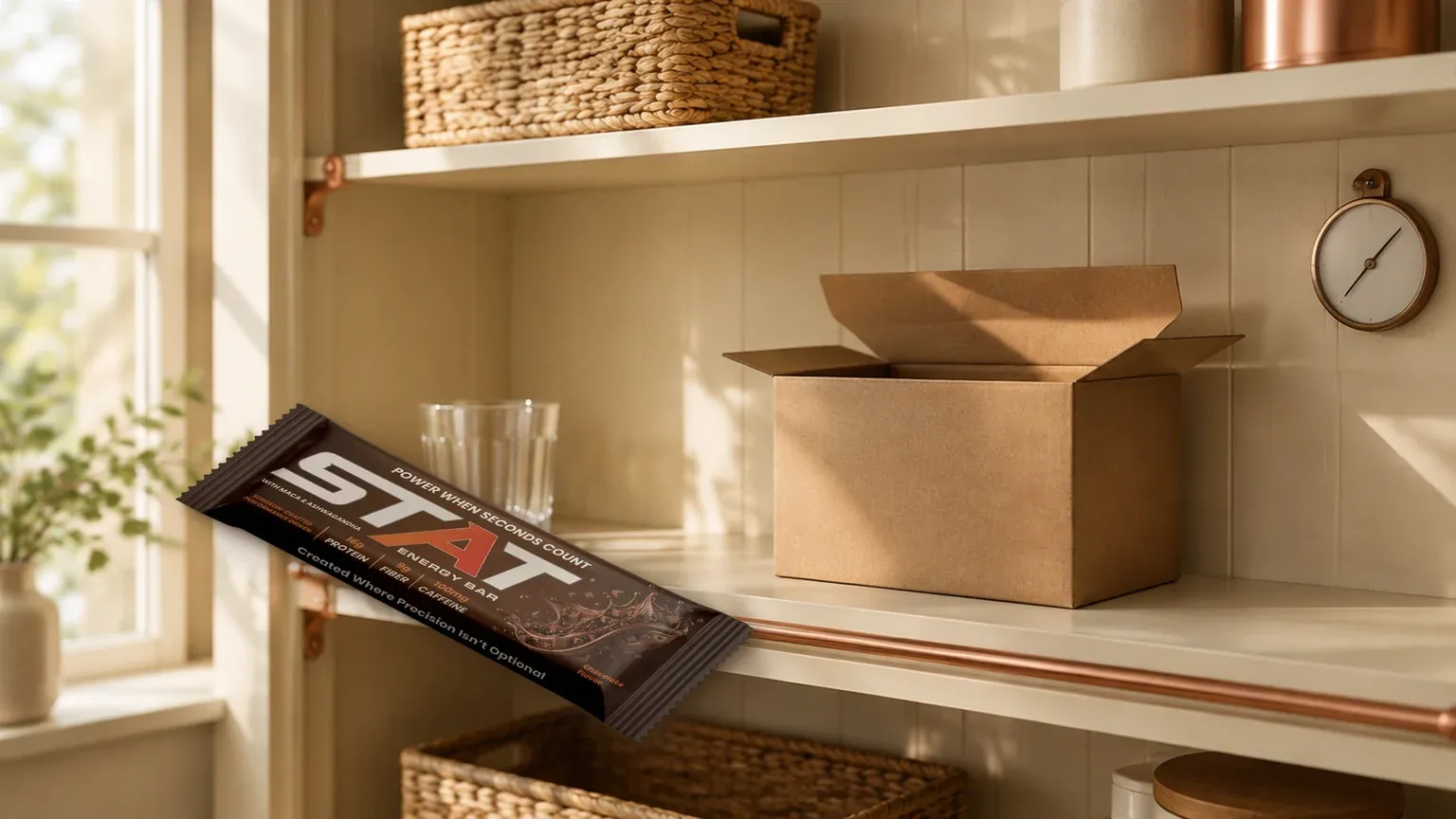
The short answer: Protein bars do not become melt-proof when you buy them in bulk. Chocolate coatings soften around 85 to 95°F, and high-protein bars can harden over weeks as proteins aggregate. Store sealed bars cool and dry, rotate first-in first-out, and keep cases out of hot cars. Check each printed best-by date.
| Fact | Number | Source |
|---|---|---|
| Chocolate fat bloom risk | At 85 to 95°F, chocolate melts and fat can rise to the surface | GCCA Candy Storage Manual, 2024 |
| Preferred chocolate holding temp | Consistent temperatures at 68°F (20°C) or lower | GCCA Candy Storage Manual, 2024 |
| High-protein bar hardening | Hardness rose 4.4x to 7.2x over 6 weeks in pea, whey, and rice model bars | Dietrich et al., Journal of Food Science, 2025 |
| Maillard-linked hardening | Bars stored at 25, 35, and 45°C formed protein polymers that hardened texture later in storage | Zhou et al., Journal of Food Science, 2013 |
Searchers who type "protein bars that won't melt" usually want the same practical answer as someone stocking a locker, a break room, or a car for a week of shifts: will this case survive heat, stay edible, and still be worth the bulk price? This guide covers melting, crumbling, shelf life, and storage with primary sources, then uses STAT Energy Bars as a worked example with only the durability statements published on statbar.com/wholesale.
Do protein bars melt in heat?
Many protein bars include chocolate chips, coatings, or cocoa butter. Those ingredients follow confectionery rules, not locker-room myths. The Global Cold Chain Alliance's Candy Storage Manual (revised 2024) states that chocolate at 85 to 95°F (30 to 35°C), unless specially treated, will melt and its natural fat will rise to the surface. When the piece cools again, that fat can stay on the surface as a grayish fat bloom. The same manual says chocolate candies should be held at consistent temperatures at 68°F (20°C) or lower to minimize fat bloom, and that chocolate-coated pieces should not go above 85°F after the coating is set, even for one hour, or fat bloom will develop.
A filled-chocolate storage study in Food Science and Nutrition (2021; open access via PMC) tracked dark and milk chocolate bars at 6, 12, 20, and 30°C for up to 26 weeks. Temperatures of 6 and 12°C were the most suitable. Samples held at 20°C started to lose quality after about 10 weeks, with decline in meltdown rate and more off-flavors. That is confectionery science, not a brand ranking: if your bar has chocolate on the label, treat summer heat as a quality risk, not a non-event.
On the STAT Chocolate and Peanut Butter Espresso wrappers, the ingredient list includes dark chocolate chips (unsweetened chocolate, erythritol, cocoa butter, sunflower lecithin, stevia leaf extract). Salted Caramel Coffee lists cocoa butter without those chips. None of that makes any flavor melt-proof. It only tells you which bars carry chocolate fat that can soften when a bag sits in a hot car.
Why high-protein bars harden or crumble in storage
Melting is not the only failure mode. High-protein bars often get harder, drier, or crumblier the longer they sit, especially in warm storage. Dietrich and colleagues, writing in the Journal of Food Science in January 2025, stored pea, whey, and rice protein bars for six weeks and measured hardness increases of 7.2x, 5.4x, and 4.4x respectively. They linked hardening to moisture loss, protein and lipid oxidation, Maillard reactions, and protein aggregation. Pea and whey bars showed more Maillard-related protein glycations (about 6.9% and 7.7%) than rice bars (about 2.1%).
An earlier model-system study by Zhou and colleagues (Journal of Food Science, 2013) stored high-protein bars with reducing sugars at 25, 35, and 45°C. Early Maillard progress changed hardness little, but later storage produced high-molecular-weight protein polymers and a clear jump in hardness. Replacing reducing sugars with nonreducing ingredients such as sugar alcohols reduced those texture changes in their models. The takeaway for a bulk buyer is simple: heat speeds the chemistry that turns a soft bar into a chalky one, even when the wrapper never looks melted.
How to store protein bars bought in bulk
Commercial shelf-life claims vary by brand and formula, so the printed best-by date on your case is the number that matters for the bars you actually bought. What the research supports is how you store them while you work through the case.
| Buyer check | What to do | STAT Energy Bar example |
|---|---|---|
| Temperature | Keep sealed bars away from hot cars, sunny windows, and unvented garages. Chocolate fat softens in the mid-80s °F. | Wholesale guidance on statbar.com says store wrappers in a cool, dry place below 80°F; bars are shelf-stable at room temperature with no refrigeration. |
| Humidity and light | Avoid damp rooms and direct sun. Candy manuals flag high RH for stickiness and UV for faster fat breakdown. | Individually wrapped bars in a closed 12-count box limit air and light exposure between uses. |
| Rotation | First-in, first-out. Open one box at a time from a multi-box order. | A 12-count box, Variety 3-Pack, or build-your multi-pack lets you finish older dates first. |
| Label math | Confirm protein, added sugars, and caffeine mg on the panel before you commit to a case. | Label-true numbers live on STAT by the numbers: 16-19g protein, 100mg caffeine, 0g added sugars. |
For bag and cooler rules when food is perishable, see our portable protein snack guide. USDA's Food Safety and Inspection Service reminds people that bacteria grow rapidly between 40°F and 140°F, and that perishable leftovers should not sit out more than 2 hours (1 hour above 90°F). A sealed, shelf-stable bar is not a dairy cup, but a soft cooler full of yogurt still follows that clock.
Documented STAT storage language on the wholesale and bulk orders page is limited and specific: the bars are shelf-stable at room temperature, need no cold chain or refrigeration, and the wrapper is described as easy to store in a cool, dry place below 80°F, including lockers, duty bags, and unattended pantries. That is storage guidance, not a claim that STAT bars will not melt, will not crumble, or are heat-proof.
Buying protein bars in bulk without wasting the case
Bulk only helps if you will finish the bars before quality slips. A practical order size is enough for two to four weeks of shifts, plus a little buffer, not a year of inventory in a warm closet. If you stock a unit pantry, label the outer case with the earliest best-by date, keep it indoors, and move a smaller working box to the break room.
Night crews often get treated last when food shows up on the unit. Shelf-stable bars that stay in a labeled night-shift box after 7 p.m. are a more reliable thank-you than a tray that disappears before change of shift. For how to pack protein for overnight work, see our guide to protein bars for shift workers.
If the bars you buy include caffeine, count every source toward your day. The FDA cites 400mg a day as an amount not generally associated with negative effects for most healthy adults, and it advises counting caffeine from coffee, tea, chocolate, and foods with added caffeine.
STAT Energy Bars as a bulk worked example
STAT Energy Bars are food for when you can't stop for a meal. Each bar prints 100mg of caffeine, 16-19g of protein depending on flavor, and 0g added sugars, with calories in the 200-210 range. That is not a low calorie food. Chocolate gets caffeine from coffee fruit extract. Peanut Butter Espresso and Salted Caramel Coffee use real coffee and coffee fruit extract. Full panels sit on STAT by the numbers.
Value on the live shop (verified 2026-10-14) leads with discounts, not the single-box sticker alone: subscribe and save 10% brings a 12-count box to $35.99 ($3.00 per bar) instead of $39.99 ($3.33 per bar); the Variety 3-Pack is $104.99 ($2.92 per bar) with free shipping; the build-your 4-pack is $134.99 ($2.81 per bar) with free shipping; free standard shipping starts at $50; flat $4.90 shipping applies under $50. Bundle prices are one-time and are not combined with subscription. Shop the Chocolate, Peanut Butter Espresso, and Salted Caramel Coffee boxes, or ask about case pricing for workplaces. Store them cool and dry below 80°F, rotate the oldest date first, and read the printed caffeine line before you stack a bar on top of coffee.
Frequently asked questions
Do protein bars melt in a hot car?
Chocolate coatings and chips can soften once temperatures climb into the mid-80s °F, and fat bloom can appear after the bar cools. Keep bulk cases indoors and pack only what you will eat that shift.
How should I store protein bars bought in bulk?
Keep sealed wrappers cool, dry, and out of direct sun. Rotate first-in first-out, open one box at a time, and follow the printed best-by date on your case. STAT's wholesale page specifies a cool, dry place below 80°F and room-temperature shelf stability without refrigeration.
Why do protein bars get hard or crumbly over time?
Moisture migration, oxidation, Maillard reactions, and protein aggregation can raise hardness during storage, especially in warm conditions. Studies of high-protein model bars show large hardness increases over a few weeks when those reactions run.
Are protein bars shelf stable?
Many commercial bars are sold as shelf-stable at room temperature, but shelf life still depends on formula, packaging, and storage. Use the best-by date on the package you bought. STAT is described on its wholesale page as shelf-stable at room temperature with no cold chain.
What temperature makes chocolate on a protein bar soften?
Confectionery storage guidance puts melting and fat bloom risk for chocolate around 85 to 95°F, and recommends holding chocolate near 68°F or lower when you can. That applies to chips and coatings listed on a protein bar label too.
References
- Global Cold Chain Alliance / GCCF. Commodity Storage and Handling Manual: Candy (revised 2024). gcca.org PDF
- Hřivna L, Machálková L, Burešová I, Nedomová Š, Gregor T. Texture, color, and sensory changes occurring in chocolate bars with filling during storage. Food Sci Nutr. 2021;9(9):4863. doi: 10.1002/fsn3.2434 (PMC8441319).
- Dietrich RB et al. Role of protein and lipid oxidation in hardening of high-protein bars during storage. J Food Sci. 2025;90(1):e17663. doi: 10.1111/1750-3841.17663 (PMC11743340).
- Zhou P, Guo M, Liu D, Liu X, Labuza TP. Maillard-reaction-induced modification and aggregation of proteins and hardening of texture in protein bar model systems. J Food Sci. 2013. doi: 10.1111/1750-3841.12061.
- USDA FSIS. How Temperatures Affect Food; Keep Food Safe basics (40°F to 140°F danger zone; 2-hour / 1-hour rules). fsis.usda.gov
- FDA. Spilling the Beans: How Much Caffeine is Too Much? (400mg/day context). fda.gov
- STAT Energy Bar. Wholesale and Bulk Orders (cool, dry place below 80°F; shelf-stable at room temperature; no refrigeration). statbar.com/wholesale
- STAT Energy Bar. STAT by the numbers. statbar.com/stat-by-the-numbers
Related reading
- Snacks for drivers, trades and travel crews: food that survives the cab, the site and the jump seat
No fridge, breaks on someone else's schedule, and food that has to be eaten parked. Shared rules first, then truck drivers, delivery, warehouse, construction, flight crews and ATC.
- Snacks for doctors, residents and surgeons: what survives rounds, cases and call
One guide for physicians at every stage: the food-safety, label and caffeine rules that apply to everyone, then what works for residents, surgeons, overnight call and physician assistants.
- Portable protein snack: what actually survives the bag
Portability is not a slogan. It is shelf stability, a printed serving, and a snack you can finish without a microwave or a shared fridge.
Ready to Fuel Up?
Try STAT Bar: the energy bar built for those who can't afford to slow down.
Get shift snack tips in your inbox
Join the STAT Bar newsletter for new flavor drops, subscriber-only deals, and practical shift guides, plus $5 off your first box.
By signing up you agree to receive marketing emails from On Call Foods LLC. You can unsubscribe at any time. See our Privacy Policy and Terms.