
What to Eat Before Running: Foods and Timing by Distance
STAT Bar TeamLast reviewed by Mikael Petrosyan, MD, founder
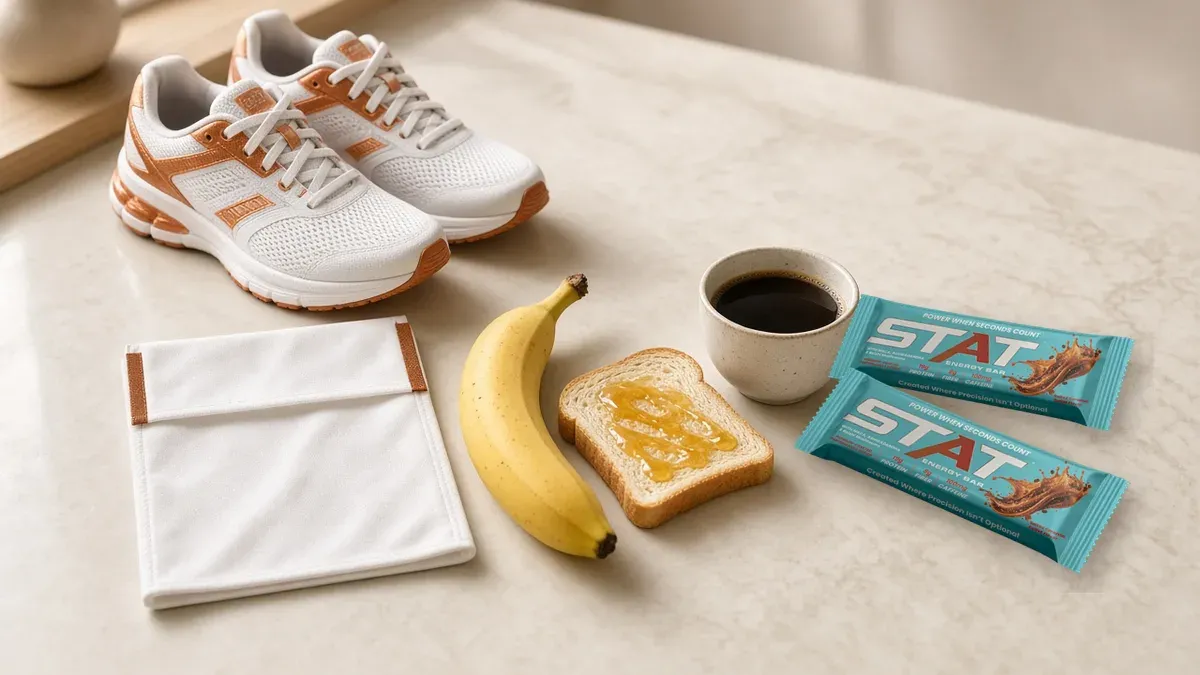
Before most runs, eat easy-to-digest carbohydrate with little fat and fiber, sized to the clock. Three to four hours out, have a real meal, like a bagel with peanut butter and a banana. One to two hours out, eat a smaller snack. Under an hour, keep it to a banana, a few dates or a sports drink.
| Fact | Number | Source |
|---|---|---|
| Meal before a long run or race | About 3 to 4 hours before: a low-fat meal with 200 to 300 g of carbohydrate and about 30 g of lean protein | Mayo Clinic Health System, Fueling strategies for distance runners |
| Less time than that | A snack 1 to 2 hours before; under an hour, liquids such as a sports drink may be the better choice | Mayo Clinic Health System, Fueling strategies for distance runners |
| Athlete carbohydrate guidance | 1 to 4 g of carbohydrate per kg of body weight, eaten 1 to 4 hours before exercise | Mata et al., Nutrients, 2019 |
| Right before the start | About 30 g of carbohydrate when there is little chance to refuel during the event | Gleeson, Performance Nutrition, 2026 |
Should you eat before a run?
Usually, yes, but how much depends on two things: how long it has been since you last ate, and how long you will be running.
Your time on your feet matters more than the distance on the sign. A 10K is a 40-minute effort for some runners and a 75-minute effort for others, so plan by the clock.
| How long you will run | Before the run | During the run |
|---|---|---|
| Under about 30 minutes | Normal meals; a small carbohydrate snack if your last meal was 3+ hours ago | Not needed |
| About 30 to 75 minutes | A snack 1 to 2 hours before, or about 30 g of fast carbohydrate shortly before | Usually not needed |
| About 75 minutes to 2 hours | A carbohydrate-rich meal 3 to 4 hours before, plus a small top-up near the start | About 30 g of carbohydrate per hour |
| Over 2 hours | Carbohydrate-rich eating the day before, a meal 3 to 4 hours before, about 30 g near the start | 30 to 60 g per hour |
Sources: Gleeson 2026 (Performance Nutrition); Mayo Clinic Health System; Mayo Clinic.
Mayo Clinic puts the short-run case plainly: a snack eaten soon before a workout of less than 60 minutes probably won't add energy, but it may keep you from feeling hungry. Hunger at mile two is a distraction you do not need.
The case for skipping food is weaker than many runners think. A 2019 review in Nutrients notes that most studies of carbohydrate in the hour before exercise found no change or an improvement in performance, and calls the idea that you must avoid it "an unfounded myth." The real reason to be careful is your stomach, which we cover below.
How long before a run should you eat?
Use the time you have, then pick the food to match.
| Time before the run | What to eat | Example | Source |
|---|---|---|---|
| 3 to 4 hours | A full meal, mostly carbohydrate, low in fat, with some lean protein | A turkey sandwich with baked chips and fruit; a bagel with peanut butter and a banana | Mayo Clinic Health System |
| 1 to 2 hours | A smaller snack | Fruit, a bowl of cereal with milk, yogurt, a small bagel with peanut butter | Mayo Clinic Health System |
| Under 1 hour | Carbohydrate only, or a drink | A sports drink, a piece of fruit or a small jam sandwich | Mayo Clinic News Network; Mayo Clinic Health System |
| Just before the start | About 30 g of fast carbohydrate, if you will not fuel during the run | A medium banana (27 g) or one slice of white toast with jam (28 g) | Gleeson 2026; USDA FoodData Central |
The rule under every row: the closer you get to the start, the less fat, fiber and protein the food should carry. A 2026 review in Performance Nutrition says the pre-competition meal should be low in fiber and fat because both delay stomach emptying, and that any new strategy should be tested in training first.
Drink, too. Mayo Clinic cites American College of Sports Medicine advice to drink roughly 2 to 3 cups of water during the 2 to 3 hours before a workout. The Performance Nutrition review's athlete figure, about 7 ml per kg 2 to 3 hours before, comes to roughly 2 cups for a 70 kg (154 lb) runner.
Best things to eat before a run
Here are common pre-run foods on the same scale. We did the math from USDA FoodData Central per-100 g values and its listed portion weights.
| Food (portion) | Calories | Carbs | Protein | Fat | Fiber | Good window |
|---|---|---|---|---|---|---|
| Medium banana (118 g) | 105 | 27 g | 1.3 g | 0.4 g | 3.1 g | 15 to 60 min |
| 2 Medjool dates (48 g) | 133 | 36 g | 0.9 g | 0.1 g | 3.2 g | 15 to 60 min |
| Unsweetened applesauce (1/2 cup, 122 g) | 51 | 14 g | 0.2 g | 0.1 g | 1.3 g | 15 to 60 min |
| Honey (1 tbsp, 21 g) | 64 | 17 g | 0.1 g | 0 g | 0 g | 5 to 30 min |
| Hard pretzels (1 oz) | 109 | 23 g | 2.8 g | 0.8 g | 1.0 g | 30 to 60 min |
| 1 slice white toast + 1 tbsp jam | 133 | 28 g | 2.6 g | 1.0 g | 1.0 g | 30 to 90 min |
| Small plain bagel (69 g) + 1 tbsp honey | 246 | 53 g | 7.3 g | 0.9 g | 1.1 g | 1 to 2 hours |
| Banana + 1 tbsp peanut butter | 201 | 31 g | 4.8 g | 8.6 g | 3.9 g | 1 to 2 hours |
| Oats, 1/2 cup dry, cooked with water, + 1 tbsp honey | 217 | 45 g | 5.4 g | 2.6 g | 4.1 g | 1 to 3 hours |
| White rice (1 cup cooked) | 205 | 45 g | 4.3 g | 0.4 g | 0.6 g | 2 to 4 hours (with a meal) |
| Medium plain bagel (105 g) + 1 tbsp peanut butter + medium banana | 478 | 86 g | 15.9 g | 10.0 g | 5.5 g | 3 to 4 hours |
USDA FoodData Central sources: banana 173944, Medjool dates 168191, applesauce 167772, honey 169640, pretzels 167555, white bread 174924, jams and preserves 169641, plain bagel 174899, peanut butter 172470, oats 173904, white rice 168878.
What jumps out when the numbers sit side by side:
- Plain white-flour foods are low in fiber. White toast with jam carries about 1 g of fiber and 28 g of carbohydrate, which is why it shows up on so many race-morning plates.
- Peanut butter changes the timing. One tablespoon adds about 8 g of fat to a banana: fine an hour or two out, less comfortable right before a hard effort.
- The 3 to 4 hour meal is bigger than most people expect. A bagel with peanut butter and a banana is about 86 g of carbohydrate, while Mayo Clinic Health System's target before a long run or race is 200 to 300 g.
What to eat before a run in the morning
The early run is where the usual timing breaks down. You cannot eat a meal 3 hours before a run you start 20 minutes after waking.
Mayo Clinic's advice: if you exercise in the morning, get up early enough to finish breakfast at least an hour before your workout. If you will run within an hour after breakfast, eat a light meal or have a sports drink, and focus on carbohydrate. Mayo Clinic Health System adds that with less than an hour to go, liquids may be the better choice.
In practice, that gives you three morning options:
- Up 60 to 90 minutes before the run. Toast with jam or honey, a small bagel, or cereal with milk.
- Up 20 to 30 minutes before the run. A banana, two dates or applesauce, with water: about the 30 g of fast carbohydrate the Performance Nutrition review gives for just before the start.
- Straight out the door. For an easy run under about 30 minutes, many runners go without food and are fine. If you feel flat or lightheaded, try option 2 next time.
Some athletes run fasted on purpose. The Performance Nutrition review lists training after an overnight fast as a "train-low" strategy for specific sessions, alongside high-carbohydrate fueling for competition. It is not a reason to skip breakfast before a race.
What to eat before a 5K, 10K, half marathon or marathon
Race day is where a plan pays off. Here is how the guidance above translates to common race distances. The carbohydrate numbers use a 70 kg (154 lb) runner as the example; scale them to your own weight.
5K. A short, hard effort. Eat a normal dinner the night before and a light breakfast 2 to 3 hours before the start, like toast with jam. If you get hungry while you wait, a banana 30 to 60 minutes before is plenty.
10K. Same plan as the 5K, with room for a bigger breakfast. A small bagel with honey and a banana 2 to 3 hours out is about 80 g of carbohydrate.
Half marathon. Make breakfast a real pre-race meal. The Performance Nutrition review recommends a meal with 1 to 3 g of carbohydrate per kg of body weight 3 to 4 hours before competition, which is 70 to 210 g for our 70 kg runner. Then about 30 g near the start, and roughly 30 g per hour during the race if you will be out longer than about 75 minutes.
Marathon. The preparation starts a day or more out. The same review describes 6 to 10 g of carbohydrate per kg per day for 24 to 36 hours before an endurance event to top up glycogen stores (420 to 700 g a day for our 70 kg runner), then the 3 to 4 hour pre-race meal and about 30 g near the start. During the race, Mayo Clinic Health System suggests 30 to 60 g of carbohydrate an hour, and the review notes trained athletes may go up to 90 g an hour in events longer than about 2.5 to 3 hours when they have practiced it.
The front of the field does this too. Canadian Running reported on November 5, 2026 that the winner of the 2026 New York City Marathon took a gel with 25 g of carbohydrate two minutes before the start, followed by a drink with 80 g of carbohydrate at every 5 km aid station. That is the "about 30 g right before the start" guidance in action. Breath testing during his training runs, as described in the report, found it took roughly 60 minutes for the carbohydrate he drank to reach a steady contribution to his fuel, a good argument for fueling early.
Elite numbers come with an asterisk. In a 2025 Journal of Applied Physiology study of eight elite male marathoners, stomach symptoms were common at every carbohydrate intake tested and worst at the highest (120 g an hour), and the authors called for gut training first.
What to eat before a long run
Think of a long training run as a dress rehearsal for race day. Eat the meal you plan to race on 3 to 4 hours before; Mayo Clinic Health System suggests a low-fat meal with 200 to 300 g of carbohydrate and about 30 g of lean protein. If that is too much at 6 a.m., start smaller and build up over several weeks. Top up with about 30 g of fast carbohydrate in the last 15 to 30 minutes, and for runs longer than an hour or two, practice taking 30 to 60 g of carbohydrate every hour from sports drinks, gels or chews with water. Our guide to sport fuel bars covers how those differ from protein bars on the label.
What not to eat before a run
Stomach trouble is common among runners. A 2025 systematic review in the Journal of the International Society of Sports Nutrition estimates that between 30 and 90 percent of endurance-trained runners experience gastrointestinal symptoms during exercise. The same review lists dietary fiber, protein and fat, plus high-FODMAP foods in sensitive people, among the nutrition factors linked to symptoms, and found that gut training protocols look promising for reducing them over time.
So in the last few hours before a run, go easy on:
- High-fiber foods. Beans, lentils, bran cereals and big salads. They are great at other meals.
- High-fat foods. Fried food, bacon, cream sauces and big portions of cheese or nut butter.
- Large protein portions. Some protein is fine (see below). A big steak is not a pre-run meal.
- Anything new. Mayo Clinic notes that any time you try a food or drink for the first time before a workout, you risk an upset stomach.
- Sugar alcohols, if they bother you. Some bars and "sugar-free" snacks use polyols, and tolerance varies. See sugar alcohols in protein bars for how to spot them on a label.
What about protein? A 2026 trial in the Journal of the International Society of Sports Nutrition gave 13 recreational runners a carbohydrate shake with a low (0.15 g per kg) or moderate (0.4 g per kg) dose of whey protein 60 minutes before a 10 km run at 85% of race pace. Total stomach symptoms were not affected by the protein dose, though bloating was higher with the moderate dose. The authors concluded that easily digestible protein up to 0.4 g per kg (28 g for a 70 kg runner) an hour before running was generally well tolerated, and should be trialed before competition. Our explainer on whether protein gives you energy covers why protein is a slower, more filling fuel than carbohydrate.
Coffee before running
The guidance here is relaxed. Mayo Clinic says that if you usually have coffee in the morning, it's probably OK to have a cup before your workout.
How much caffeine is in that cup? USDA FoodData Central lists brewed coffee at 40 mg per 100 g and an 8 fl oz cup at 237 g, which works out to about 95 mg per cup (FDC 171890). Brew strength varies, so read that as an average.
On timing, the Performance Nutrition review describes caffeine in sports research as commonly taken about 1 hour before the event, at around 3 mg per kg of body weight. Our guide to caffeine before a workout walks through the timing and the milligram math, and how long caffeine lasts helps if you run in the evening and want to sleep later.
If you prefer caffeinated snacks to a cup of coffee, read the label for a printed milligram number, and count the fat and fiber the same way you would for any other pre-run food. Our guide to how to read a nutrition facts label walks through every line.
Running after work or after a shift
The hardest pre-run meal is often the one you forget to plan. If lunch was at noon and you run at 6, you are heading out six hours after your last real food. Pack a carbohydrate-forward snack in the morning, like dates, a banana or pretzels, and eat it 60 to 90 minutes before the run. If you work nights and run around your shift, our night shift snacks guide covers how to pace food across the whole shift.
Sample pre-run plans
| Run | Plan |
|---|---|
| 6:00 a.m. easy 30-minute run | Up at 5:35. A banana or applesauce and a glass of water. Coffee if you want it. |
| Saturday 8:00 a.m. long run (90+ minutes) | Bagel with peanut butter and a banana plus juice by 5:00 to 5:30, then two dates at 7:45. Carbohydrate during the run after the first hour. |
| 6:00 p.m. run after work, lunch at noon | Pretzels or a banana with peanut butter at 4:30. Water through the afternoon. |
| Half marathon, 7:00 a.m. start | Familiar dinner the night before. A carbohydrate-rich breakfast around 3:30 to 4:00 a.m. if you can, or a smaller one by 5:00. About 30 g near the start, and a fueling plan you practiced in training. |
Our recommendation: STAT Energy Bar
STAT Energy Bar: 100 mg caffeine, 16-19 g protein, 0 g added sugar.
If you want your caffeine and a pre-run snack in one wrapper, STAT Energy Bar is our pick for the longer gap before an easy run. Each bar is 200 to 210 calories with 15 to 17 g of total carbohydrate, 6 to 7 g of fiber, 11 to 12 g of fat, 2 g of total sugars and 0 g added sugars. Protein is 16 g in Chocolate, 17 g in Peanut Butter Espresso and 19 g in Salted Caramel Coffee. With that fiber and fat, plan STAT about 2 to 3 hours before a run, alongside a banana or toast for more carbohydrate. Try it on a training day first, as with any new pre-run food.
It's 3am, there are six hours left on your shift, and the next call could come any second. That's the moment STAT Energy Bar was made for, when seconds count. Each bar has 100mg of caffeine for alertness and energy, about what's in a strong cup of coffee, plus 16 to 19g of protein and 0g added sugar. It's caffeine and protein you can eat in two minutes, then get right back to work. If you like chocolate, the Chocolate bar (16g protein) uses coffee fruit extract. If you're a coffee person, Peanut Butter Espresso (17g) and Salted Caramel Coffee (19g) use real coffee plus coffee fruit extract. Tuck a couple in your locker for the nights you can't stop for a meal, and keep one in your bag for the afternoon before an evening run. See what's inside every STAT bar, compare all three panels on STAT by the numbers, or start from the shop.
Not sure which flavor fits? Variety, 3 Boxes has one 12-count box of each, or you can shop all three flavors. Subscribe and save 10%, and orders over $50 ship free.
What to eat before running: FAQ
What should I eat before a run?
Eat easy-to-digest carbohydrate with little fat and fiber. Three to four hours out, have a real meal such as a bagel with peanut butter and a banana. One to two hours out, have a smaller snack like toast with jam. In the last hour, a banana, a few dates or a sports drink works.
How long before a run should I eat?
Mayo Clinic Health System suggests a meal about 3 to 4 hours before a long run or race, or a snack 1 to 2 hours before if you have less time. With under an hour to go, keep it small and simple, or choose a drink such as a sports drink.
Is it OK to run on an empty stomach?
For an easy run under about 30 minutes, many runners feel fine without food. For longer or harder runs, carbohydrate beforehand has more support, and a 2019 review calls the idea that you must avoid carbohydrate in the hour before exercise an unfounded myth. If you feel flat or lightheaded, eat a small carbohydrate snack next time.
What should I eat before a 5K?
Eat a normal dinner the night before and a light, carbohydrate-forward breakfast 2 to 3 hours before the start, such as toast with jam or a small bagel with honey. If you get hungry while you wait, a banana 30 to 60 minutes before is plenty. Most runners do not need to fuel during a 5K.
What should I eat before a long run?
Have a low-fat, carbohydrate-rich meal 3 to 4 hours before. Mayo Clinic Health System suggests 200 to 300 g of carbohydrate and about 30 g of lean protein. Add about 30 g of fast carbohydrate near the start, and plan 30 to 60 g of carbohydrate per hour for runs longer than an hour or two.
What should you not eat before a run?
In the last few hours, limit high-fiber foods like beans and bran, high-fat foods like fried food and bacon, large protein portions, and anything you have not tried before. A 2025 systematic review links fiber, protein, fat and high-FODMAP foods to stomach symptoms during endurance exercise.
Is it OK to drink coffee before running?
For most people who already drink coffee, yes. Mayo Clinic says it's probably OK to have your usual cup before a workout. An 8 fl oz cup of brewed coffee has about 95 mg of caffeine, per USDA FoodData Central. Try it before training runs first, not for the first time on race day.
Is a protein bar good to eat before a run?
It can be, if you give it time. Most protein bars carry more fat and fiber than fruit or toast, so they fit better 2 to 3 hours before a run. A 2026 trial found moderate protein an hour before a 10 km run was generally well tolerated, though bloating was higher at the larger dose.
Ready for your next run? Plan the snack tonight, and keep a few STAT bars where you'll need them.
References
- Mayo Clinic Health System (Wergin A). Fueling strategies for distance runners. June 5, 2018. https://www.mayoclinichealthsystem.org/hometown-health/speaking-of-health/fueling-strategies-for-distance-runners
- Mayo Clinic Staff. Eating and exercise: 5 tips to maximize your workouts. December 21, 2023. https://www.mayoclinic.org/healthy-lifestyle/fitness/in-depth/exercise/art-20045506
- Mata F, Valenzuela PL, Gimenez J, et al. Carbohydrate Availability and Physical Performance: Physiological Overview and Practical Recommendations. Nutrients. 2019;11(5):1084. https://pmc.ncbi.nlm.nih.gov/articles/PMC6566225/
- Gleeson M. The 4Ps framework of nutritional strategies for optimal performance. Performance Nutrition. Published March 3, 2026. https://link.springer.com/article/10.1186/s44410-026-00022-0
- Mlinaric J, Mohorko N. Nutritional strategies for minimizing gastrointestinal symptoms during endurance exercise: systematic review of the literature. Journal of the International Society of Sports Nutrition. 2025;22. https://pmc.ncbi.nlm.nih.gov/articles/PMC12258207/
- Shaw K, Lindstrom B, Moss A, Parnell JA. Whey protein intakes up to 0.4g/kg body mass are well tolerated before a 10km run at 85% of race pace: a clinical trial. Journal of the International Society of Sports Nutrition. Published January 20, 2026. https://www.tandfonline.com/doi/full/10.1080/15502783.2026.2615270
- Ravikanti S, Silang KG, Martyn HJ, et al. 13C-labelled glucose-fructose show greater exogenous and whole-body CHO oxidation and lower O2 cost of running at 120 versus 60 and 90 g/h in elite male marathoners. Journal of Applied Physiology. 2025;139(6):1581-1595. https://journals.physiology.org/doi/full/10.1152/japplphysiol.00665.2025
- Sussman S. The scientific fuelling strategy behind Andreas Almgren's debut marathon win. Canadian Running. November 5, 2026. https://runningmagazine.ca/the-scene/the-scientific-fuelling-strategy-behind-andreas-almgrens-winning-debut-marathon/
- U.S. Department of Agriculture, Agricultural Research Service. FoodData Central (SR Legacy): bananas, raw (173944); dates, Medjool (168191); applesauce, canned, unsweetened (167772); honey (169640); pretzels, hard, plain, salted (167555); bread, white, commercially prepared (174924); jams and preserves (169641); bagels, plain, enriched (174899); peanut butter, smooth style, without salt (172470); oats, regular and quick, dry (173904); rice, white, long-grain, regular, enriched, cooked (168878); coffee, brewed, prepared with tap water (171890). https://fdc.nal.usda.gov/
- Olsen J. Mayo Clinic Minute: Foods to fuel your workout. Mayo Clinic News Network. July 19, 2017. https://newsnetwork.mayoclinic.org/discussion/mayo-clinic-minute-foods-to-fuel-your-workout/
- STAT Nutrition Facts panels and ingredient lists. /stat-by-the-numbers
Related reading
- Night Shift Snacks: What to Eat Overnight, and When
What to pack for a night shift, when to eat it across 12 hours, and where caffeine fits, built on NIOSH guidance and trials in night workers.
- Adaptogenic Protein Bar: What Maca, Ashwagandha, Cordyceps and Reishi Are on a Label
The phrase is a search, not a food category. Maca, ashwagandha, cordyceps, and reishi are adaptogens. Listing them is not a health claim, and it is not a milligram dose.
- Adaptogens in food: what the label means (and what it doesn’t)
"Adaptogens in food" is not an FDA food category. Here is the historical meaning of the term, how botanicals show up on packaged-food labels, and what a plant name does (and does not) claim.
Ready to Fuel Up?
Try STAT Bar: the energy bar built for those who can't afford to slow down.
Get shift snack tips in your inbox
Join the STAT Bar newsletter for new flavor drops, subscriber-only deals, and practical shift guides, plus $5 off your first box.
By signing up you agree to receive marketing emails from On Call Foods LLC. You can unsubscribe at any time. See our Privacy Policy and Terms.