
Healthy Energy Bars: What to Look For
STAT Bar TeamLast reviewed
Energy bars occupy a strange shelf: half of them are confectionery with a protein claim, and the other half are genuinely useful food. The front of the package will not tell you which is which. The Nutrition Facts panel and the ingredient list will. Here are the six numbers worth checking, and the research behind each one.
1. Protein: how much, and from what
Two separate questions hide inside "protein content." The first is quantity. Dose response work on muscle protein synthesis (Moore and colleagues; Witard and colleagues) consistently finds the response to a single feeding plateaus somewhere around 20–25g of high quality protein in healthy young adults, and appetite research points to a similar neighborhood: whey preload studies and the distribution trial by Leidy and colleagues (Current Developments in Nutrition, 2017) found roughly 25–30g per eating occasion produced better appetite control than smaller, skewed intakes. A bar carrying 4g of protein is not competing in that conversation.
The second question is protein quality, and this is where bars quietly diverge. Whey and casein sit at or near the top of the PDCAAS scale (1.0); soy scores close behind. Collagen and gelatin — cheap, common, and technically "protein" for labeling purposes — score essentially zero on PDCAAS because they lack tryptophan entirely. If collagen is high in the ingredient list of a bar advertising 15g of protein, the usable amino acid profile is not what the front of the box implies.
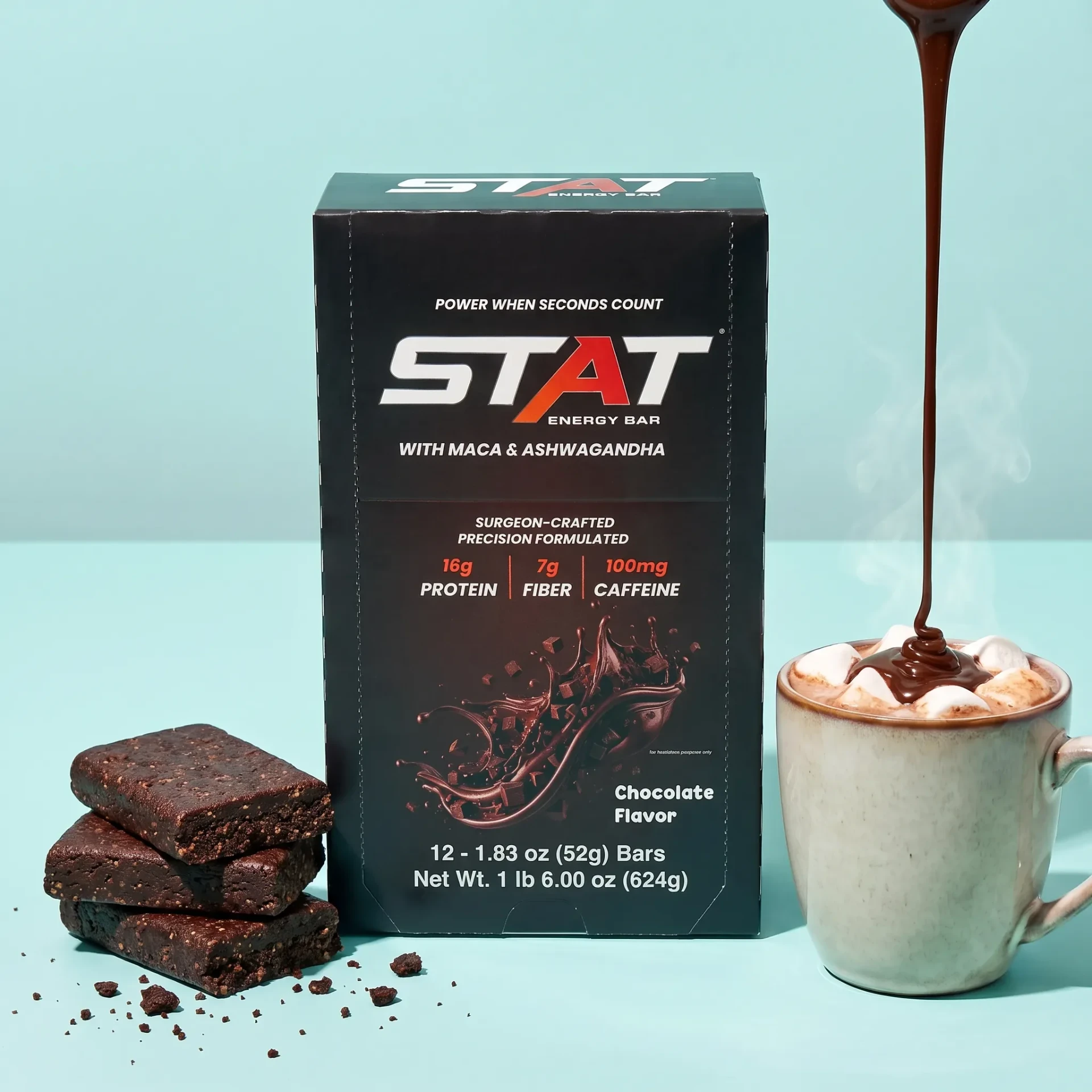
Each STAT Bar carries 16-19g of protein depending on flavor, with no collagen filler. The complete ingredient breakdown is on our What's Inside page.
2. Added sugars — read the second sugar line
Since the FDA's 2016 Nutrition Facts overhaul (Federal Register 81 FR 33742), "Added Sugars" appears as its own line with a %DV based on a 50g daily reference. That line, not "Total Sugars," is the one to read — total sugars include naturally occurring sugar from dates or dried fruit.
For context: the American Heart Association suggests a ceiling of about 25g of added sugar per day for women and 36g for men, and the 2020–2025 Dietary Guidelines for Americans recommend keeping added sugars under 10% of daily calories, roughly 50g on a 2,000 calorie diet. A single bar carrying 18g of added sugar consumes most of a day's budget before dinner. Single digits is a reasonable bar to hold a bar to.
3. Fiber: the FDA has actual thresholds
Labeling rules are specific here: 3g of fiber per serving qualifies as a "good source," and 5g qualifies as an "excellent source." Beyond the label claim, fiber slows gastric emptying and blunts the postprandial glucose curve — relevant for anyone eating at hours when glucose tolerance is naturally lower, which is the entire population of night shift workers (see the circadian misalignment work by Chellappa and colleagues, Science Advances, 2021).
4. Sugar alcohols: the low-sugar tradeoff nobody prints on the front
Many bars hit a low "added sugars" number by leaning on sugar alcohols. Tolerance varies enormously by compound and by person. Erythritol is generally the best tolerated; maltitol, sorbitol, and xylitol are considerably less so, and threshold studies have found osmotic GI distress in sensitive individuals at doses as low as 10–20g. The FDA requires a "may have a laxative effect" statement for sorbitol and mannitol above set levels — that sentence exists for a reason. If you are eating a bar mid-shift with no reliable bathroom break, this is not a trivial detail.
5. Caffeine: is the milligram number actually printed?
Here is a genuine transparency gap in US labeling. When caffeine is added as an ingredient it must be declared, but when it arrives via a botanical source — guarana, green coffee bean extract, yerba mate — current rules do not require the manufacturer to quantify how many milligrams you are getting. "Contains guarana" tells you nothing about dose.
The FDA notes that up to 400mg of caffeine per day is generally not associated with negative effects in healthy adults, but you cannot manage a daily total built from unlabeled amounts. Every STAT Bar states 100mg of caffeine from coffee and coffee fruit extract, printed on the wrapper, so the arithmetic is possible. See our buyer's guide to caffeinated protein bars for a deeper comparison.
6. The ingredient list itself
There is no regulatory threshold for "too many ingredients," and short lists are a heuristic rather than a rule. Still, food classification frameworks such as NOVA treat long stacks of gums, emulsifiers, and blended sugar alcohols as a marker of heavier processing. Scan for the things you would recognize in a kitchen, and note where the protein source sits in the ordering.
A 30-second label check
- Protein 10g or more, from whey, casein, or soy — not collagen
- Added Sugars line in single digits
- Fiber 3g or more
- Sugar alcohols present? Check which one, and how much
- Caffeine stated in milligrams, not implied by a botanical name
- An ingredient list you can read out loud
Where STAT Bar lands
- STAT Bar Chocolate — 16g protein, 100mg natural caffeine
- STAT Bar Peanut Butter Espresso — 17g protein, 100mg natural caffeine
- STAT Bar Salted Caramel Coffee —19g protein, 100mg natural caffeine
- STAT Bar Variety 3-Pack — one box of each flavor
16-19g protein, 0g added sugar, a stated 100mg of natural caffeine, and adaptogenic botanicals — maca, ashwagandha, and cordyceps, a culinary mushroom. All three flavors are $39.99 per 12-pack and shelf stable. Compare the full panels on What's Inside.
References
- FDA. Spilling the Beans: How Much Caffeine is Too Much? fda.gov
- FDA. Food Labeling: Revision of the Nutrition and Supplement Facts Labels. 81 FR 33742 (2016).
- American Heart Association. How Much Sugar Is Too Much? heart.org
- USDA / HHS. Dietary Guidelines for Americans, 2020–2025.
- Leidy HJ et al. Protein distribution and appetite control. Current Developments in Nutrition (2017).
- Chellappa SL et al. Circadian misalignment increases glucose intolerance. Science Advances (2021).
Related reading
- Snacks for drivers, trades and travel crews: food that survives the cab, the site and the jump seat
No fridge, breaks on someone else's schedule, and food that has to be eaten parked. Shared rules first, then truck drivers, delivery, warehouse, construction, flight crews and ATC.
- High protein caffeine snack: how to read the label
A high protein caffeine snack is a label problem first. Count printed protein grams and caffeine milligrams, check added sugars and calories, and ask whether the food survives the USDA 2-hour rule.
- Snacks for doctors, residents and surgeons: what survives rounds, cases and call
One guide for physicians at every stage: the food-safety, label and caffeine rules that apply to everyone, then what works for residents, surgeons, overnight call and physician assistants.
Ready to Fuel Up?
Try STAT Bar — the energy bar built for those who can't afford to slow down.
Get shift snack tips in your inbox
Join the STAT Bar newsletter for new flavor drops, subscriber-only deals, and practical shift guides — plus $5 off your first box.
By signing up you agree to receive marketing emails from On Call Foods LLC. You can unsubscribe at any time. See our Privacy Policy and Terms.