
Snacks for delivery drivers: what works between stops, scans, and peak season
STAT Bar TeamLast reviewed
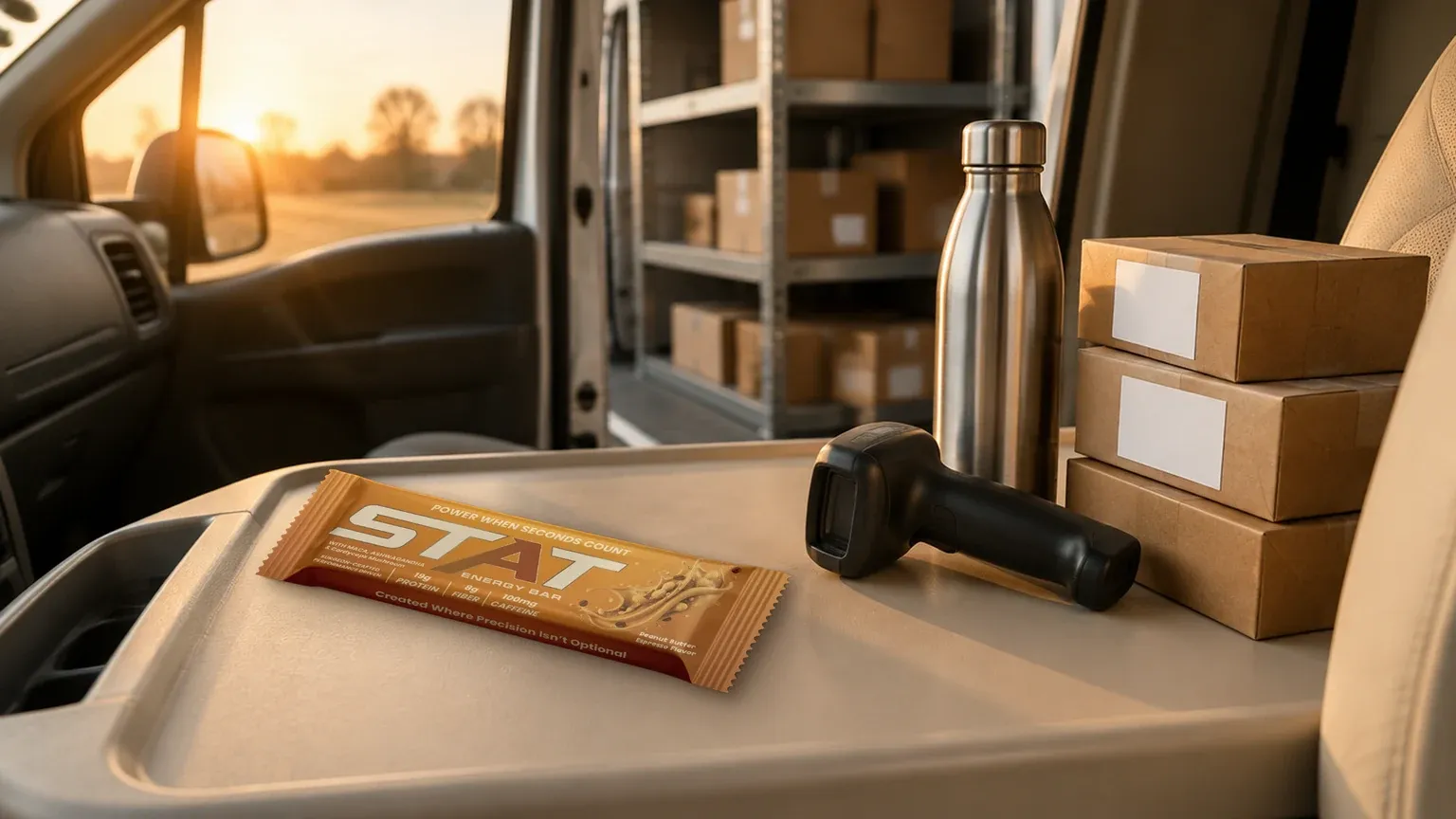
Snacks for delivery drivers have an odd job. There is no break room on a route. The kitchen is a center console, the pantry is a door pocket, and the clock is a stop count on a scanner. Food has to wait in a van that warms up fast in sun, get eaten in the few minutes you are actually parked, and work with hands that just carried a hundred boxes. Fourth-quarter peak season adds longer routes, earlier starts, darker evenings, and new seasonal drivers who have not learned where the good stopping spots are yet.
The useful frame is simple: eat parked, keep perishables out of the warm-van problem, clean hands before food, read the Nutrition Facts panel, and count caffeine milligrams instead of guessing. It is not performance marketing. Long-haul cab packing is covered in snacks for truck drivers. The people who loaded your van this morning have their own guide in snacks for warehouse workers. Delivery routes sit between the two: short hops, many stops, and almost no real break.
Eat when the van is parked, not between stops
NHTSA defines distracted driving as any activity that diverts attention from driving, and it names eating and drinking alongside phones, passengers, and fiddling with navigation. A route with dozens of stops creates a constant temptation to eat one-handed at every light. The safer plan is to treat food as a parked task. Pick a stop where you are legally and safely parked, follow your company rules on idling and breaks, eat, then drive.
That changes what belongs in the van. Food that takes a fork, a microwave, or two hands to unwrap tends to get skipped or eaten while moving. Food that opens in one tear and is done in two minutes fits the time you actually have at a parked stop. Drinks should have a lid that closes, so a bottle does not become a reason to look down while driving.
A parked van is not a fridge
USDA's Food Safety and Inspection Service calls 40°F to 140°F the Danger Zone. Bacteria grow most rapidly in that range and can double in as little as 20 minutes. Never leave perishable food out of refrigeration over 2 hours. If the air temperature is above 90°F, food should not be left out more than 1 hour.
A delivery vehicle can pass that 90°F line long before the weather report does. The National Weather Service notes that the temperature inside a vehicle can rise 20 degrees in as little as 10 minutes and 50 degrees in an hour, even when the outside air is in the 70s. Every stop with the engine off and the sun on the windshield moves a sandwich closer to the 1-hour clock. In winter the logic flips without going away: a heated cab can sit squarely inside the Danger Zone even when it is freezing outside, so the same 2-hour rule still applies to anything perishable.
FSIS bag-lunch guidance gives the fix for food that has to stay cold: an insulated, soft-sided bag with at least two cold sources, such as two frozen gel packs or one gel pack plus a frozen juice box or water bottle, with the perishable food between them. FSIS take-out guidance also names foods that travel without that problem: cookies, crackers, bread, and whole fruits. A sealed shelf-stable pouch or bar sits closer to crackers than to a yogurt cup that needed refrigeration when you packed it. Keep the bag on the floor in shade, not on the dash.
Clean hands between packages and food
Boxes, totes, door handles, and gate keypads all pass through your hands before lunch does. CDC says washing with soap and water is the best way to get rid of germs in most situations. If soap and water are not available, use a hand sanitizer with at least 60% alcohol, cover all surfaces of your hands, and rub until dry, which takes about 20 seconds. CDC also notes that sanitizer may not work as well when hands are visibly dirty or greasy, and it advises washing with soap and water instead when a sink is available.
On a route that usually means sanitizer in the door pocket, a real wash at the depot or a planned restroom stop, and food you can eat straight from the wrapper so your fingers touch packaging more than food. Peel the wrapper down like a sleeve instead of handling the snack itself.
Caffeine milligrams are inventory, not a substitute for sleep
FDA states that for most adults, 400 milligrams a day is an amount not generally associated with negative effects, while noting wide variation in how sensitive people are to caffeine and how fast they clear it. Coffee at the depot, a soda at lunch, and an energy drink on the last loop can add up faster than most drivers expect. Products that print caffeine milligrams let you keep an honest tally. The same label logic applies when you compare a caffeine protein bar with other caffeine sources.
Caffeine is not a fatigue plan. NHTSA warns that coffee or energy drinks alone are not always enough: they might help you feel more alert, but the effects last only a short time, and a seriously sleep-deprived driver can still have microsleeps. NIOSH guidance on driver fatigue at work says that if you feel fatigued while driving, pull over, drink a cup of coffee, and take a 15 to 30 minute nap before continuing, and it adds that the effects are only temporary because the only real fix for fatigue is sleep. NIOSH also points out that hours rules exist for jobs like driving a large truck, while workers in most other jobs are not covered by regulations meant to reduce driver fatigue. On a long peak-season route, planning sleep is part of the job, and a printed milligram number is only something to add to the tally.
What the Nutrition Facts panel has to answer
FDA's Nutrition Facts guide starts with serving size. Every nutrient amount on the panel refers to one serving, so a gas-station bag with three servings means three times the numbers if you finish it at one stop. FDA notes that some packages that could be eaten in one sitting carry dual-column labels, showing amounts per serving and per package. Read the per-package column when that is how you will eat it.
FDA groups saturated fat, sodium, and added sugars among the nutrients to get less of. Five percent Daily Value or less is low, and twenty percent Daily Value or more is high. Added sugars carry a Daily Value of 50 grams on a 2,000-calorie label. FDA also says 2,000 calories is a general guide and that calorie needs vary with physical activity level. A route with hundreds of steps and stairs is not a desk day, so read calories as a number to plan around, not a score.
For a parked two-minute stop, prefer a package whose serving size is the whole thing you will eat. Mid-teens of protein grams is a snack sitting. Zero grams added sugars is 0 percent DV for added sugars. It is still not a low calorie food. Calories stay on their own row.
A van list that usually works
- Water in a bottle with a closing lid, refilled at the depot and planned stops.
- Hand sanitizer with at least 60% alcohol in the door pocket.
- Sealed tuna or salmon pouch for a longer parked break.
- Jerky or meat sticks (watch sodium %DV).
- Nuts in a pre-portioned ounce.
- Whole fruit that travels, such as an apple or a banana.
- Crackers or bread for the stop where you want something that feels like a meal.
- A protein bar with Nutrition Facts (not Supplement Facts): protein grams, calories, added sugars, and caffeine milligrams if caffeine is part of the story.
- Anything perishable in an insulated bag with two cold sources, kept in shade, eaten inside the 2-hour window (1 hour above 90°F).
The same packing logic shows up in portable snacks for long shifts when food has to ride with you all day, in portable protein snacks when there is no fridge on the route, and in snacks for night shift workers when the route starts before sunrise or runs past dark.
A 30-second pre-route snack check
- Can I eat this in two minutes while parked, without a fork or a microwave?
- Will it still be safe after 2 hours in the van, or 1 hour if the cab tops 90°F?
- Is my perishable food between two cold sources and out of the sun?
- Do I have sanitizer, and do I know where I can wash with soap and water?
- Is the serving size the amount I will actually eat?
- Are protein grams, calories, and added sugars on the Nutrition Facts panel?
- If caffeine matters today, are milligrams printed so I can add them to the coffee already planned?
- Did I sleep enough to drive this route, and where will I pull over if I start to fade?
A bar that rides in the door pocket
STAT Energy Bars are a food you can keep in the van without a fridge and finish at one parked stop. Each bar prints 16-19g of protein, 100mg caffeine from coffee fruit extract, and 0g added sugars on the Nutrition Facts panel. Calories sit in the 200-210 range by flavor. That is not a low calorie food. The protein blend is whey concentrate, milk protein isolate, and whey isolate. Botanicals are flavor only. This is a food product, not a dietary supplement. Like any bar, keep it off the sunny dash. Use the printed caffeine milligrams when you add a bar such as Peanut Butter Espresso to coffee already planned for the route, and eat it parked.
References
- NHTSA. Distracted Driving. nhtsa.gov
- NHTSA. Drowsy Driving: Avoid Falling Asleep Behind the Wheel. nhtsa.gov
- NIOSH. Driver Fatigue on the Job. cdc.gov
- USDA FSIS. Danger Zone (40°F - 140°F). fsis.usda.gov
- USDA FSIS. Keeping "Bag" Lunches Safe. fsis.usda.gov
- USDA FSIS. Safe Handling of Take-Out Foods. fsis.usda.gov
- National Weather Service (Louisville). Look Before You Lock! weather.gov
- CDC. Hand Sanitizer Guidelines and Recommendations. cdc.gov
- U.S. FDA. How to Understand and Use the Nutrition Facts Label. fda.gov
- U.S. FDA. Spilling the Beans: How Much Caffeine is Too Much? fda.gov
Related reading
- Overnight call snacks: what holds up when the fridge is hours away
Overnight call snacks fail when they need a fridge you will not see until morning. Pack shelf-stable protein, printed caffeine milligrams, and water you can measure on a long night.
- Portable snacks for long shifts: what to pack when breaks aren’t guaranteed
Portable snacks fail on a long shift when they need a fridge, a microwave, or a break that never comes. Pack shelf-stable protein, printed caffeine milligrams, and water you can carry.
- Snacks for medical residents: what survives call without a fridge
Resident snacks fail when they need a fridge the next admission will not wait for. Pack shelf-stable protein, printed caffeine milligrams, and water you measure on purpose.
Related reading
- Overnight call snacks: what holds up when the fridge is hours away
Overnight call snacks fail when they need a fridge you will not see until morning. Pack shelf-stable protein, printed caffeine milligrams, and water you can measure on a long night.
- Portable snacks for long shifts: what to pack when breaks aren’t guaranteed
Portable snacks fail on a long shift when they need a fridge, a microwave, or a break that never comes. Pack shelf-stable protein, printed caffeine milligrams, and water you can carry.
- Snacks for medical residents: what survives call without a fridge
Resident snacks fail when they need a fridge the next admission will not wait for. Pack shelf-stable protein, printed caffeine milligrams, and water you measure on purpose.
Ready to Fuel Up?
Try STAT Bar — the energy bar built for those who can't afford to slow down.
Get shift snack tips in your inbox
Join the STAT Bar newsletter for new flavor drops, subscriber-only deals, and practical shift guides — plus $5 off your first box.
By signing up you agree to receive marketing emails from On Call Foods LLC. You can unsubscribe at any time. See our Privacy Policy and Terms.