
Snacks for correctional officers: what clears the gate and lasts a double
STAT Bar TeamLast reviewed
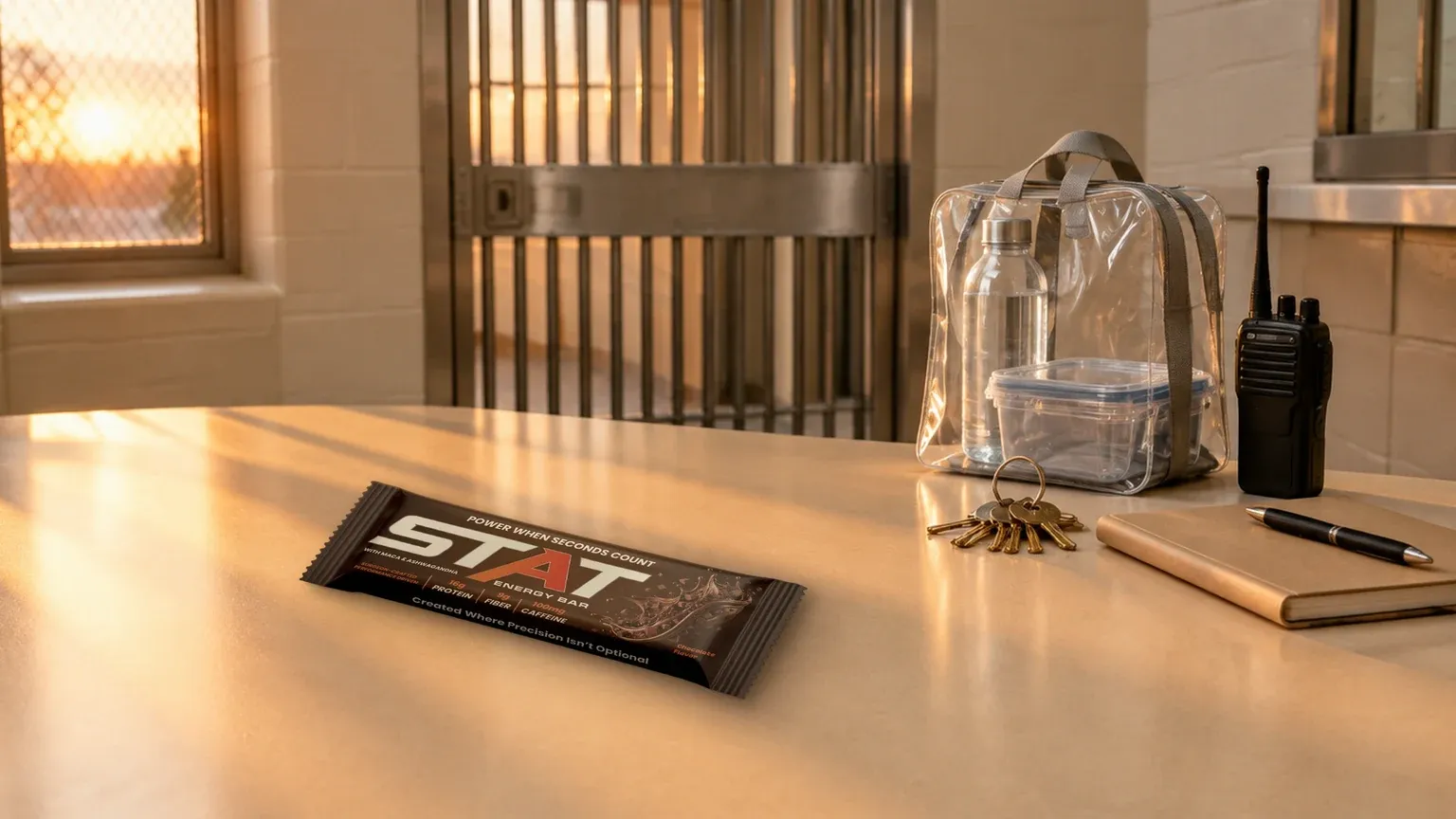
Snacks for correctional officers have to clear the front entrance before they do anything else. Every item in your bag gets searched or scanned, many facilities want it visible through a clear bag, and the food has to stay safe through a shift that may not end on time. The Bureau of Labor Statistics notes that because jail and prison security must be provided around the clock, correctional officers work shifts that cover all hours of the day and night, including weekends and holidays, and may be required to work overtime. NIOSH lists long and irregular hours, including unusual shifts, among the workplace hazards correctional workers face.
So the useful frame is practical: read your facility's property policy, pack sealed food the entry officer can identify at a glance, plan for the holdover, keep perishables cold without an insulated bag, wash hands before food, and count caffeine milligrams instead of guessing. It is not performance marketing. Patrol officers have their own guide in snacks for police officers, and a fixed post with no fridge looks a lot like snacks for security guards. Corrections adds the entry search, the clear bag, and the mandatory extra shift.
Start with your facility's staff property policy
Rules differ by state, agency, and facility, so the written policy at your institution wins over any list online. Two published state policies show how specific those rules can get. The Wisconsin Department of Corrections staff personal property policy for adult institutions allows up to two clear carrying bags of about 1,400 cubic inches combined, with all contents visible, plus one non-glass, non-ceramic beverage container of no more than 32 ounces, food and drink for daily consumption, and plastic eating utensils. Food has to be self-contained, in clear plastic wrap or a clear resealable container, and commercially purchased food must be in cardboard, plastic, or other packaging that can be inspected. Aluminum foil wrapped items are prohibited, and so is personal hand sanitizer. Facilities can add tighter rules, such as one clear bag only, food and drinks in clear containers, and no food delivered from outside vendors.
Kentucky's corrections policy on staff entry takes a similar line. Items should be consumable and reasonably expected to be used during the assigned shift, small bags of snack foods may be permitted, containers should be clear plastic to speed up the search, coolers and lunch containers top out at 10 quarts, and eating utensils must be non-metal. Pre-sealed items that cannot be searched by hand go through the x-ray machine.
The pattern is easy to pack for. Choose food the officer at the entrance can identify without opening it: sealed commercial packages, clear containers, no foil, no glass, and no mystery bundles. If you are not sure whether an item is allowed, ask your supervisor before you need it, not at the checkpoint.
Pack for the holdover, not just the shift
An eight-hour shift that becomes sixteen is the corrections version of a missed lunch. NIOSH driver fatigue guidance tells employers to set policies for maximum numbers of overtime hours and consecutive shifts and to allow rest breaks and napping during extended work shifts. You cannot control the schedule, but you can control what is already in your bag when the holdover is announced.
A simple rule: pack one planned meal plus at least one extra sealed, shelf-stable item that needs no fridge, no microwave, and no metal utensil. That backup is what keeps a double from becoming a vending machine shift. Eat when your post and relief allow, and choose food you can finish in a few minutes and put away fast if a call comes.
Clear bags change the cold food math
When Wisconsin moved staff to clear bags, the department said staff would no longer be able to bring typical insulated lunch bags, so it provided a clear lunch-sized bag that lets staff use ice packs to keep food safe, and said facilities were reviewing refrigerator availability in work areas. That trade is worth planning around wherever you work.
USDA's Food Safety and Inspection Service calls 40°F to 140°F the Danger Zone. Bacteria grow most rapidly in that range and can double in as little as 20 minutes. Never leave perishable food out of refrigeration over 2 hours, or 1 hour if the air temperature is above 90°F. FSIS bag lunch guidance says insulated, soft-sided bags are best, but to pack at least two cold sources with perishable food in any type of lunch bag: two frozen gel packs no smaller than 5 by 3 inches, or one gel pack plus a frozen juice box or frozen bottle of water, placed on the top and bottom of the food. If a refrigerator is available at work, store perishables there when you arrive.
In a clear bag, those cold sources are doing all the work. Keep the perishable part of the meal small, eat it first, and let the sealed shelf-stable items cover the back half of a double. A frozen water bottle can work as a cold source, but check whether your policy counts it as your one beverage container.
Clean hands when sanitizer may not be allowed
Keys, door handles, radios, gates, and paperwork all pass through your hands before food does. CDC lists before and after eating among the key times to wash hands, and its steps are simple: wet hands with clean running water, apply soap, lather the backs of hands, between fingers, and under nails, scrub for at least 20 seconds, rinse, and dry. CDC says hand sanitizer with at least 60% alcohol is the fallback when soap and water are not readily available.
In some facilities that fallback is off the table. Wisconsin's policy lists personal hand sanitizer among prohibited items. Plan a real wash at relief or break, and pack food you can eat straight from the wrapper, peeling it down like a sleeve so your fingers touch packaging more than food.
Caffeine milligrams and the drive home
FDA states that for most adults, 400 milligrams of caffeine a day is an amount not generally associated with negative effects, while noting wide variation in how sensitive people are to caffeine and how fast they clear it. Coffee before roll call, a soda at the midpoint, and an energy drink when the holdover hits can add up fast. Products that print caffeine milligrams let you keep an honest tally, and the same label logic applies when you compare a caffeine protein bar with other caffeine sources.
Caffeine is not a sleep plan, and the drive home after a double is where that matters most. NIOSH notes that after 17 consecutive hours awake, impairment is equivalent to a blood alcohol content of .05, and after 24 hours awake it is equivalent to .10. NIOSH says most adults need 7 to 9 hours of sleep each day. If you feel fatigued while driving, NIOSH advises pulling over, drinking a cup of coffee, and taking a 15 to 30 minute nap before continuing, and it adds that the effects are only temporary because the only real fix for fatigue is sleep. For overnight rotations, see how to stay awake on night shift.
What the Nutrition Facts panel has to answer
FDA's Nutrition Facts guide starts with serving size. Every amount on the panel refers to one serving, so a package with three servings means three times the numbers if you finish it on one break. Some packages that could be eaten in one sitting carry dual-column labels with amounts per serving and per package. Read the column that matches how you will actually eat it.
FDA groups saturated fat, sodium, and added sugars among the nutrients to get less of. Five percent Daily Value or less is low, and twenty percent Daily Value or more is high. Added sugars carry a Daily Value of 50 grams on a 2,000-calorie label. FDA also says 2,000 calories is a general guide and that calorie needs vary with age, sex, height, weight, and physical activity level. A shift spent walking tiers and standing posts is not a desk day, so read calories as a number to plan around, not a score.
For a short break, prefer a package whose serving size is the whole thing you will eat. Mid-teens of protein grams is a snack sitting. Zero grams added sugars is 0 percent DV for added sugars. It is still not a low calorie food. Calories stay on their own row.
A clear bag list that usually works
- Water in a non-glass bottle that fits your policy's container limit.
- Two cold sources around any perishable food, eaten first and inside the 2-hour window.
- A sealed tuna or chicken pouch for a longer break (plastic fork, not metal).
- Jerky or meat sticks in their original sealed package (watch sodium %DV).
- Nuts in a clear, pre-portioned container.
- Whole fruit such as an apple, a banana, or an orange.
- Crackers or bread in clear wrap for the break where you want something that feels like a meal.
- A protein bar with Nutrition Facts (not Supplement Facts): protein grams, calories, added sugars, and caffeine milligrams if caffeine is part of the plan.
- No foil, no glass, and nothing you would have to unwrap at the checkpoint to explain.
The same packing logic shows up in portable protein snacks when there is no fridge on post, in snacks for night shift workers when the shift runs overnight, and in snacks for 911 dispatchers when the console does not pause for lunch.
A 30-second pre-shift snack check
- Does everything in my bag match my facility's written property policy?
- Can the entry officer identify each food item without opening it?
- Do I have one extra sealed item in case I get held over?
- Is my perishable food between two cold sources, and will I eat it within 2 hours?
- Where will I wash my hands before I eat?
- Is the serving size the amount I will actually eat?
- Are protein grams, calories, and added sugars on the Nutrition Facts panel?
- If caffeine matters today, are milligrams printed so I can add them to the coffee already planned?
- If this becomes a double, how will I get home safely?
A sealed bar for the clear bag
STAT Energy Bars are a sealed, commercially packaged food you can keep in a clear bag without a fridge and finish on one short break. Each bar prints 16-19g of protein, 100mg caffeine from coffee fruit extract, and 0g added sugars on the Nutrition Facts panel. Calories sit in the 200-210 range by flavor. That is not a low calorie food. The protein blend is whey concentrate, milk protein isolate, and whey isolate. Botanicals are flavor only. This is a food product, not a dietary supplement. Check your facility's property policy before you pack anything new, and use the printed caffeine milligrams when you add a bar such as Chocolate to coffee already planned for the shift.
References
- U.S. Bureau of Labor Statistics. Occupational Outlook Handbook: Correctional Officers and Bailiffs. bls.gov
- NIOSH. Correctional Workers Safety. cdc.gov
- Wisconsin Department of Corrections, Division of Adult Institutions. Policy 300.00.58: Staff Personal Property. doc.wi.gov
- Wisconsin Department of Corrections. New Entrance Procedures at DOC's Secure Facilities (August 1, 2022). doc.wi.gov
- Kentucky Corrections. CPP 9.12: Allowable Property and Staff Entry to Correctional Institutions. corrections.ky.gov
- NIOSH. Driver Fatigue on the Job. cdc.gov
- USDA FSIS. Danger Zone (40°F - 140°F). fsis.usda.gov
- USDA FSIS. Keeping "Bag" Lunches Safe. fsis.usda.gov
- CDC. About Handwashing. cdc.gov
- U.S. FDA. How to Understand and Use the Nutrition Facts Label. fda.gov
- U.S. FDA. Spilling the Beans: How Much Caffeine is Too Much? fda.gov
Related reading
- Overnight call snacks: what holds up when the fridge is hours away
Overnight call snacks fail when they need a fridge you will not see until morning. Pack shelf-stable protein, printed caffeine milligrams, and water you can measure on a long night.
- Portable snacks for long shifts: what to pack when breaks aren’t guaranteed
Portable snacks fail on a long shift when they need a fridge, a microwave, or a break that never comes. Pack shelf-stable protein, printed caffeine milligrams, and water you can carry.
- Snacks for medical residents: what survives call without a fridge
Resident snacks fail when they need a fridge the next admission will not wait for. Pack shelf-stable protein, printed caffeine milligrams, and water you measure on purpose.
Related reading
- Overnight call snacks: what holds up when the fridge is hours away
Overnight call snacks fail when they need a fridge you will not see until morning. Pack shelf-stable protein, printed caffeine milligrams, and water you can measure on a long night.
- Portable snacks for long shifts: what to pack when breaks aren’t guaranteed
Portable snacks fail on a long shift when they need a fridge, a microwave, or a break that never comes. Pack shelf-stable protein, printed caffeine milligrams, and water you can carry.
- Snacks for medical residents: what survives call without a fridge
Resident snacks fail when they need a fridge the next admission will not wait for. Pack shelf-stable protein, printed caffeine milligrams, and water you measure on purpose.
Ready to Fuel Up?
Try STAT Bar — the energy bar built for those who can't afford to slow down.
Get shift snack tips in your inbox
Join the STAT Bar newsletter for new flavor drops, subscriber-only deals, and practical shift guides — plus $5 off your first box.
By signing up you agree to receive marketing emails from On Call Foods LLC. You can unsubscribe at any time. See our Privacy Policy and Terms.