
Key Ingredients to Look For in Protein Bars
STAT Bar TeamLast reviewed
The protein bar aisle is crowded with claims. "High protein," "low sugar," "keto-friendly," and "clean label" all compete for attention, but the only information that matters is on the back of the wrapper. When you strip away the marketing, three ingredient categories determine whether a bar is a practical snack or a candy bar in disguise: protein quality, dietary fiber, and healthy fats.
1. Protein quality matters more than protein quantity
A bar can advertise 20g of protein and still deliver a weak amino acid profile. The source of that protein is what counts. Whey protein isolate and concentrate, casein, and soy protein are complete proteins, meaning they contain the nine essential amino acids the body cannot make on its own. Plant-based blends — pea, rice, hemp, and pumpkin seed — are popular for vegetarian and vegan bars, but individual plant proteins are usually incomplete. A well-formulated blend can complement the missing amino acids and reach a complete profile.
One common shortcut is collagen. Collagen is technically protein, but it lacks tryptophan entirely, so it scores poorly on the PDCAAS (Protein Digestibility Corrected Amino Acid Score) scale used to measure protein quality. If a bar lists collagen high in the ingredient order but claims a big protein number, the usable protein is lower than the label suggests.
For a snack intended to hold you over between meals or after activity, look for complete or complementary proteins and keep the total in a realistic range. Research on protein distribution and appetite suggests that roughly 20–30g of protein per eating occasion is where most people see the best satiety response, rather than loading the entire day's protein into one bar.
2. Dietary fiber keeps the bar useful
Fiber is the ingredient category that turns a protein bar from a sweet treat into a filling snack. Under FDA labeling rules, 3g of fiber per serving qualifies as a "good source" and 5g qualifies as an "excellent source." Beyond the label claim, fiber slows gastric emptying and helps blunt the post-meal glucose curve, which is especially relevant for people eating at odd hours when glucose tolerance is naturally lower.
The best fiber sources in a bar are ingredients you can recognize: oats, chia seeds, flaxseed, nuts, and inulin from chicory root. These ingredients add texture and flavor while contributing to the nutritional profile. Fiber from isolated sources is not harmful, but it is less informative than fiber that arrives inside a whole food ingredient.
One practical warning: some bars use very high amounts of isolated fiber to hit a low net-carb number. For some people, large doses of inulin or soluble corn fiber can cause bloating or digestive discomfort. If you are eating a bar mid-shift with no easy break, a moderate fiber dose from real ingredients is usually a safer bet.
3. Healthy fats add staying power
Fats are often treated as the enemy on snack labels, but they are a key reason some bars keep you satisfied for hours. Nuts, seeds, nut butters, coconut, and cocoa provide fatty acids that slow digestion and extend the feeling of fullness. They also give the bar a richer texture and help carry fat-soluble flavors.
What you want to avoid are the fats that do not occur naturally in those ingredients: partially hydrogenated oils, fully hydrogenated oils, and heavily refined vegetable fats. These are often added to improve shelf life or texture at a lower cost, and they are a signal that the bar is more engineered than assembled. The ingredient list should read like a kitchen, not a refinery.
A good rule of thumb: if the fat source is a whole food you would eat on its own — almonds, peanuts, cashews, sunflower seeds, or coconut — it belongs in the bar. If it is an oil you cannot picture in your pantry, treat it as a red flag.
4. What to limit or question on the label
Even a bar with excellent protein, fiber, and fat can be undermined by what else is in the mix. Here are four things to check before you add it to your cart:
- Added sugars: Read the "Added Sugars" line, not "Total Sugars." Total sugars include naturally occurring sugar from dates, fruit, or milk. The American Heart Association recommends limiting added sugars to roughly 25g per day for women and 36g per day for men.
- Sugar alcohols: Erythritol, maltitol, sorbitol, and xylitol keep the added-sugar number low, but tolerance varies. Maltitol and sorbitol are especially likely to cause GI distress at moderate doses.
- Artificial sweeteners and colors: These are not inherently unsafe, but they are a marker of how heavily processed the bar is. If you are looking for a clean label, they work against that goal.
- Caffeine from mystery sources: Caffeine added as an ingredient must be declared, but caffeine from botanicals like guarana or green coffee bean extract does not always have to be quantified. A good bar tells you the milligram dose.
Where STAT Bar lands
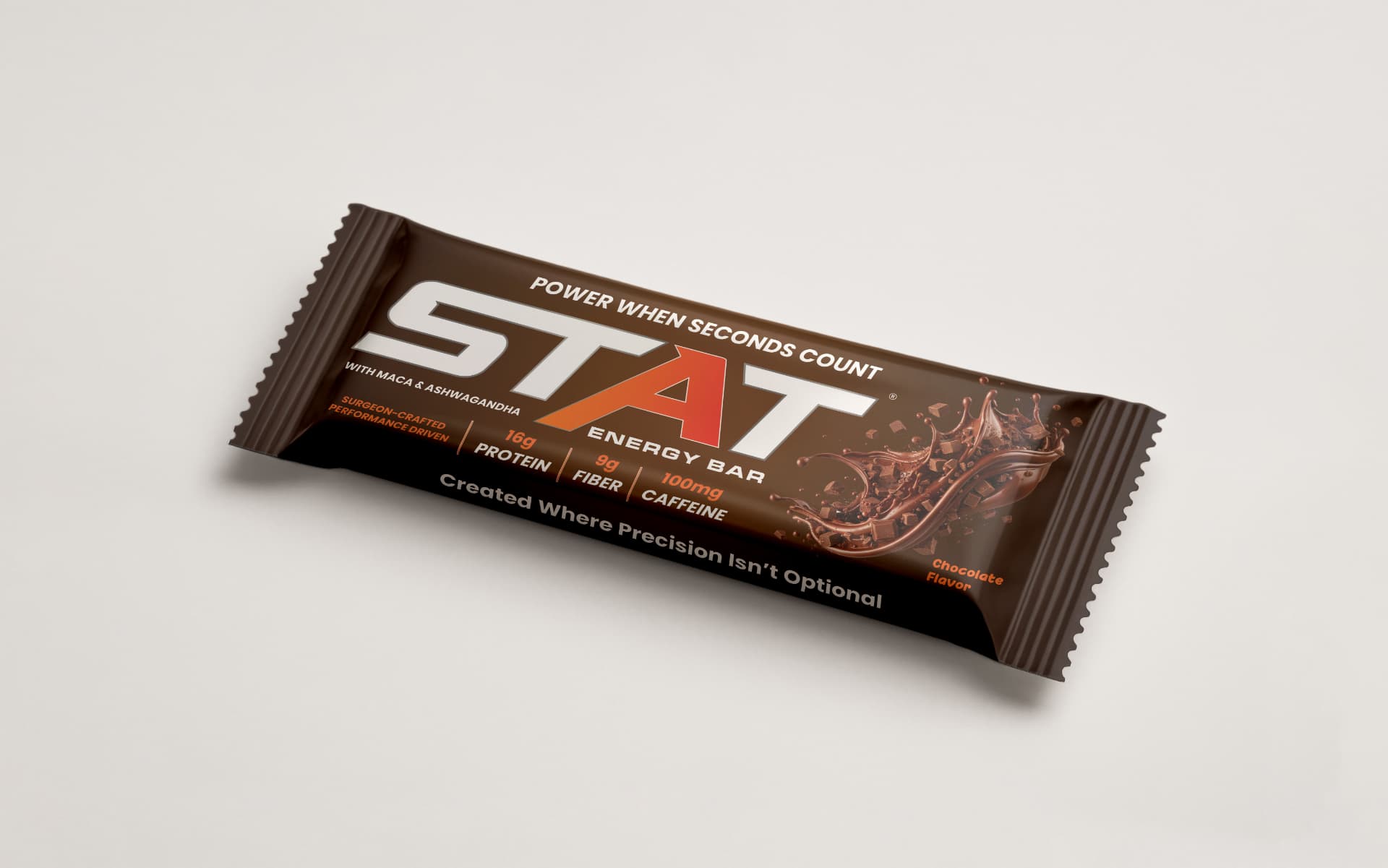
- STAT Bar Chocolate — 16g protein, 100mg natural caffeine
- STAT Bar Peanut Butter Espresso — 17g protein, 100mg natural caffeine
- STAT Bar Salted Caramel Coffee —19g protein, 100mg natural caffeine
- STAT Bar Variety 3-Pack — one box of each flavor
STAT Bars are built around a whey and milk protein blend, real-food sources of dietary fiber, and fats from nuts and coconut. Each bar lists 16-19g of protein, 0g of added sugar, and a stated 100mg of natural caffeine. Adaptogenic botanicals — maca, ashwagandha, and cordyceps, a culinary mushroom — are included for their traditional use in energy formulations. The full ingredient breakdown is on What's Inside.
References
- FDA. Food Labeling: Revision of the Nutrition and Supplement Facts Labels. 81 FR 33742 (2016).
- American Heart Association. How Much Sugar Is Too Much? heart.org
- USDA / HHS. Dietary Guidelines for Americans, 2020–2025.
- Leidy HJ et al. Protein distribution and appetite control. Current Developments in Nutrition (2017).
- Chellappa SL et al. Circadian misalignment increases glucose intolerance. Science Advances (2021).
Related reading
- Snacks for drivers, trades and travel crews: food that survives the cab, the site and the jump seat
No fridge, breaks on someone else's schedule, and food that has to be eaten parked. Shared rules first, then truck drivers, delivery, warehouse, construction, flight crews and ATC.
- High protein caffeine snack: how to read the label
A high protein caffeine snack is a label problem first. Count printed protein grams and caffeine milligrams, check added sugars and calories, and ask whether the food survives the USDA 2-hour rule.
- Snacks for doctors, residents and surgeons: what survives rounds, cases and call
One guide for physicians at every stage: the food-safety, label and caffeine rules that apply to everyone, then what works for residents, surgeons, overnight call and physician assistants.
Ready to Fuel Up?
Try STAT Bar — the energy bar built for those who can't afford to slow down.
Get shift snack tips in your inbox
Join the STAT Bar newsletter for new flavor drops, subscriber-only deals, and practical shift guides — plus $5 off your first box.
By signing up you agree to receive marketing emails from On Call Foods LLC. You can unsubscribe at any time. See our Privacy Policy and Terms.